

Free text
Summary and key ideas
Book summary prepared by ReWio. Original book author: Sahil Bloom.
Introduction
The central move in The 5 Types of Wealth is simple but challenging: stop treating money as the scoreboard for an entire life. Bloom does not claim that money is irrelevant. He argues that it is one resource among several, and that a person can become richer in dollars while becoming poorer in freedom, health, inner steadiness, or close connection.
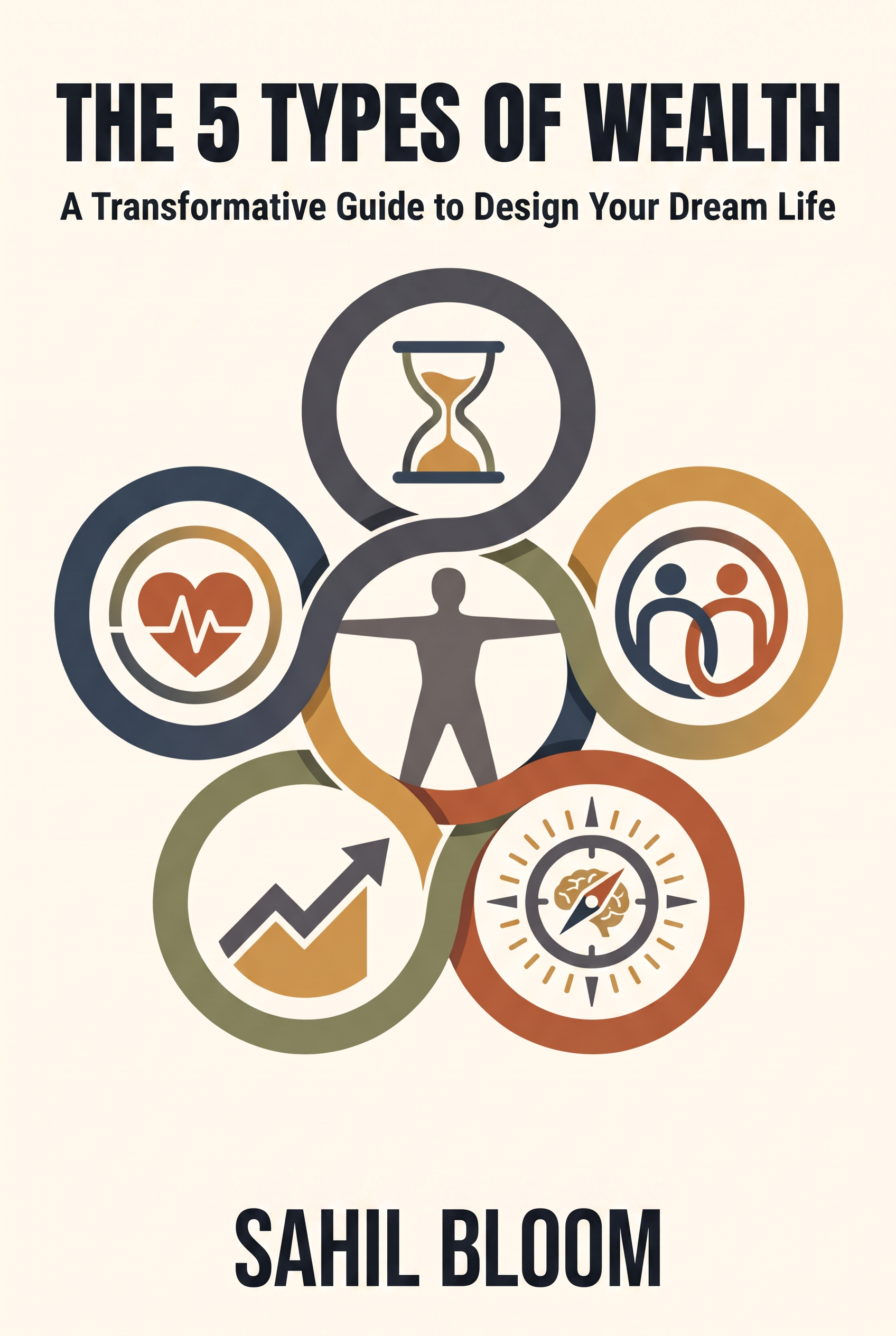
His five-part model names those other resources: time wealth, social wealth, mental wealth, physical wealth, and financial wealth. The purpose is not to produce a perfect balance every day. Life has seasons. A new parent, a student, a caregiver, an entrepreneur, and someone recovering from illness may have sharply different constraints and priorities. Bloom’s claim is that fulfillment improves when those trade-offs are seen clearly and chosen consciously rather than accepted by default.
That distinction matters. Many people inherit an operating system: work hard, earn more, upgrade the visible markers of success, and assume the meaningful parts of life can be recovered later. But later is not a bank account. Time passes, bodies change, relationships need attention while people are present, and interests can go dormant. The book is therefore less a promise that every life can be optimized than an invitation to audit the life you are already building.
The framework should also be held with healthy skepticism. The five categories are Bloom’s organizing tool, not a universally validated clinical or economic measurement system. Its strength is practical clarity. It gives you five questions to ask: Do I control meaningful parts of my day? Who can I call, celebrate with, and rely on? Does my life have purpose and room to grow? Does my body support the life I want? And do I have enough financial security to make choices without constant fear?
The rest of the book turns those questions into design work. Wealth, in this broader sense, is not merely possession. It is access: access to attention, people, energy, possibility, and choice.
Time Wealth
Time wealth is the felt freedom to spend a meaningful share of your life on what matters to you. It is not simply having empty hours. A person can have a light schedule and still be trapped by anxiety, caregiving demands, ill health, or financial precarity. Conversely, a demanding period can feel worthwhile when its demands are chosen and connected to a clear purpose. Bloom’s emphasis is on agency: the capacity to direct time rather than only react to other people’s priorities.
This changes the question from “How can I fit more in?” to “What deserves a place?” Productivity can be useful, but it becomes destructive when it turns every spare minute into a unit to exploit. The book urges readers to notice activities that reliably drain energy and those that restore it. Then, where circumstances allow, reduce the former, protect the latter, and build a calendar around the life you say you value.
A practical audit starts with one ordinary week. Track commitments, not to shame yourself, but to reveal reality. Mark each item: necessary, nourishing, neutral, or draining. Look for small changes before dramatic ones: a meeting that can become an email, a commute that can become a walk, a recurring obligation that needs renegotiation, or a phone boundary that returns attention to dinner. Protecting time for relationships, movement, reflection, and play is not laziness; it is a decision about what the calendar is for.
There is an important limit to individual advice here. Not everyone can buy back time, delegate work, set flexible hours, or decline extra shifts. Income, job conditions, disability, family responsibilities, and discrimination shape time autonomy. Bloom’s model works best when it prompts both personal choices and honest recognition of structural constraints. Time wealth may begin with a ten-minute walk or an honest conversation, not a fantasy of total control.
The deeper lesson is that postponement has a cost. If a relationship, a creative interest, or your own rest always receives whatever time is left, it is being assigned the lowest priority. Put what matters somewhere more durable than good intentions: on the calendar, in the budget, and in the boundaries you are willing to defend.
Social Wealth
Social wealth is the quality and reliability of your relationships: the people with whom you can be known, supported, useful, and joyful. Bloom distinguishes this from having a long contact list or an impressive professional network. Popularity can be thin. A wealthy social life is built from reciprocity, presence, trust, and repeated shared experience.
This part of the framework has strong support from independent evidence, even if Bloom’s label is his own. Public-health authorities identify social connection as important to well-being, while loneliness and isolation are associated with poorer health outcomes. But association is not a guarantee that every friendship improves health, nor does it mean anyone can solve loneliness through willpower alone. Connection is influenced by work schedules, neighborhoods, culture, caregiving, money, mobility, and opportunity.
Bloom’s practical challenge is to stop treating relationships as something that survives automatically. Closeness generally needs maintenance. Make the invitation. Remember the detail. Call before a crisis. Be the person who follows through. Regular, low-friction rituals often matter more than grand gestures: a weekly walk, a standing family meal, a monthly call, a shared hobby, or a yearly trip planned early enough to happen.
The book also asks readers to think beyond intimacy alone. Social wealth includes community: neighbors, mentors, collaborators, teammates, and people from different generations. These ties can create practical help, perspective, belonging, and opportunity. Yet networking becomes hollow when every conversation is treated as a transaction. The more durable approach is to lead with curiosity and contribution. Ask what someone needs, offer help within your capacity, and allow trust to accumulate over time.
A useful exercise is to draw three circles. Put your closest people in the center, important but less frequent relationships in the second, and communities you want to nourish in the third. Then choose one concrete act for each circle this week. Send the message. Schedule the meal. Join the group. Repair a minor rupture before it becomes a permanent distance.
Social wealth is not measured by constant availability. Good boundaries are part of it. The aim is a web of relationships where care runs both ways—not an overfull social calendar that leaves nobody genuinely seen.
Mental Wealth
Mental wealth is Bloom’s name for an inner life marked by purpose, curiosity, growth, and emotional steadiness. It includes how you relate to your thoughts, whether you can pay attention, whether your work and learning feel meaningful, and whether you have room to become someone new. It is not the same as being cheerful all the time, and it should not be confused with a diagnosis or a substitute for mental-health care.
Bloom argues that people often pursue external achievement while neglecting the question underneath it: What kind of life would feel worth living to me? His response is not to prescribe one universal purpose. Instead, he encourages exploration—trying interests, learning, creating, serving, and noticing what creates a sense of aliveness. Purpose may be expressed through paid work, but it may also live in parenting, friendship, craft, citizenship, faith, care, or a cause.
A practical implication is to replace the pressure to “find your one passion” with a more modest commitment to follow useful signals. What problems do you care about? What activities make you lose track of time in a good way? What kind of effort leaves you tired but satisfied? What do people seek your help with? These clues do not produce certainty, but they can guide experiments.
Mental wealth also requires an information environment you can inhabit without being constantly fragmented. If attention is repeatedly sold to alerts, outrage, comparison, and endless input, reflection becomes difficult. Create deliberate spaces for reading, thinking, journaling, therapy, prayer, meditation, conversation, or simply boredom. The method matters less than the regular return to your own experience.
Independent research supports many forms of psychological support, but the right response to distress varies. Habits such as sleep, movement, social support, and mindfulness may help some people, yet they are not replacements for professional assessment when symptoms are persistent, severe, or unsafe. Bloom’s framework is most constructive when it lowers the stigma of asking, “What is my mind asking for?” rather than implying that a better routine can solve every problem.
The goal is not a permanently optimized mindset. It is a life in which you keep learning, can recover perspective after setbacks, and pursue aims that feel like yours rather than borrowed status contests.
Physical Wealth
Physical wealth is the capacity of your body to carry you through the life you want. Bloom frames health as a foundational asset because energy, mobility, sleep, and resilience affect almost every other category. When the body is neglected, more time or money may not translate into the ability to enjoy them. When health is protected, ordinary experiences—walking with a friend, playing with a child, concentrating at work, traveling, or resting—become more available.
The book’s broad practical message is refreshingly unglamorous: build repeatable basics rather than chase heroic bursts of self-improvement. Move regularly. Eat in a way you can sustain. Sleep enough to function well. Strengthen and maintain the body across the years. Public-health evidence supports regular physical activity for physical health, sleep, and aspects of mental well-being. Still, “healthy” does not look identical for everyone, and exercise or nutrition plans should account for age, injury, disability, medication, access, and medical history.
Treat vitality as an investment in capacity, not a punishment for failing an aesthetic standard. A useful starting point is to choose a minimum viable routine: a daily walk, brief strength sessions, a consistent bedtime window, a more reliable breakfast, or a preventive appointment you have avoided. Make the behavior easy enough that it survives a stressful week. Consistency compounds more reliably than intensity that ends in injury, resentment, or abandonment.
Bloom also links physical wealth with identity. If you see yourself as someone who protects energy, you make choices differently: you plan meals before extreme hunger, schedule movement before the day disappears, and view sleep as an appointment rather than leftover time. That identity should remain flexible and compassionate. Illness, grief, pregnancy, aging, and demanding work can change what is possible. Adapting is not failure.
The trade-off is real. Training can consume time; strict food rules can strain social life; performance goals can become another source of anxiety. The purpose is not to turn your body into a project that crowds out everything else. It is to build enough physical capacity to participate fully in the relationships, work, and adventures you care about.
In Bloom’s larger map, physical wealth is not a side quest. It is the infrastructure that lets the rest of the life run.
Financial Wealth
Financial wealth is the form most people already recognize: money, assets, income, and the security and options they can provide. Bloom does not tell readers to abandon financial ambition. He argues that money matters profoundly when it reduces instability, funds necessities, protects against shocks, supports loved ones, and expands choice. The mistake is allowing the pursuit of more to become infinite and to consume the very life that money was meant to serve.
The key idea is “enough.” Enough is not a number copied from a peer group, a social-media feed, or an arbitrary lifestyle tier. It is a personally defined threshold tied to the life you actually want: basic security, obligations, a margin for emergencies, room for generosity or freedom, and goals that are meaningful to you. Defining it does not eliminate ambition. It gives ambition a boundary and a reason.
Start with clarity rather than complicated tactics. What does your current life cost? What obligations are fixed? What risks keep you awake? What would greater freedom make possible: less debt, a career change, a safer home, time with family, a sabbatical, retirement, or the ability to say no? A written answer turns vague craving into a decision problem.
Then use sound, individualized financial practice: spend below income where possible, build an emergency cushion, manage high-cost debt, understand taxes and insurance, and invest according to goals, time horizon, risk tolerance, and professional guidance when appropriate. These are general principles, not personal financial advice. Markets are uncertain, and a financial plan must fit real circumstances.
Bloom’s warning is about substitution. Money can purchase convenience and reduce many pressures, but it cannot directly purchase reciprocal love, purpose, health, or time already spent. It can also become a scoreboard with no finish line, especially when comparison keeps changing the definition of success. The antidote is not guilt about wanting comfort. It is intentionality: decide what money is for before accumulating it becomes the only plan.
Financial wealth is most valuable when it supports the other four forms—when it buys breathing room, not merely more expensive obligations.
Designing Trade-Offs and Seasons
The five forms of wealth are interconnected, but they do not automatically rise together. A promotion may improve financial security while shrinking time and physical energy. A demanding caregiving season may deepen social meaning while reducing sleep and autonomy. A move may create career opportunity while weakening community. Bloom’s framework is valuable because it makes these exchanges visible before they harden into a life you did not mean to choose.
The answer is not a perfectly equal score across five columns. Balance is often too static a metaphor. Think instead in seasons and guardrails. In one season, you may deliberately lean into work to stabilize finances. In another, you may protect recovery, family time, or health. What matters is that the sacrifice is named, limited, and periodically reviewed. A temporary imbalance can be wise; an unexamined imbalance can become permanent.
Try a quarterly wealth review. Rate your current experience in each area, using your own definitions rather than a universal scale. Ask three questions: What is growing? What is being depleted? What is one trade-off I am willing—and unwilling—to make next? The last question matters because values become real when they constrain choices.
Next, identify your non-negotiables. They might be a weekly call with a parent, a recurring date with a partner, a protected hour for training, an emergency-fund target, a therapy appointment, or one device-free meal a day. Non-negotiables should be few enough to honor. They are not evidence of moral superiority; they are reminders of what you refuse to leave entirely to chance.
Also examine your definition of success for borrowed goals. If your desired lifestyle requires continuous overwork, constant comparison, or neglect of people you love, ask whether the goal is truly yours. Sometimes the redesign is large—a job change, move, spending reset, or change in business model. More often it begins with smaller architecture: a default no, an automatic transfer, a shared ritual, a walking meeting, or a screen boundary.
Bloom’s deepest practical argument is that designing a dream life is less about discovering a hidden ideal than repeatedly aligning choices with what you already know matters. You will not eliminate trade-offs. You can become better at choosing the ones you can live with.
Final Summary
The 5 Types of Wealth offers a corrective to a narrow version of success. Bloom’s framework says that a life can be financially impressive and still be impoverished in time, connection, purpose, or health. His proposed alternative is to treat time, social, mental, physical, and financial resources as a connected portfolio of life.
Use the model as a compass, not a report card. Its categories are the author’s framework, not a scientific law, and they will not erase unequal constraints or solve every financial, medical, or psychological problem. Yet they can expose an important question: What am I accumulating, and what am I sacrificing to get it?
Begin with one honest inventory. Identify the form of wealth that feels most neglected. Define a small version of enough. Put one protecting action on the calendar this week. Call someone. Go outside. Review your spending. Make an appointment. Reclaim an hour. Start a learning practice.
The ultimate lesson is not to become maximally efficient or maximally wealthy in every category. It is to make your life recognizable to yourself. Money can create options, but the point of options is to use them well: to have time for what matters, people with whom to share it, a mind that can appreciate it, and a body able to live it.