

Free text
ReWio Short
How one highway invented the American road trip
A road can be erased from the map and still refuse to disappear. Route 66 lost its federal highway status in 1985. Yet in 2026, a century after it was designated, its name still summons neon motels, desert horizons, diner stools, tailfins, and the feeling that freedom might begin at the next exit.
But Route 66 did not invent the American road trip simply by connecting Chicago to the Pacific. It did something bigger: it turned movement into a national story. For millions of people, the road meant escape, work, risk, reinvention, or a family vacation. Its romance was real. So were its costs.
Officially designated in November 1926, U.S. Highway 66 stitched together older roads into a roughly 2,400-mile route through eight states: Illinois, Missouri, Kansas, Oklahoma, Texas, New Mexico, Arizona, and California. It was not America’s oldest highway or its longest. Its advantage was practical. It provided a relatively direct, all-weather connection between the industrial Midwest and Southern California.
That connection changed the economic map. A traveler needed gasoline, food, repairs, and a bed. Towns that had once been isolated could suddenly serve a passing public. Small operators built filling stations, cafés, motor courts, souvenir stands, and roadside attractions. Along Route 66, a family with a little capital and a conspicuous sign could try to make a living from traffic.
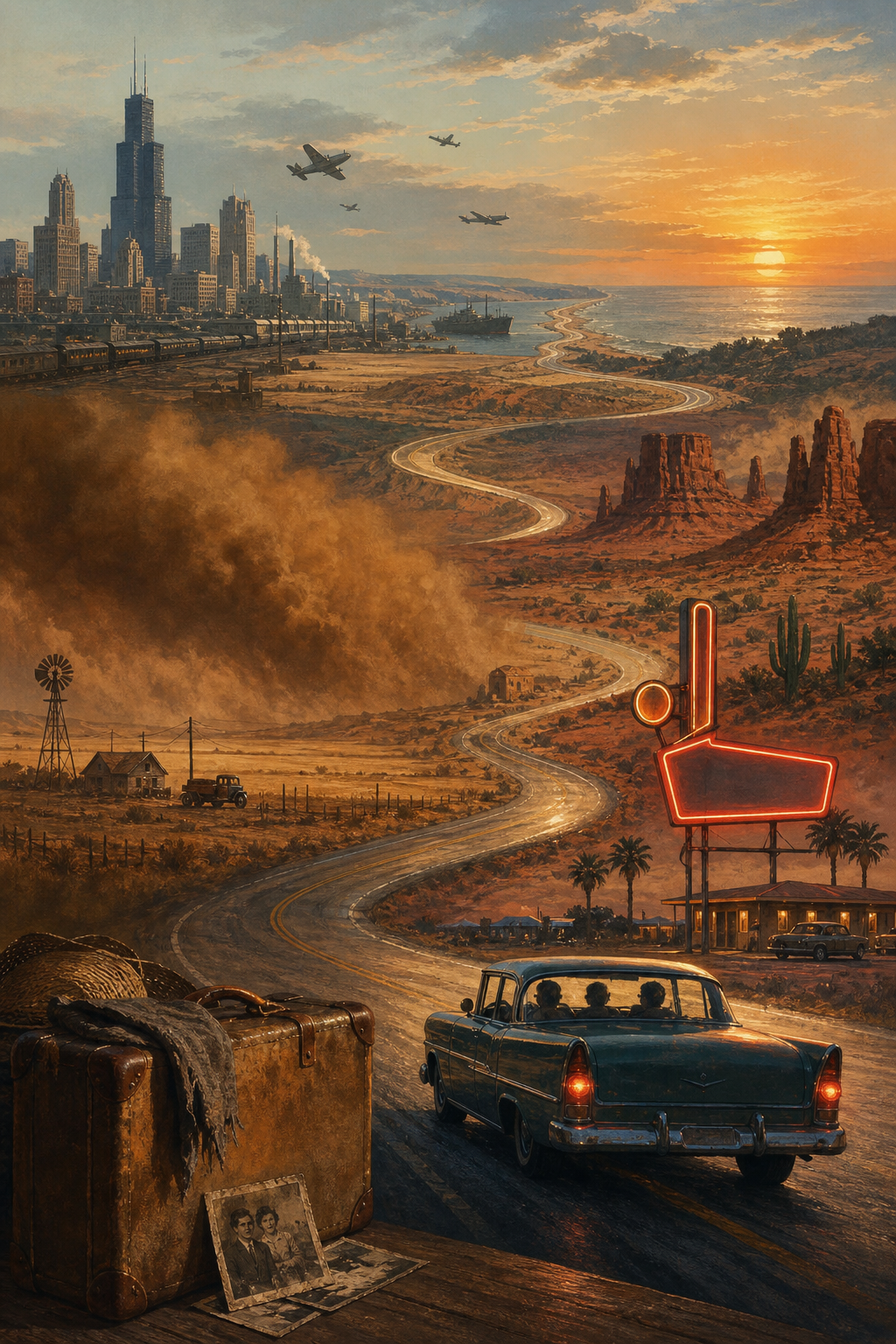
The road’s first great human drama was not leisure. During the Depression and Dust Bowl years, families fleeing drought, debt, and farm collapse traveled westward, many toward California. John Steinbeck gave the route its enduring nickname, the Mother Road, in The Grapes of Wrath. Yet the phrase should not make us sentimental. For many migrants, this was not a carefree journey into possibility. It was a hard passage toward uncertain work, often in overcrowded and hostile conditions.
World War II gave Route 66 another purpose. Civilian tourism slowed, but the highway carried troops, supplies, and workers toward military installations and defense-industry jobs in the West. The route helped channel a vast wartime migration that accelerated California’s transformation into a major metropolitan and industrial center.
Then came the postwar boom, and Route 66 became the road trip of popular imagination. More Americans owned cars. Families had more money and more leisure. They drove toward the Grand Canyon, the beaches of Southern California, and Disneyland. Businesses answered with a new visual language designed for drivers moving at speed: towering signs, streamlined gas stations, wigwam-shaped motels, giant statues, glowing neon, and architecture that could be understood in a glance through a windshield.
That landscape created opportunity, but it was never equally open to everyone. Native communities along the route gained customers and built businesses, while also confronting land loss through eminent domain and tourist marketing that flattened distinct cultures into stereotypes. Black motorists traveling during segregation faced a more dangerous road, relying on networks and guides such as the Green Book to identify places where lodging, meals, and safety might be available. The open road was not equally open.
Route 66 also helped create the system that would replace it. By the 1950s, traffic that made roadside businesses flourish also made the old two-lane highway feel slow and crowded. The Interstate Highway System offered faster, limited-access travel. Over three decades, interstates bypassed Route 66 town by town. When the final stretch was bypassed in 1984, the highway was formally decommissioned the following year.
For many communities, bypass meant a sharp economic shock. Traffic vanished. Motels emptied. Gas pumps went quiet. But retirement made Route 66 legible as history. Local advocates, preservation groups, state agencies, and the National Park Service worked to save what remained: road segments, bridges, diners, signs, motor courts, and the stories attached to them.
That is why Route 66 still matters at 100. It is not a perfectly preserved line, and it never was a single, simple experience. It is a patched-together corridor of changing alignments and competing memories. Its power comes from that complexity.
Route 66 taught America to treat the journey as a destination. A century later, its most lasting lesson is less about speed than attention: the places that endure are often the ones we would have missed if we never slowed down.