

Free text
Summary and key ideas
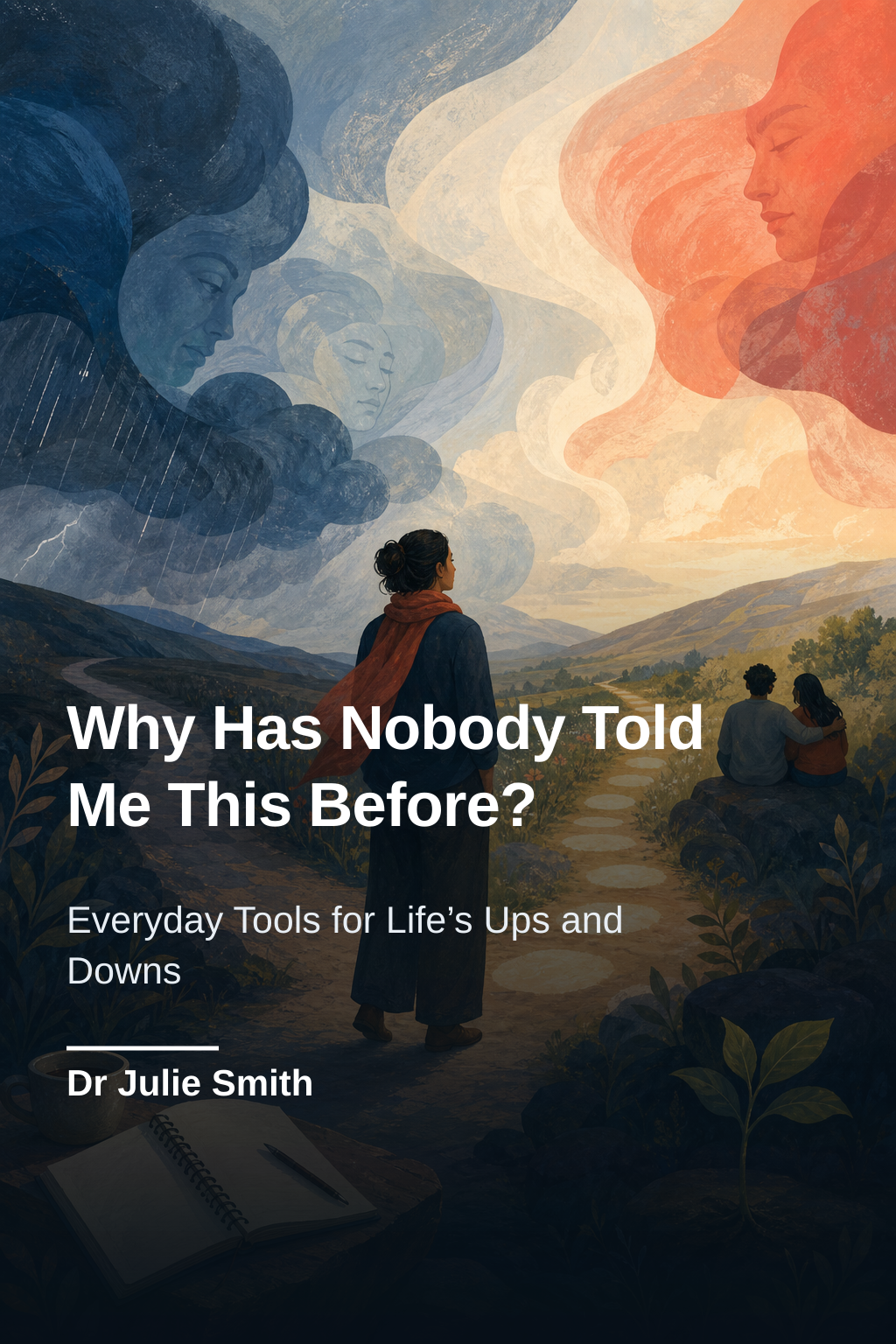
Book summary prepared by ReWio. Original book author: Dr Julie Smith.
Introduction
Why do useful emotional skills so often arrive late? Many of us learn algebra, grammar, and workplace procedures, yet receive little clear teaching about what to do when our mind is racing, our confidence collapses, or getting out of bed feels like a major task. In Why Has Nobody Told Me This Before?, clinical psychologist Dr Julie Smith offers a collection of tools meant for those ordinary but consequential moments.
The book’s promise is modest in the best sense. It does not offer permanent happiness, a personality makeover, or a way to avoid pain. Smith’s core claim is that psychological skills can be learned, practised, and used before a difficult moment becomes even harder. Knowledge alone is not enough; the point is to build a small repertoire of responses that remain available when your thinking is under pressure.
That distinction matters. A feeling can be real, intense, and meaningful without being a command. Anxiety may urge you to avoid. Shame may urge you to hide. Anger may urge you to attack. Low mood may insist that nothing is worth doing. The feeling deserves attention, but it does not automatically deserve control of the steering wheel.
This is also not a book that can diagnose anyone through a checklist. Stress, fear, sadness, and anxiety are universal experiences, but clinical conditions involve severity, duration, impairment, context, and professional assessment. If you feel unsafe, are considering harming yourself, cannot manage basic daily life, or your symptoms are severe or persistent, self-help is not the whole answer. Contact qualified local medical, mental-health, or crisis support. The tools in this summary are best understood as supportive skills, not substitutes for care.
Mood Is Partly a Moving System
Smith invites us to stop treating mood as a verdict about who we are. A bad morning can feel like proof that life is broken or that we have failed. But mood is affected by a moving system: sleep, food, activity, connection, physical illness, stress, uncertainty, thoughts, and recent experiences. This does not mean every emotion is caused by lifestyle, or that serious depression can be solved with a walk. It means that, alongside the things we cannot immediately change, there may be small levers we can influence.
When mood drops, the natural response is often to withdraw. We cancel plans, stop moving, postpone tasks, and seek relief through endless scrolling or staying in bed. Sometimes rest is exactly what we need. But sometimes withdrawal narrows life and removes the very sources of energy, mastery, and connection that could gradually support recovery.
A helpful question is not, ‘How do I force myself to feel good?’ It is, ‘What action would give my mind and body a slightly better chance today?’ The action might be opening the curtains, taking a shower, eating something substantial, replying to one message, or stepping outside for five minutes. Its value is not that it guarantees a brighter mood. Its value is that it interrupts a cycle in which low mood determines every behaviour.
Think of this as behavioural activation in plain language: do a small, purposeful action before waiting for the desire to do it. Make the step so small that it is possible on a difficult day. Afterwards, notice the effect without demanding a miracle. Repetition builds evidence that you can still act while feeling low. That evidence matters because it weakens the belief that you are completely powerless.
Name the Feeling, Find the Need
Emotions are often treated as enemies to defeat. Smith takes a different approach: feelings are information. They can point toward a loss, a threat, a need, a value, an injustice, or an uncertainty. They are not always accurate interpretations of the situation, but they do tell us that something in our system needs attention.
The first skill is specificity. ‘I feel bad’ is honest, but broad. Are you disappointed, lonely, resentful, overwhelmed, frightened, embarrassed, guilty, depleted, or numb? Naming an emotion does not instantly resolve it, yet it creates a little distance. Instead of being swallowed by an unnamed storm, you can observe: ‘Anxiety is here,’ or ‘I am noticing shame.’ That shift is small but powerful. You are no longer identical to the feeling.
Then ask what the feeling might be protecting or requesting. Anger might signal a boundary that has been crossed. Jealousy may reveal something you value or fear losing. Anxiety may highlight uncertainty and a wish for safety. Sadness may reflect attachment and loss. The goal is not to obey the first impulse. Anger may carry valid information while an angry message still makes things worse. Anxiety may point to a real risk while avoidance prevents you from learning that you can cope.
Try a three-part pause: identify the feeling, locate it in the body, and choose a response that serves your longer-term values. If you are hurt, perhaps the response is to ask for clarity rather than retaliate. If you are anxious before a presentation, perhaps the response is to prepare and attend rather than wait for fear to disappear. Emotions can be welcomed as visitors without handing them the keys.
Stress, Fear, and Anxiety
The book carefully separates experiences that people often collapse into one word. Stress is the pressure we feel when demands seem greater than our resources. Fear is a response to a present, identifiable threat. Anxiety often involves anticipating a possible threat, especially one that is uncertain or future-focused. These experiences overlap, and none of them automatically means illness.
Anxiety has a protective purpose. Your body is designed to notice danger and prepare you to respond. The trouble comes when the alarm is triggered too strongly, too often, or in situations where fighting, fleeing, or endlessly preparing does not actually help. A racing heart, tight chest, shallow breath, restless thoughts, and a desire to escape can all be part of an alarm response. They can be frightening, but sensations themselves are not always evidence that catastrophe is happening.
Smith’s practical emphasis is on reducing struggle with the alarm rather than trying to win an argument with it in the moment. Grounding can help return attention to the present: notice what you can see, hear, and physically feel; press your feet into the floor; describe a nearby object in detail. Slow, comfortable breathing may help some people settle their arousal, especially by making the out-breath unhurried. But breathing is not a cure, and it will not erase every anxious state. If focusing on breath makes you more distressed, choose another grounding anchor.
Attention is another lever. Anxiety pulls attention toward threat predictions. Gently redirecting attention does not deny a problem; it prevents worry from consuming every available mental resource. Ask: What is happening now? What is within my control in the next few minutes? What is the next practical step? For persistent, escalating, or disabling anxiety, professional support can help identify an appropriate path forward.
Act Before Motivation Arrives
One of Smith’s most useful reversals concerns motivation. We often assume motivation must come first: once I feel ready, confident, or inspired, I will start. Yet many important actions do not work that way. Motivation often grows after movement, not before it.
Consider a task you have avoided. The longer it sits untouched, the more threatening it becomes. Your mind turns it into a vague mountain. Waiting to feel motivated can prolong the avoidance, which increases guilt and makes starting even harder. Instead, make the first step concrete and deliberately small. Do not write the report; open the document and write a rough heading. Do not clean the home; clear one surface. Do not fix the relationship; send a message asking for a time to talk.
This approach respects the reality of limited energy. It is not a demand to become relentlessly productive. Rest, play, and recovery are not rewards to earn only after exhaustion. The point is to distinguish restorative rest from avoidance that leaves you feeling smaller and more stuck.
Planning can also reduce friction. Decide when, where, and how you will begin. Remove one obstacle in advance. Put shoes by the door, prepare the ingredients, set out the notebook, or schedule the call. Then evaluate success by whether you kept the small commitment, not by whether you felt wonderful doing it.
Every completed action becomes data. It tells your mind: ‘I can take a step even when I do not feel like it.’ Over time, that is more dependable than waiting for a perfect emotional state. If an inability to act is prolonged, severe, or accompanied by major changes in sleep, appetite, concentration, or safety, it deserves compassionate professional attention rather than harsher self-discipline.
Criticism, Shame, and the Inner Judge
Criticism hurts partly because belonging matters. We are social creatures, and a disapproving look or sharp comment can awaken an old fear: perhaps I am unacceptable. Smith distinguishes between useful feedback and the global story shame tends to create. Feedback concerns an action or outcome: something could be improved. Shame converts that into an identity statement: I am fundamentally inadequate.
When criticism arrives, pause before either accepting it wholesale or rejecting it defensively. Ask what exactly was said. Is there a specific behaviour here that I can assess? Is the source informed and trustworthy? Is there a useful grain I can take without adopting their entire judgment? This preserves your ability to learn without making another person’s opinion the final authority on your worth.
The inner critic can be even more relentless because it knows where you are vulnerable. It often claims to be motivating you, but constant self-attack commonly creates paralysis, avoidance, and fear of mistakes. A more effective stance is accountable compassion. Speak to yourself as you might speak to a capable friend who has made an error: clearly, honestly, and without contempt.
Comparison adds fuel to the critic. Social media and professional environments display selected results while hiding doubt, support, luck, repetition, and failure. Comparison can sometimes reveal a goal, but it becomes corrosive when you use someone else’s visible highlight reel as evidence against your private, unfinished life. Notice the comparison, identify the value underneath it, and return to a step available in your own circumstances.
Confidence Is Built From Evidence
Confidence is frequently mistaken for a feeling that certain people simply possess. Smith presents a more workable view: confidence is built through evidence. Each time you do something difficult, imperfectly but in line with what matters to you, you collect proof that you can cope, learn, or recover.
This is why avoiding every uncomfortable situation can make confidence shrink. Avoidance gives immediate relief, so the brain learns to repeat it. But it also prevents new evidence from arriving. You never discover whether the conversation, journey, challenge, or performance might have been survivable. Building confidence therefore involves carefully chosen exposure to manageable discomfort, not reckless leaps into overwhelming situations.
Start with a ladder. Choose a challenge that matters and break it into steps. If speaking up is difficult, first write your point down, then ask one question in a low-stakes meeting, then offer a brief view in a larger group. Repeat each step long enough to learn from it. Measure courage by participation, not by the absence of nerves.
Values make this process sturdier. Goals are destinations, while values describe the way you want to move through life: honesty, kindness, curiosity, creativity, family, fairness, contribution, or learning. You may not control whether an interview leads to a job, but you can control whether you prepare thoughtfully and show up in a way that reflects your values. That kind of success remains available even when outcomes disappoint.
Confidence is not the belief that nothing will go wrong. It is growing trust that, if something does go wrong, you will have ways to respond.
Boundaries and Relationships
A boundary is not a way to control another person. It is a clear statement of what you will do to protect your time, wellbeing, dignity, or responsibilities. This distinction is important. You cannot force someone to stop being demanding, dismissive, or intrusive. You can decide what you will participate in, how you will communicate, and what you will do if a limit is ignored.
People often avoid boundaries because they anticipate guilt, conflict, or rejection. Those feelings may indeed appear. Setting a limit does not guarantee that others will like it. But discomfort is not proof that the boundary is wrong. It may simply be the cost of changing a pattern in which your needs were previously invisible.
Good boundaries tend to be specific, brief, and calm. Instead of delivering a long defence, state the limit and the next step: ‘I can talk for ten minutes now.’ ‘I am not able to take that on.’ ‘If the conversation becomes insulting, I will end it and we can try again later.’ You do not need a courtroom-quality case to have a limit.
At the same time, relationships need more than boundaries. They need repair, curiosity, and direct communication. When you are upset, try to describe the impact of a behaviour rather than assume the other person’s motives. Ask for what you need where possible. Listen for their perspective without abandoning your own. Not every relationship can become safe or reciprocal, but clearer boundaries help reveal which connections can grow and which repeatedly cost too much.
Grief Cannot Be Put on a Schedule
Grief is not a problem to solve or a ladder to climb once. It is a response to loss, and it can involve sadness, anger, longing, numbness, relief, guilt, confusion, and moments of unexpected peace. These states may arrive in no neat order. A good day does not mean you have forgotten. A painful day does not mean you have gone backwards.
Smith’s broader message about emotions applies here with special care: make room for the experience without turning it into a verdict. There is no correct timetable for mourning a person, a relationship, a role, a hoped-for future, health, or a version of life you expected to have. Grief changes shape as life continues.
Practical support still matters. Eat, rest where you can, accept concrete help, speak to someone trustworthy, and create small rituals of remembrance if they feel meaningful. Do not demand that yourself or someone else ‘move on’ according to an external schedule. The task is not to erase love or significance. It is gradually to carry the loss in a way that makes room for life alongside it.
Some grief reactions can become so intense, prolonged, or disruptive that extra support is needed. Reaching out to a doctor, therapist, bereavement service, or trusted local organisation is not a failure of resilience. It is a recognition that human beings are not designed to carry every form of pain alone.
Final Summary
Why Has Nobody Told Me This Before? is best understood as a practical map, not a cure-all. Dr Julie Smith’s central idea is that emotional wellbeing is shaped by skills we can practise: noticing what we feel, understanding the message without blindly obeying it, caring for the conditions that influence mood, and choosing the next action with intention.
When mood is low, reduce the task and take one small purposeful step. When anxiety is loud, ground yourself in the present, use a supportive physical anchor if it helps, and focus on what you can do rather than on every possible outcome. When motivation is absent, begin before you feel ready. When criticism stings, separate information about an action from a sweeping conclusion about your identity. When comparison takes over, return to your values and your own next step.
Build confidence through repeated evidence, not through waiting to feel fearless. Set boundaries as statements of what you will do, not demands that other people change. Treat grief as a non-linear process that deserves patience. And throughout, replace harsh self-judgment with the kind of honest, steady support that makes growth more likely.
Most importantly, use self-help responsibly. Skills can make daily life more manageable, but they are not proof that you should handle serious distress alone. Seek qualified support when symptoms are overwhelming, persistent, or affecting your safety and ability to function. Asking for help is not the opposite of strength. It is one of the most practical actions a person can take.
You do not need to control every feeling to live well. You need enough space between feeling and action to choose what matters next.