

Free text
Summary and key ideas
Book summary prepared by ReWio. Original book author: Sahil Bloom.
Introduction
Most of us learn a simple equation early in life: work hard, earn more, and eventually you will be secure and happy. Sahil Bloom’s central claim is that this equation is incomplete. Money matters; it can reduce hardship, widen choices, and protect against emergencies. But a life can look financially impressive while being poor in time, health, close connection, or inner direction.
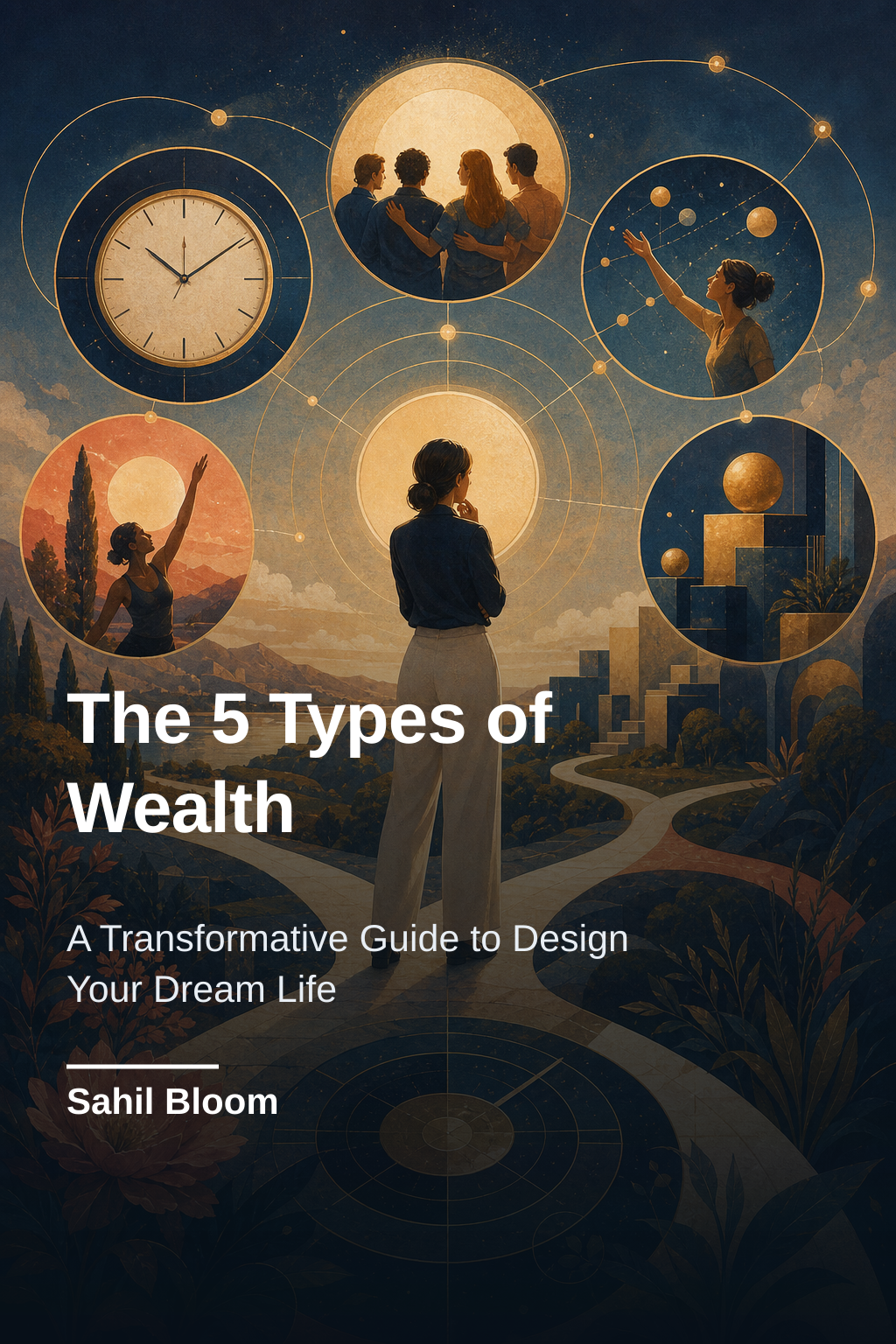
His alternative is a personal framework rather than a scientific measurement system. Bloom calls it the five types of wealth: time wealth, social wealth, mental wealth, physical wealth, and financial wealth. The important word is wealth. Each category is treated as something that can be built, protected, spent, neglected, and compounded over time.
The framework is not a demand for perfect balance every day. A new parent, a student, a caregiver, an entrepreneur, and a retiree may reasonably emphasize different things. Bloom’s deeper invitation is to stop outsourcing the definition of a good life to status signals. Instead, decide what prosperity means in this season, notice what it costs, and make choices that serve the whole picture.
That is a useful distinction. The author’s five-part model is his own organizing lens, not an established universal taxonomy. Still, the underlying idea is practical: if you only track the resource that society displays most visibly, you can accidentally sacrifice resources that are harder to replace. This summary turns that idea into questions, choices, and repeatable practices.
Measure the Whole Life
Bloom begins with diagnosis. His Wealth Score is meant to make an invisible problem visible. Rather than asking whether life is generally going well, you assess the condition of each kind of wealth. The score is not a verdict on your worth, a competition, or an instruction to maximize every category. It is a snapshot that can reveal a mismatch between your stated values and your lived reality.
For example, someone may say family comes first but repeatedly have no unhurried time for family. Someone may have savings but no margin in their schedule. Another person may be physically capable and socially connected yet feel mentally adrift, with little curiosity or meaning in the week. A single total score can hide these differences, so the useful information lies in the pattern.
The exercise works best when you add context. Ask: What is strong? What feels fragile? Which area has been ignored because another area looked more urgent? What is enough for now? And what would a modest improvement actually look like? A score becomes useful only when it leads to a specific decision.
Bloom also cautions, in effect, against permanent optimization. Seasons change. Training for a demanding opportunity may temporarily consume more time. Supporting a sick relative may reduce financial progress. Raising children can change the shape of social life. The question is not whether every account rises at once. The question is whether the trade-off is conscious, temporary when it needs to be, and consistent with what you most care about.
Revisit the diagnostic periodically, not obsessively. A quarterly or seasonal review can be more revealing than daily self-surveillance. Look for direction rather than perfection. If your choices are gradually increasing freedom, connection, vitality, meaning, and security in ways you recognize as valuable, the framework is doing its job.
Design Before You Optimize
A major danger in personal development is becoming highly efficient at pursuing the wrong destination. Bloom’s response is life design: establish principles before tactics. First decide what you want your life to stand for; then make your calendar, spending, environment, and commitments reflect it.
One tool he proposes is a Life Razor: a short decision rule that helps you cut through ambiguity. It might be a principle such as choosing work that leaves room for the people you love, or favoring long-term trust over short-term prestige. A good razor is memorable, personal, and useful under pressure. It should not sound impressive in public while being impossible to apply in private.
He pairs this with Anti-Goals. Goals describe outcomes you want. Anti-goals name outcomes you refuse to accept on the way there. Perhaps you want to grow a business, but not at the price of constant travel. Perhaps you want financial independence, but not through work you find dishonest. Perhaps you want to be exceptionally skilled, but not so specialized that curiosity disappears. Anti-goals clarify the boundaries of ambition.
This does not remove difficult choices. It improves them. Without a principle, every attractive offer can look equally urgent. With one, you can ask whether an opportunity advances your desired life or merely flatters your ego. The answer will sometimes be no, even when the money or recognition is real.
Treat your design as a working hypothesis. Write a few priorities. Identify one or two commitments that contradict them. Then adjust the system around you: a boundary on meetings, a spending rule, a protected evening, a recurring call, a training appointment, or a block for deep work. Values become credible when they appear in the structure of ordinary days.
Time Wealth Is Agency
Time wealth is not simply having an empty calendar. Bloom frames it as control over how your time and attention are used. You can be busy with meaningful work and still feel time wealthy if you have enough choice, enough presence, and enough room to respond to what matters. By contrast, a schedule packed with obligations you do not control can feel impoverishing even when it signals success.
The author emphasizes energy as well as hours. Two people may have the same number of free hours, but one is too depleted or distracted to use them well. This is why reclaiming time often means identifying tasks, relationships, and routines that drain energy without delivering proportionate value. It also means protecting activities that renew you.
Start with an honest calendar audit. For one week, observe where time goes without trying to defend it. Separate commitments into three groups: necessary, meaningful, and merely habitual. Then ask which necessary demands can be simplified, delegated, renegotiated, or done less often. Ask which meaningful activities deserve a protected place rather than leftover time. And ask what is habitual because it is easy to say yes, easy to scroll, or hard to disappoint someone.
Attention is part of the same account. Constant interruption makes time feel smaller because it prevents immersion. You do not need an extreme digital lifestyle to improve this. Create a few intervals where notifications are off, the phone is physically away, and one important task has your full attention. Use transitions deliberately, too. A short walk, a pause before entering the house, or a closing ritual at work can keep one domain of life from consuming the next.
The aim is not to control every minute. It is to regain authorship. When you can direct a meaningful portion of your days, time starts to function less like a conveyor belt and more like a resource you can invest.
Social Wealth Needs Depth and Range
Social wealth is the quality of your relationships and the reliability of your community. Bloom treats it as more than networking. A wide contact list may create opportunities, but it is not the same as having people who know you, tell you the truth, celebrate your good news, and show up when life becomes difficult.
The book encourages both depth and breadth. Depth comes from a small number of relationships where trust can accumulate. It requires time, attention, vulnerability, and follow-through. Breadth comes from belonging to a wider web: neighbors, colleagues, mentors, collaborators, old friends, newer friends, and communities where help and ideas can circulate. One without the other can leave a person exposed. A huge network can be lonely; an intimate circle with no wider community can become fragile or insular.
Established research does support the broad importance of social connection for well-being, although no single relationship formula works for everyone. Bloom’s practical contribution is to ask readers to act less passively. Do not wait until connection happens by accident. Put it on the calendar and make it easier to repeat.
Choose a few relationship rituals that fit your real life. A standing walk, a shared meal, a monthly call, an annual trip, a message sent without an agenda, or a small group that meets regularly can matter more than occasional grand gestures. When you reach out, be specific. Instead of saying that you should catch up sometime, propose a day, a place, or a simple reason to connect.
Also widen the definition of generosity. Social wealth grows when you make introductions, remember what matters to people, offer useful help without keeping score, and let others help you. The goal is not social performance. It is a life in which care moves in both directions and no important relationship is left entirely to chance.
Mental Wealth Is a Life of Meaning
Mental wealth concerns the inner experience of being alive: purpose, curiosity, learning, peace of mind, and a sense of growth. Bloom argues that external success can become hollow when these capacities are neglected. You may be admired, busy, and well compensated, yet still experience your life as repetitive or disconnected from what you consider meaningful.
Purpose does not have to mean discovering one grand mission. That expectation can create unnecessary pressure. A more workable approach is to notice the activities, problems, and people toward which you feel a durable pull. What kind of contribution feels worthwhile? What subjects keep drawing your attention? What work would you still respect if it brought less applause? Your answers can evolve.
Curiosity is equally important because it protects against a narrowed life. In practical terms, keep learning beyond immediate career demands. Read outside your field. Try a skill at which you are a beginner. Spend time with people whose experience differs from yours. Ask better questions. Curiosity does not guarantee happiness, but it can make life feel more open and less automatic.
Mental wealth also needs recovery. No framework should imply that anxiety, depression, grief, or burnout can be solved through productivity techniques. Those experiences may require professional care, social support, rest, or medical treatment. Bloom’s ideas are best used as design prompts, not as replacements for qualified help.
A simple practice is to create a personal learning and reflection rhythm. Reserve a modest block each week for reading, writing, studying, making, or thinking without an immediate output requirement. At the end, ask what gave you energy, what you learned, and what you want to explore next. Over time, this creates evidence about the conditions under which your mind feels engaged rather than merely occupied.
Physical Wealth Is Capacity
Physical wealth is the health, energy, and capability that lets you participate in the life you are designing. Bloom stresses that health is not a side project to address after everything else is finished. It is an enabling asset. More stamina can make work, parenting, friendships, travel, and creative effort more available. Reduced health can make every other form of wealth harder to enjoy.
The author organizes physical wealth around simple, sustainable fundamentals rather than elaborate optimization. The details of someone’s health plan should be individualized, especially when illness, disability, injury, medications, pregnancy, age, or access to care are involved. But the broad foundations are familiar: regular movement, nourishing food, adequate sleep, recovery, and medical care when needed.
The transformative idea is to treat these not as punishments or aesthetic projects, but as deposits in future capacity. Instead of asking, ‘What is the fastest way to change my body?’ ask, ‘What practices would help me have more energy and independence in the years ahead?’ That question encourages consistency over intensity.
Design for friction reduction. Put walking shoes by the door. Choose a form of movement you do not dread. Prepare a few default meals that support your needs. Set a realistic bedtime cue. Schedule preventive appointments. If you are returning after a long break, begin far below the level that would make you quit. Small routines become powerful when they survive busy weeks.
Be careful with comparison. Physical wealth does not mean matching someone else’s body, performance, or routine. It means increasing your own ability to live, work, move, rest, and connect with as much vitality as your circumstances allow. In Bloom’s larger framework, health is valuable not because it wins status, but because it expands the range of lives you can actually inhabit.
Financial Wealth Defines Enough
Financial wealth is the form most people already recognize: money, assets, income, and the ability to meet needs and choose among options. Bloom does not dismiss it. Financial strain is real, and a lack of money can severely limit time, safety, health care, and freedom. His argument is that money becomes most useful when it is placed in service of the other four forms of wealth rather than treated as the sole scorecard.
A key idea is defining enough. Without a personal stopping rule, the goalpost can move indefinitely. More income may solve a real problem, then become a default pursuit driven by comparison, fear, or identity. Defining enough does not mean rejecting ambition. It means deciding what financial security, generosity, flexibility, and comfort mean to you before the market, your peers, or your own anxiety decide for you.
Create clarity before complexity. Know your essential expenses, high-interest obligations, savings rate, insurance needs, and the gap between your current position and your desired margin of safety. Build a plan suited to your circumstances and seek qualified financial guidance when decisions involve investments, taxes, debt, or retirement. The book’s framework can set priorities, but it is not individualized financial advice.
Then ask what money is for. It might buy freedom from an unhealthy job, time with children, an education, a safer home, a business experiment, help for a relative, or the ability to give. It can also buy impressive things that do not improve your lived experience. The distinction is personal, but it deserves honesty.
Financial wealth is strongest when it reduces desperation without becoming an excuse to postpone living. Use money to create options, not simply to accumulate a larger number. The point is not a universally correct target. It is enough security and agency to support the life you consciously chose.
Make Trade-Offs Deliberate
The five types of wealth interact, and that is what makes the framework more demanding than a checklist. A promotion may improve financial wealth while reducing time wealth. Intensive training can strengthen physical wealth but take time from friendships. Moving cities may expand opportunity and curiosity while weakening an established community. None of these trade-offs is automatically wrong.
Bloom’s central discipline is to make the exchange visible. Ask four questions before a major commitment: What will this add? What will it cost? Which form of wealth is being spent? And is that cost acceptable in this season? A choice that is painful but aligned can be worthwhile. A choice that is costly but unconscious is more likely to produce regret.
This perspective also counters the fantasy of deferred life. It is tempting to say that once you have achieved a certain title, income, or milestone, you will begin caring for your body, calling friends, protecting your attention, or doing meaningful work. But habits of postponement can become a lifestyle. Some investments cannot simply be recovered later, particularly time with people or health practices that support long-term capacity.
The solution is not to do everything now. It is to maintain a minimum viable version of each form of wealth while one area receives extra emphasis. During a financially demanding season, perhaps you still protect a weekly meal with a friend, basic movement, and an hour for reflection. During a caregiving season, perhaps your financial goal becomes stability rather than maximum growth. Small maintenance deposits keep an account from being abandoned.
Finally, convert your values into systems. Put recurring actions in the calendar. Create defaults that make the good choice easier. Review your Wealth Score and your anti-goals at regular intervals. Tell trusted people what you are trying to protect. The goal is a repeatable way of living, not a dramatic one-time reset.
Final Summary
The 5 Types of Wealth offers a corrective to a narrow definition of success. Sahil Bloom’s framework asks you to see prosperity in five connected forms: control over time, meaningful relationships, an engaged mind, physical capacity, and financial security. It is not a promise that life can be perfectly balanced. It is a way to notice what your current choices are building and what they may be quietly eroding.
Use the Wealth Score as a mirror, not a judgment. Let your season of life shape your priorities, but do not let temporary trade-offs become permanent neglect. Define a Life Razor that helps you decide. Name Anti-Goals that keep ambition from taking you somewhere you do not want to go. Protect attention, invest in relationships, stay curious, care for your body, and make money serve a personally defined enough.
Most importantly, move from intention to design. A valued life is rarely created by one heroic decision. It is built through recurring choices: what you schedule, what you decline, what you spend on, who you contact, how you recover, and what you keep learning. Wealth, in this broader sense, is not merely what you possess. It is the capacity to live in a way that you would recognize as deeply your own.