

Free text
Summary and key ideas
Book summary prepared by ReWio. Original book author: Bill Perkins.
Introduction
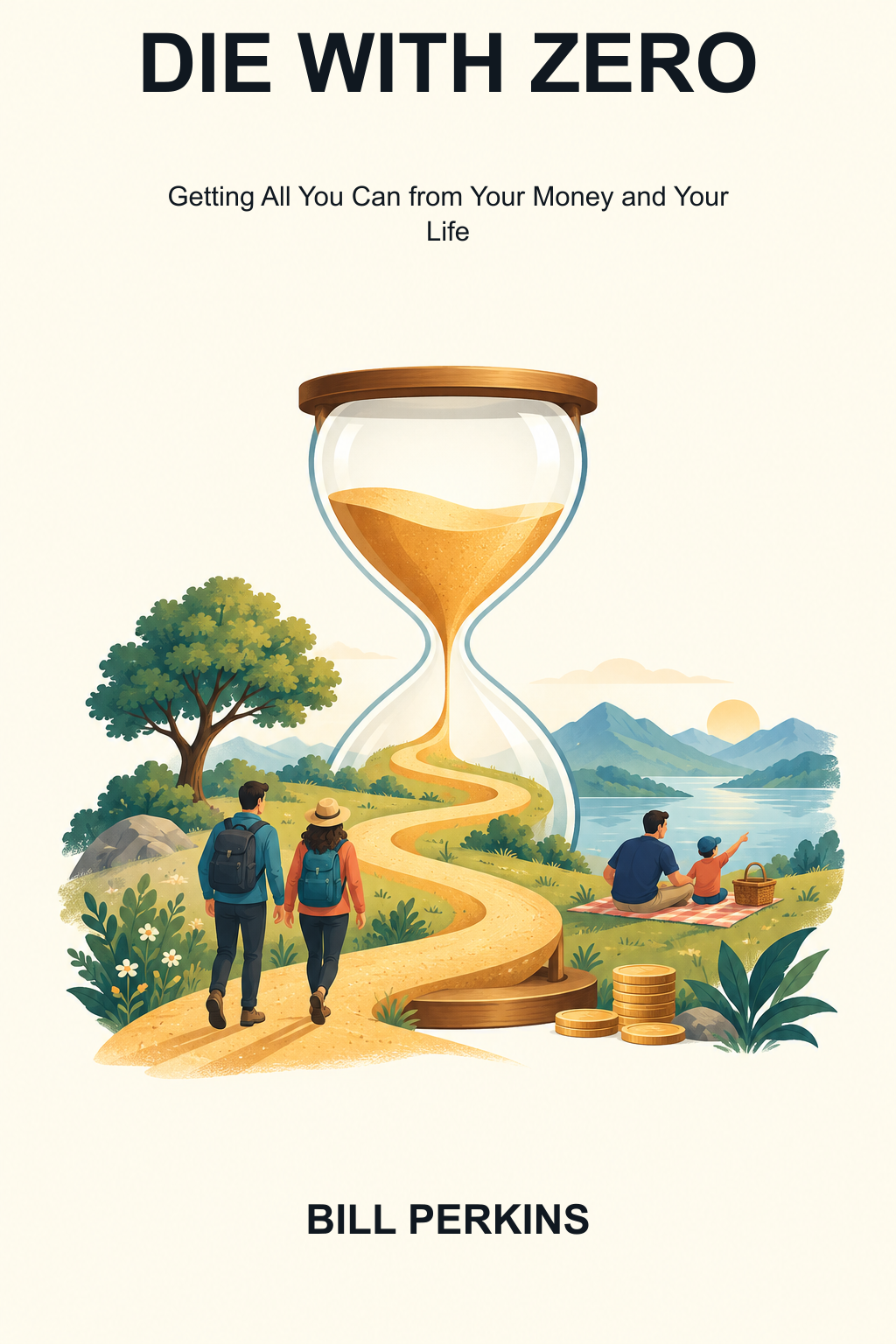
Die With Zero begins with a reframing rather than a spreadsheet. Bill Perkins’s central claim is that money is a tool for living, not a score that deserves to rise forever. A bank balance can buy options, reduce fear and protect people we love. But it becomes incomplete as a goal when accumulation continues automatically after it no longer serves a life the owner genuinely wants.
The title is intentionally provocative. Taken literally, dying with exactly nothing is not a safe or realistic target. No one can know their lifespan, future care needs, market conditions, inflation or family obligations with precision. Perkins’s more useful challenge is to avoid reaching the end of life with substantial unused capacity: money that could have supported connection, meaningful activity, generosity or relief from needless work, but never did.
This is a philosophy, not universal financial advice. It is most actionable for people with a financial margin after essentials and prudent protection are covered. Someone choosing between rent, food, medicine and debt payments does not need a lecture about maximizing experiences. Security itself is an experience-enabling resource. The practical question is not “How do I spend everything?” It is “What am I saving for, what does enough look like, and am I postponing the life I claim to value?”
An important distinction runs through this summary: explaining an author's challenge does not require accepting every conclusion. We can take the question seriously while adapting the answer to our circumstances. A comfortable trader and a caregiver living on a modest wage face different choices. Both can ask what makes a day worthwhile, but they cannot safely use the same financial plan. Here, the practical illustrations are original examples for understanding, not reported cases from the book.
Money Is Stored Life Energy
Perkins asks us to notice the hidden exchange behind income. Most earnings require time, attention, effort and sometimes health. That does not make work a mistake; work can offer purpose, competence and community. It does mean that every purchase and every act of saving should be understood in relation to the life energy used to earn the money.
An original example: a worker is considering an upgrade that costs the equivalent of several working days after tax. Instead of asking only whether it is affordable, they ask what those days represent. Would the item genuinely improve daily life? Would a smaller alternative do? Or would the same resources protect a future choice, fund time with someone important, or simply reduce financial strain? None of these answers is automatically correct. The value comes from seeing the tradeoff.
The reverse tradeoff matters too. Saving is not free merely because it avoids a purchase. Extra work, deferred rest and postponed connection can have costs. Perkins’s point is not that leisure always outranks earning. It is that inaction is also a decision with consequences. A person can sacrifice too much present life for a future that may not need all the sacrifice.
A grounded version of this idea keeps obligations visible. Do not borrow for a holiday merely to obey a slogan. Do not cancel emergency savings, housing plans, pension contributions or care for children and dependents. Instead, make spending and saving compete honestly for the same limited resource: your life energy.
Consider another original illustration. A person accepts extra evening work to afford a newer device, then finds that the evenings lost were also the only time their friends could meet. This does not prove the device was a bad choice. It reveals a second price that the receipt could not show. Compare realistic alternatives, including keeping what already works. Sometimes extra income is necessary and genuinely protective; sometimes an inherited habit, rather than a need, is making the decision.
Experiences and Memory Dividends
One of Perkins’s best-known metaphors is the “memory dividend.” A meaningful experience may continue to provide pleasure through recollection, conversation, photographs and the way it shapes identity. A simple afternoon with a child, an affordable class with a partner or a reunion with friends can keep returning in the mind long after the bill is paid.
This is a metaphor, not a promised investment return. Some trips disappoint. Some photographs evoke grief. Memory is uneven, and no purchase can guarantee meaning. The idea is valuable because it broadens the accounting. A cost is not always exhausted at the moment it leaves an account; nor is an expensive activity necessarily valuable merely because it is memorable.
The useful test is personal and concrete. What kinds of moments do you tend to revisit warmly? Which ones deepen a relationship or express a value? What can be made easier by modest planning? Luxury is not the point. Accessible local activities, shared meals, a regular walk, learning a family recipe or volunteering together may matter more than an impressive destination.
An original illustration: a parent notices that a child currently enjoys building things. Rather than promising a grand future holiday, the parent protects a few ordinary weekends for a low-cost project. The purpose is not to manufacture perfect memories. It is to recognize that attention has timing, and a relationship is built through repeated presence.
Remembering is also a relationship practice, not simply a private archive. Calling a friend after a shared walk can turn a brief outing into an ongoing connection. Yet an event does not need an audience, a photograph or an impressive story to be worthwhile. A quiet afternoon may be valuable because it gave someone rest. Treating every moment as an investment can become another performance burden. The useful lesson is to notice what matters, not to make leisure justify itself with a measurable return.
Windows, Not Deadlines
Perkins argues that time, money and health do not rise and fall together. A person may have energy but little money early in adulthood, more earning power but less free time in a demanding career, and greater flexibility later with different physical or family realities. This makes timing part of good planning.
The important word is “window,” not deadline. There is no universal age when someone must travel, play sport, start a family project or change careers. Bodies, preferences, cultures and responsibilities differ greatly. The point is simply that some opportunities are easier in one period than another, and indefinite postponement can quietly close them.
Perkins proposes time buckets: flexible periods, often spanning several years, in which to place experiences that matter. A bucket might include “regular time with my teenager,” “visit relatives while travel is manageable,” “learn a skill with friends,” or “take a sabbatical if finances permit.” The plan is not a demand to spend. It is a reminder to match intentions with the conditions that make them possible.
Review the buckets periodically. A health event, job change, new child, caregiving duty or economic setback can rearrange everything. Flexibility is not failure; it is the point. The calendar should serve reality, not force reality to obey a calendar.
Do not confuse urgency with panic. Recognizing that opportunities change does not mean saying yes to every invitation or fearing that ordinary life is being wasted. A person recovering from illness may need rest, not an ambitious itinerary. A parent may need to postpone a trip without abandoning what the trip represented. Search for an appropriate version of the intention: connection might mean a nearby visit, a conversation or a later plan with sensible safeguards. Timing is a question to investigate, not a command.
Turn Intentions into a Flexible Calendar
The time-bucket idea deserves its own practical treatment. A distant wish list can hide decisions: everything remains possible because nothing has a date. Perkins's framework asks us to consider periods of life and what belongs in them. Several years can form a useful planning horizon, but the boundaries are a tool, not a rule about how every life develops.
Here is an original exercise, not a financial prescription. First, list intentions without prices: seeing a relative, learning something, contributing to a community, sharing an activity or having time to rest. Next, identify what each requires. A visit needs the other person's availability. A course needs energy and a manageable schedule. A long trip may need money, mobility and freedom from immediate responsibilities. Listing conditions shows which intentions are flexible and which depend on a window that could change.
Then place a few intentions in realistic periods. Do not promise a complete transformation. Consider what can happen soon, what needs preparation and what may reasonably wait. For an original example, friends hoping for a distant adventure might discover that a nearby day together is possible this month. The smaller version does not erase the larger ambition. It stops all connection being held hostage by the perfect plan.
A calendar is not enough on its own. Ask who shares the decision, what commitments must be protected and whether there is an affordable version. Someone caring for a parent may not control their weekends. Their next step might be a conversation about shared care, not buying tickets. Respecting constraints makes a plan more humane and more likely to work.
Finally, leave blank space. A schedule packed with supposedly meaningful activities can reproduce the pressure of work. Unplanned time, recovery and discoveries have value. Revisit the plan when circumstances change, and let an intention disappear if it no longer fits your values. The exercise succeeds when it creates useful attention, not when every box is filled.
Giving When It Can Help
Perkins also challenges the assumption that generosity should wait until death. His claim is that a gift can be more useful when the recipient has time, energy and a real need or opportunity to use it. Support given during education, a difficult family transition or an early stage of adulthood may sometimes matter more than a later inheritance.
That principle requires care. Earlier is not automatically better. A recipient may not be ready, may prefer independence or may experience a gift as control. The giver may need funds for their own safety, partner, dependents or care. Charity, too, deserves discernment: urgency, effectiveness, personal values and the organization’s credibility all matter.
An original example: a family discusses helping an adult child with a manageable need. Instead of announcing a gift with conditions, they ask what would be useful and whether help is welcome. They set an amount they can genuinely afford, clarify that it does not purchase obedience, and preserve room for the child to decline. That conversation may be more valuable than the transfer itself.
This is not tax or legal advice. Gifts, inheritances and charitable donations can have local legal, tax and benefit implications. Significant decisions warrant qualified local professional guidance. The moral lesson is modest: if you intend to help, consider not only how much you give, but whether the timing, form and relationship make the help constructive.
Giving involves more than transferring a sum. Listening, sharing a skill or offering reliable practical help can also serve another person at the right moment. In an original illustration, a relative asks whether a young adult wants advice, temporary help or simply someone to listen. The answers need not match the giver's expectations. Generosity that disregards someone's autonomy can strain the relationship it meant to support. Discuss affordability and boundaries without turning the gift into a test of gratitude or a purchase of influence.
Enough and the Cost of Autopilot
The hardest concept in the book may be “enough.” It is difficult because enough is not merely a number. It includes a person’s desired lifestyle, obligations, tolerance for uncertainty, health, work prospects, community and the kind of legacy they want. Two people with similar incomes can reasonably define it differently.
Perkins’s criticism is directed at autopilot: the habit of continuing to accumulate because accumulation once made sense, because others applaud it, or because stopping feels frightening. The alternative is not a magical calculation. It is a recurring review. Ask what security you need, what commitments you have, what future options you want to preserve, and what current opportunities would be costly to lose.
A practical exercise is to make two lists. On one side, write responsibilities that should not be gambled with: basic living costs, debt, dependents, essential reserves and long-term security. On the other, write experiences, relationships and forms of contribution that you would regret repeatedly delaying. Then look for modest, affordable actions rather than one dramatic overhaul.
The author’s own wealth and comfort with risk are not templates for everyone. His philosophy is strongest as a challenge to examine assumptions, not an excuse to imitate another person’s spending. Financial security contributes to fulfillment too. A good plan leaves room for joy and generosity without pretending uncertainty has disappeared.
There are good reasons to continue earning even after basic costs are covered: meaningful work, supporting dependents, uncertainty and a chosen contribution. The problem is not that a balance grows. It is that the purpose disappears from view. Review a plan with your household rather than making a dramatic unilateral decision. If a question concerns pension income, tax, insurance or large transfers, an individual professional assessment matters more than a memorable slogan. A fulfilling life needs both room to act and protection against foreseeable hardship.
Final Summary
Die With Zero is most productive when read as an argument for intentional conversion: converting money into security where security is needed, and into time, relationships, contribution and experiences where those matter most. Perkins asks readers to remember that life is not lived in a final balance-sheet entry. It is lived in finite periods with changing capacities and people who may not always be available later.
The central discipline is not aggressive spending. It is honest planning. Protect what cannot responsibly be put at risk. Then identify a few forms of living that matter now, give them a place in a flexible calendar and revisit the plan as conditions change. The aim is not luxury, a perfect death-date calculation or an exact zero balance. It is fewer unconscious delays and fewer resources left unused merely because nobody decided what they were for.
Start with a question small enough to answer honestly: which affordable intention have I repeatedly postponed, and what is actually stopping it? The obstacle may be money, time, coordination, health or simple hesitation. Different obstacles require different responses. Protect essential security, talk with the people involved, and choose one realistic next step. An intentional life is not a perfect plan. It is a practice of making the purpose of our resources visible and revising decisions when reality changes.