

Free text
Summary and key ideas
Book summary prepared by ReWio. Original book author: Ethan Kross.
Introduction
Chatter begins with a familiar but easily misunderstood human capacity: the ability to use language privately. Some people experience a vivid stream of words in the mind; others think more through images, sensations, fragments, or occasional verbal phrases. Kross’s argument is not that everyone constantly hears an inner narrator. It is that internal verbal thought, when it occurs, can be remarkably useful—and remarkably difficult when it turns against us.
Inner speech lets us rehearse a presentation, remember what to buy, talk ourselves through a hard task, simulate possible futures, and make meaning from the past. In that sense, it is part of the mind’s practical equipment. The problem is not negative emotion itself, either. Fear can signal danger, disappointment can reveal what matters, and embarrassment can encourage repair. The trouble starts when attention repeatedly circles the same distressing interpretation without producing insight, action, or relief.
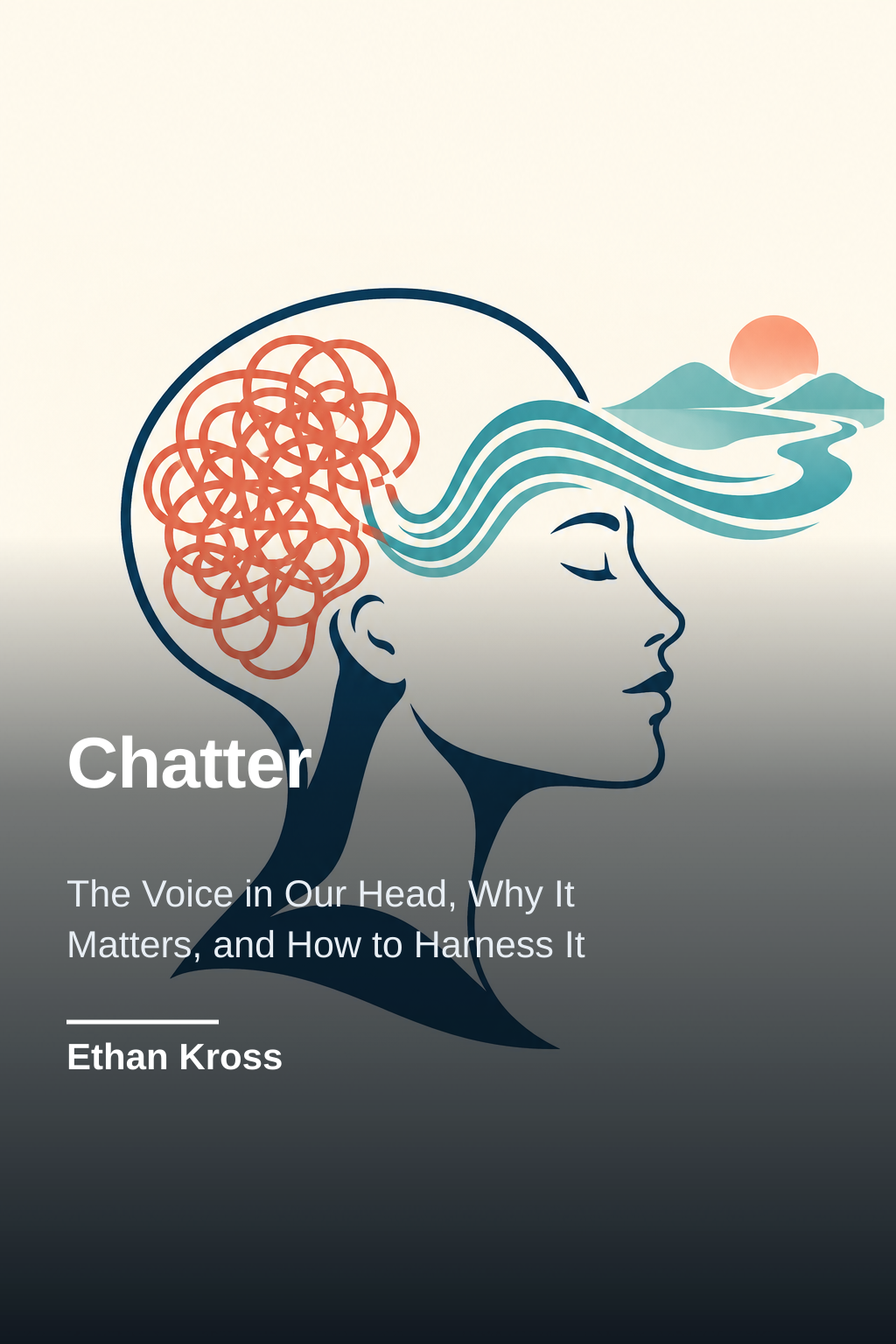
Kross calls this unproductive state chatter. In everyday terms, it is the mental loop that keeps prosecuting the case after the useful facts are already known: “Why did I say that? What does it mean about me? What if it happens again?” The loop can feel like analysis, but feeling busy is not the same as moving forward.
The book’s central proposal is therefore more realistic than “think positive” or “clear your mind.” Learn to alter your relationship to difficult thoughts. Gain enough distance to see the situation accurately, choose a next step, and preserve contact with other parts of life. The tools in this summary are not guarantees, diagnoses, or a substitute for therapy. They are options for a personal toolbox—best tested with curiosity, rather than treated as universal cures.
Reflection or Repetition
A key distinction in Chatter is between reflection and rumination. Reflection asks questions that open a situation: What happened? What is in my control? What can I learn? What should I do next? Rumination asks questions that often tighten the knot: Why am I like this? Why does this always happen? What if this proves everything I fear?
The difference is not simply whether the content is pleasant. A person can reflect on a painful failure and benefit from it. Another person can revisit a minor social moment and become increasingly distressed. What matters is the direction of thought. Does it create a clearer picture, a practical choice, or a revised understanding? Or does it magnify a threat while recycling the same evidence?
Imagine that Jordan receives a brief message from a supervisor: “Can we talk tomorrow?” A reflective response might list several plausible explanations, prepare relevant information, and then return attention to the current task. A ruminative response treats the ambiguity as proof of impending disaster and spends the evening searching memory for every possible mistake. The first response acknowledges uncertainty. The second tries to abolish uncertainty through repetition, which it cannot do.
Kross’s reasoning also suggests a useful checkpoint. When you notice recurring self-talk, do not immediately debate its accuracy for an hour. First ask: “Is this conversation helping me act wisely right now?” If the answer is no, the immediate objective is not to win an argument with the thought. It is to interrupt a process that has stopped being productive.
That can mean a small concrete move: draft the question you need to ask, schedule time to revisit the issue, take a walk, complete one bounded task, or write down the concern. These actions do not deny the problem. They stop the mind from confusing repeated alarm with effective preparation.
Creating Psychological Distance
The book’s most distinctive family of tools creates psychological distance. Distance does not mean emotional coldness, denial, or pretending that a painful event belongs to someone else. It means changing the mental vantage point so you are not trapped inside the most immediate version of the experience.
One linguistic method is to use your own name or a non-first-person pronoun in silent self-talk. Instead of asking, “Why am I panicking?” you might ask, “What does Elena need to do in the next ten minutes?” The wording is small, but it can shift the role you occupy. You move from being wholly immersed in the feeling to becoming someone who can advise a person in difficulty.
An observer perspective can work similarly. Picture a stressful scene as if you were watching it from a respectful distance. A difficult meeting is no longer only a surge of heat in your chest; it is also a situation involving several people, competing pressures, incomplete information, and choices about what to say. This broader frame can make room for strategy.
Temporal distance extends the view through time. Ask how much the current event is likely to matter next month, next year, or later. The point is not to dismiss every problem as trivial. Missing a deadline, losing a job, or facing illness may remain deeply consequential. But even serious situations often become easier to address when we distinguish what hurts now from what will define an entire life.
Suppose a student performs poorly in an important exam. “My future is over” fuses a single result with an identity and an imagined lifetime. A distanced response may still say, “This is disappointing and has consequences. What are the available options, and what support do I need?” Distance makes the problem more accurately sized. It converts a totalizing story into a situation with contours.
Writing a Coherent Account
Writing is another tool because it slows and structures experience. In a mental loop, thoughts can arrive as flashes: an image, an accusation, a remembered sentence, a feared consequence. Putting them into words on paper or a screen requires sequence. What happened first? What exactly did I assume? What evidence is missing? What feeling is present? What is the next decision?
Kross presents writing as a way of organizing an experience rather than endlessly reliving it. That distinction matters. A journal can become another stage for self-attack if every entry merely rehearses blame. More helpful writing gives the experience a beginning, middle, and possible next chapter. It may include emotion, but it also searches for meaning, context, and agency.
Consider someone who has been turned down for a role they wanted. An unstructured note might become several pages of imagined humiliation. A more useful exercise could separate facts from interpretations. Facts: the role went to another candidate; feedback mentioned experience with a particular tool. Interpretations: I am permanently behind; everyone thinks I am incompetent. Next actions: request clarifying feedback, decide whether the skill is worth learning, and tell a trusted person what happened.
Writing is not magic, and it is not always the best first move when emotion is overwhelming. Some people find immediate writing intensifies their focus on distress. In that case, a pause, physical movement, grounding activity, or conversation may be wiser before returning to the page. The broader lesson is flexible: use language to build a map, not a maze. If a practice repeatedly leaves you more activated and no clearer, change the practice rather than assuming you have failed it.
Support Without Co-Rumination
Chatter is not merely private. It can spill into relationships, and relationships can either regulate it or reinforce it. When someone is upset, they usually need emotional validation. A response such as, “That sounds painful; I understand why you are upset,” can reduce isolation and show that the listener is paying attention.
But Kross warns against stopping there. Friends can accidentally enter co-rumination: revisiting the same grievance, enlarging its worst interpretation, and supplying fresh reasons for outrage without helping the person regain perspective. It may feel intimate because both people are emotionally engaged, yet it can keep the distressed person stuck.
A stronger response combines warmth with widening. First, acknowledge the feeling. Then help the person see a fuller picture: “It makes sense that you are hurt. What do you think you want from this relationship now?” Or, “This feedback was hard to receive. Do you want me to listen, help you prepare a reply, or help you think through what it means?”
This approach respects agency. It does not rush toward a silver lining or declare that everything will be fine. Nor does it make the listener a judge who decides whether the concern is valid. It changes the conversation from an emotional echo chamber into a place where feeling and problem-solving can coexist.
For the person seeking support, a clear request can help. Instead of calling a friend with only the headline, say what you need: five minutes of listening, help identifying options, a reality check, or company while you send a difficult email. This makes support more precise and reduces the chance that a caring conversation becomes another hour of repetitive replay.
Using Context and Ritual
Chatter is influenced not only by what we think, but also by the context in which we think. Kross discusses ways that surroundings, shared practices, and moments of awe can help people step outside a narrow self-focus. A walk among trees, a view of a large landscape, a museum, music, or the night sky may not solve a concrete problem, but such experiences can make the problem occupy less of the whole mental field.
Orderly environments and routines can also provide cues of control. Clearing a small work surface before beginning a difficult task, following a familiar pre-performance ritual, or changing physical location may help mark a transition from spiraling to acting. These practices should not be mistaken for superstition or for treatment of serious distress. Their value is often practical: they direct attention, reduce friction, and create a repeatable signal that says, “Now I am entering a different mode.”
Technology deserves a similar, measured view. A phone can prolong chatter through compulsive checking, comparison, or rereading old messages. Yet it can also support perspective: a reminder to take a break, a note containing a useful coping prompt, a call to someone steady, or a calendar that turns a vague concern into a scheduled action. The object itself is not the answer; the pattern of use matters.
Try an everyday experiment. After a stressful call, do not immediately open the message thread and reread it. Put the phone away, spend ten minutes in a different setting, and then decide whether a response is necessary. The pause is not avoidance if you return to the issue with greater clarity. It is a way to prevent the environment from automatically feeding the loop.
Building a Flexible Toolbox
The practical strength of Chatter is its refusal to offer one master technique. A person may benefit from naming their own experience from a distance, while another finds that strategy artificial. One person organizes thoughts by writing; another needs a conversation, exercise, sleep, or time away from screens before words become useful. Context matters too. The best tool for pre-meeting nerves may be different from the best tool after a breakup or during a family conflict.
A workable toolbox can be simple. Notice the early signs of a loop: repeated checking, replaying an exchange, abandoning tasks, or using absolute self-judgments. Then choose one distancing tool, one action tool, one social tool, and one environmental tool. For example: use your name in a question; make a short next-steps list; call a friend who can validate and broaden; take a route that gets you outdoors. Review what actually helped rather than what sounded impressive.
There are important limits. Reframing cannot remove structural problems, financial insecurity, discrimination, grief, chronic pain, or unsafe relationships. It should not be used to pressure someone into accepting mistreatment. Nor should self-help techniques carry the burden of conditions that call for professional assessment or care. If distress is persistent, escalating, traumatic, accompanied by thoughts of self-harm, or meaningfully impairs sleep, work, relationships, or daily functioning, qualified mental-health support is important.
Kross’s framework is most useful when held with humility. Your inner experience is information, not an infallible command. You do not have to silence every difficult thought. You can learn to ask whether a thought is helping, create space around it, and choose the next response deliberately.
Final Summary
Chatter reframes inner verbal thought as a capability with two possible directions. It can be an inner coach that helps people plan, remember, interpret, and persist. Or it can become a closed loop that narrows attention, inflates threat, and turns a real problem into an endless internal trial.
The book’s answer is not forced optimism. It is perspective. Distancing language can turn “I am overwhelmed” into a more workable question about what someone needs to do next. An observer’s view can restore context. Looking forward in time can reduce the false feeling that one moment contains an entire future. Writing can turn fragments into a coherent account. Good support can validate pain without feeding repetition. Nature, awe, rituals, and environments can shift the conditions that keep attention stuck.
The unifying principle is to make room between the thinker and the thought. That room is where judgment improves. You can take a setback seriously without treating it as a verdict on your worth. You can listen to alarm without allowing it to run the whole day. And you can build a toolkit through small, honest experiments: not asking which technique should work for everyone, but which combination helps you return to clarity, connection, and constructive action.