

Free text
Summary and key ideas
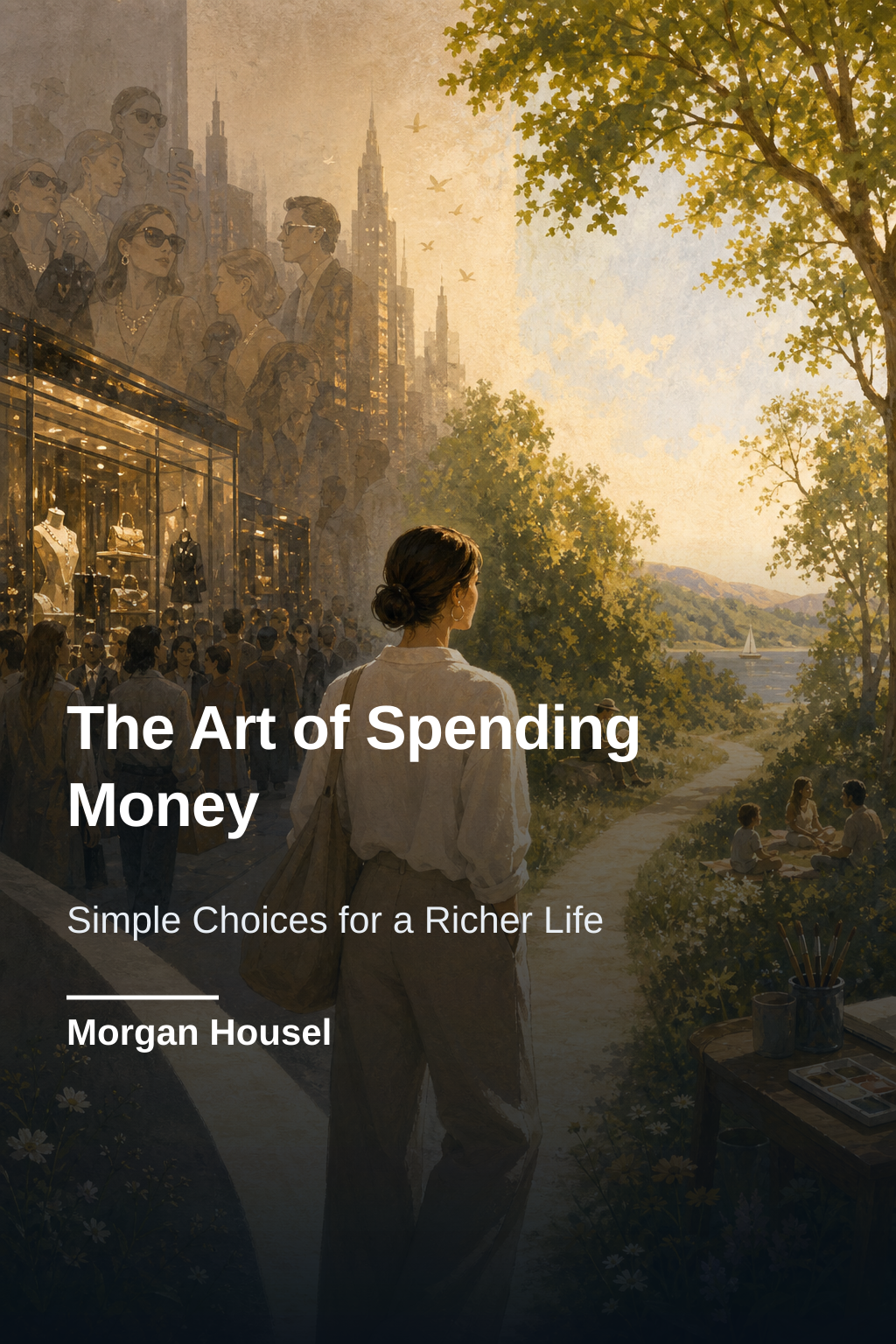
Book summary prepared by ReWio. Original book author: Morgan Housel.
Introduction
Most money advice begins with arithmetic. Earn more than you spend. Save a margin. Invest for the future. Those ideas matter, but they leave out a stubborn fact: two people with similar resources can use money in completely different ways and feel completely different about the results. One person buys convenience and feels relieved. Another buys the same convenience and feels wasteful. One person saves aggressively and feels secure. Another saves just as much and remains afraid to use any of it.
Morgan Housel’s central claim is that spending is not primarily a math problem. It is a personal and psychological one. In his account, money is woven into identity, memories, insecurity, aspiration, love, independence, and social rank. That is why no universal list of “good purchases” can settle the question. A purchase that expands one person’s life may burden another. A frugal choice that feels liberating to one person may feel like needless self-denial to someone else.
This does not mean that facts, obligations, or financial limits disappear. Bills are real. Debt is real. Long-term needs are real. But within the room left by those realities, Housel asks us to examine a more difficult issue: what are we actually trying to achieve when we spend?
The publisher presents this book as an alternative to hacks and one-size-fits-all rules, and Housel himself says he does not tell readers exactly how to spend because he does not know them. Instead, he explores envy, greed, status, contentment, and happiness. This summary follows that invitation. Its chapters are ReWio themes, not the book’s chapter titles. The goal is not to make every dollar visibly impressive. It is to make more of your choices feel honestly useful once the audience has gone home.
Money Is a Tool, Not a Self-Portrait
A useful place to start is separating money from identity. Money can pay for shelter, care, learning, rest, mobility, generosity, and options. It can soften emergencies and remove daily friction. Those are powerful functions. The trouble begins when money is asked to prove who we are.
When a purchase becomes a self-portrait, it carries an impossible burden. We may hope a home proves adulthood, a car proves achievement, a wardrobe proves taste, or an expensive experience proves that our life is exciting. None of these desires is automatically shallow. Objects and experiences can be beautiful, practical, and meaningful. But Housel’s point is that their emotional value changes when they become evidence in an internal court case about whether we are enough.
This distinction helps explain why the visible reward of spending can be so brief. If the deeper need is recognition, confidence, belonging, or relief from uncertainty, the purchase may deliver a moment of excitement without resolving the need beneath it. The next upgrade then looks necessary, not because the old item failed at its job, but because no item could complete the job it was secretly assigned.
Try a simple translation exercise. When you feel a strong urge to buy something, finish this sentence: “I believe this will give me…” The answer may be comfort, beauty, ease, credibility, adventure, privacy, or time. It may also be proof, attention, superiority, or protection from embarrassment. The answer is information, not a verdict. Naming it gives you a chance to decide whether the purchase is the best available route to that outcome.
This is also a gentler way to think about restraint. Spending less is not automatically virtuous, just as spending more is not automatically indulgent. The better question is whether money is helping you express a considered life or forcing you to act out a role. A tool should expand your agency. An identity costume can make you dependent on maintaining an image.
Learn the Difference Between Envy and Admiration
Housel highlights a confusion that can quietly direct years of spending: mistaking admiration for envy. You might admire someone’s skill, calm, relationships, discipline, or freedom. But what you notice on the surface may be the house, salary, title, holiday, or brand attached to that life. If you copy the visible artifact instead of understanding what you truly admire, you can spend a great deal pursuing the wrong thing.
Consider the person whose life seems appealing because they travel often. Is the real attraction luxury hotels and airport lounges? Or is it curiosity, unstructured time, closeness with family, distance from routine, or the confidence to be temporarily unreachable? Those motives call for different choices. A costly imitation may reproduce the photos but not the feeling.
Social comparison makes this harder because it compresses other people’s lives into highlights. You see what they display, not what they gave up, worried about, borrowed, inherited, endured, or simply value differently. Housel’s observation is not that everyone is pretending. It is that an outside view is too thin to serve as a reliable instruction manual for your own life.
There is a practical way to turn comparison into data. When you feel a flash of envy, do not immediately suppress it and do not immediately act on it. Ask: What precisely do I want from this person’s situation? Then ask a second question: Would I want the full package—their responsibilities, trade-offs, uncertainty, and priorities—or only the slice I can see? Often, what remains is not envy but a useful clue about a neglected value.
Perhaps you admire their freedom to leave work early, their craftsmanship, their community, or their willingness to live simply. Those are not shopping instructions. They are design criteria. They may lead to a purchase, but they may just as easily lead to a boundary, a new skill, a changed schedule, or an honest conversation.
This is the richer use of admiration. It stops being a command to catch up and becomes a prompt to understand yourself.
The Moving Finish Line
Housel argues that expectations often matter more to satisfaction than raw income or raw consumption. That is a claim about the mind’s reference point: what feels abundant is rarely determined by the amount alone. It is determined by the gap between what we have and what we have come to regard as normal, necessary, or deserved.
That gap can widen almost automatically. A larger home becomes the baseline. Greater convenience becomes standard. A once-special meal becomes ordinary. The mind is good at adapting, which can be a gift during hardship, but the same capacity can make improvements fade into the background. If every gain quickly becomes the new minimum, then more spending may create a treadmill rather than arrival.
This does not mean improvement is pointless. Better tools can make work easier. A safer neighborhood can change a family’s daily life. More space can create privacy and calm. The question is whether the improvement has durable usefulness, or whether it mainly raises the level you must now maintain to avoid feeling deprived.
A practical response is to protect some distance between means and lifestyle. Not because deprivation is noble, but because distance creates flexibility. It allows good surprises to feel like gains instead of obligations. It lets you make decisions from preference rather than panic when income changes or priorities shift.
You can also practice making a benefit visible before it becomes invisible. If you choose to spend on something meaningful, pause long enough to notice the particular problem it solves or the experience it enables. This is not forced gratitude. It is an effort to keep your awareness aligned with reality instead of allowing the mind to relabel every improvement as the bare minimum.
Equally important, define enough in more than financial terms. Enough sleep. Enough room to think. Enough time with people you love. Enough reliability. Enough privacy. Enough challenge. A life with clear definitions of enough is less vulnerable to an endless escalation of wants, because it has standards that are not borrowed from the crowd.
Buy More Control Over Your Time
One of the book’s deepest ideas is that money’s most valuable return may be peace of mind. Housel connects that return to independence: the ability to make more choices about your time, attention, and response to uncertainty.
Independence does not have to mean never working for anyone or reaching some dramatic financial milestone. It can mean having enough slack to leave an unhealthy situation, reduce an exhausting commute, take a needed break, help someone close to you, pursue work with a longer horizon, or say no without immediate catastrophe. It is the difference between possessing income and possessing room to maneuver.
That is why a spending decision can be evaluated by what it commits your future self to. A purchase may be affordable today but expensive in maintenance, attention, stress, or required future income. Another expense may seem ordinary yet buy back hours each week, reduce recurring conflict, or preserve energy for the people and work that matter most. The price tag is only one part of the cost.
Housel’s lens suggests asking: Does this choice increase my flexibility, decrease it, or leave it unchanged? The answer will not always favor spending less. Paying for reliable childcare, a shorter commute, equipment that prevents repeated hassle, or professional help during a demanding period might increase control. So might keeping a buffer rather than converting every increase in income into fixed lifestyle commitments.
The key is to avoid treating time merely as an empty space to fill with consumption. Control over time is valuable because it lets you direct your life. If an hour saved simply becomes an hour of compulsive busyness, its value shrinks. If it becomes rest, attention, learning, care, play, or unhurried thought, it may become one of the most meaningful things money can support.
This is not individualized financial advice. It is a question of personal priorities: which expenses reliably create a calmer, more self-directed life, and which ones make you work harder to sustain a life you do not have time to enjoy?
Status Has Hidden Maintenance Costs
Humans are social, so spending is social. Housel’s discussion of status does not require pretending that recognition never matters. We all live among other people. Signals can communicate reliability, taste, group membership, success, or care. The problem is that status purchases often come with social debt: a continuing pressure to preserve the impression they created.
A visible upgrade may invite a quiet question from both others and ourselves: can you keep this up? The answer can shape future choices. You may feel compelled to match a lifestyle, accept work you do not want, avoid cheaper options you would enjoy, or keep buying at the level that has become associated with your identity. The purchase is no longer a single event. It becomes a recurring obligation.
This is why comparison can make even high income feel cramped. There is no stable top in a game defined by ranking. Someone will always have more, newer, rarer, or more publicly legible evidence of success. If your sense of progress depends on surpassing a moving crowd, the crowd controls your contentment.
A useful distinction is between private value and public value. Private value is what remains if nobody knows you made the purchase: the comfort, functionality, beauty, time, or memory it gives you. Public value is the recognition attached to being seen making it. Many choices contain both. Honesty means estimating the proportion without pretending you are above status or entirely ruled by it.
Then look at the maintenance requirement. What must continue to be true for this choice to feel good? Does it require further upgrades, a specific income, a certain neighborhood, particular friends, or constant attention? If so, the real cost may be far larger than the initial payment.
A rich life has room for celebration and beautiful things. Housel’s warning is against outsourcing self-respect to them. The less you need strangers to validate your choices, the less expensive your life becomes psychologically—and often materially as well.
Choose Regret You Can Live With
No spending philosophy can eliminate regret. You can regret buying too soon, waiting too long, saving for a future that never arrives as imagined, or spending on a moment that does not deliver. Housel’s more humane standard is not perfect optimization. It is reasonable regret minimization.
This matters because a demand for certainty can freeze people in opposite ways. Some never spend because they fear making a foolish decision. Others buy immediately because they fear missing an experience, opportunity, or status marker. Both reactions treat uncertainty as unacceptable. But life does not offer a ledger showing the one correct use of every dollar.
Instead, decide which regrets matter most to you. You might regret permanent fixed costs more than missing occasional luxuries. You might regret postponing time with family more than buying an item that later loses appeal. You might value a large margin of safety because uncertainty weighs heavily on you. Another person, with different responsibilities and temperament, may reasonably choose otherwise.
Going slowly is one way to make room for this complexity. Slowness does not mean never acting. It means giving major wants enough time to reveal their character. Does the desire survive a few ordinary weeks? Does it become clearer when you imagine the upkeep? Can you describe the specific use rather than the general glow of ownership? Would a smaller experiment teach you what you need to know?
For experiences, going slowly can mean making space to actually experience them. An overloaded itinerary, a rushed renovation, or a frantic upgrade can turn a hoped-for pleasure into another project to manage. The point is not to make life smaller. It is to allow pleasures to register rather than racing past them in pursuit of the next proof that life is going well.
There is also a role for generosity toward your past self. Some choices will look imperfect in hindsight because you learned, changed, or faced circumstances you could not foresee. The lesson is not to rewrite history as a mistake. It is to use hindsight to improve your questions. A good spending life is built through many revisable decisions, not one irreversible demonstration of wisdom.
Build a Definition of Rich That You Can Feel
The destination in Housel’s argument is not austerity disguised as wisdom, nor consumption disguised as freedom. It is contentment: a life in which money supports what is deeply important without becoming the main object of attention.
That requires a definition of rich that is personal enough to guide decisions and concrete enough to be felt. Visible consumption is easy to measure because other people can see it. But many of the things that make life better are quiet: a manageable schedule, a dependable home, health-supporting routines, a close friendship, the ability to help, a margin for surprise, time to make something, and the confidence that you do not need to impress everyone.
These forms of richness may not produce the strongest signal. That is partly why they are powerful. They reduce the need to constantly prove that your life is valuable.
One practical exercise is to write two lists. On the first, list expenses or ambitions that make daily life genuinely better. Be specific: not “more comfort,” but “a chair that lets me work without pain,” “a weekly evening with my partner,” “a reserve that lets me sleep during uncertainty,” or “a trip that lets us be fully together.” On the second, list the things you pursue mostly because failing to have them feels embarrassing. The second list is not shameful. It simply reveals where social pressure may be steering the wheel.
Then consider what you want money to make easier, not what you want it to announce. The answer will change with age, obligations, health, relationships, and opportunity. That is not inconsistency. It is the reason spending must remain personal.
Housel’s underlying invitation is demanding because it asks for self-knowledge rather than a formula. Yet it can also be freeing. You do not have to win a public contest in order to spend well. You only have to become more accurate about the life your money is there to serve.
Final Summary
The Art of Spending Money reframes spending as a choice about life, not merely lifestyle. Housel’s central observation is that money decisions reflect inner forces—identity, comparison, expectations, fear, aspiration, and the longing for control. That is why the same amount of money can create freedom for one person and pressure for another.
The practical shift is to move from automatic questions—Can I afford it? Will people notice? Is this what successful people do?—to deeper ones. What need am I trying to meet? Is this envy or genuine admiration? What ongoing obligation will this create? Does it buy time, calm, flexibility, or connection? Would I still value it if nobody saw it? What regret am I trying to avoid, and is that regret truly mine?
There are no perfect answers and no universal spending blueprint. But there can be greater honesty. Spend deliberately where money makes ordinary life more workable, relationships more available, and time more your own. Be cautious where it demands a performance, raises the finish line, or turns admiration into debt.
A richer life is not necessarily the one with the most visible evidence of wealth. It is the one in which money quietly expands your ability to live by your own considered values—and leaves you content enough to notice that you already are.