

Free text
ReWio Short
A skin reflex shaped by cold, nerves, and emotion
A song reaches its final note. A voice delivers a line that suddenly means more than it did a second ago. Or a gust of cold air catches your arms. Then it happens: a ripple races over your skin, hairs rise, and tiny bumps appear as if your body has briefly remembered a much furrier past.
We call them goosebumps because the raised skin resembles the plucked surface of a goose. The scientific term is piloerection. It is ordinary, fast, involuntary, and more revealing than it looks—not because it reads your personality or detects a lie, but because it shows an ancient skin-and-nerve reflex switching on in real time.
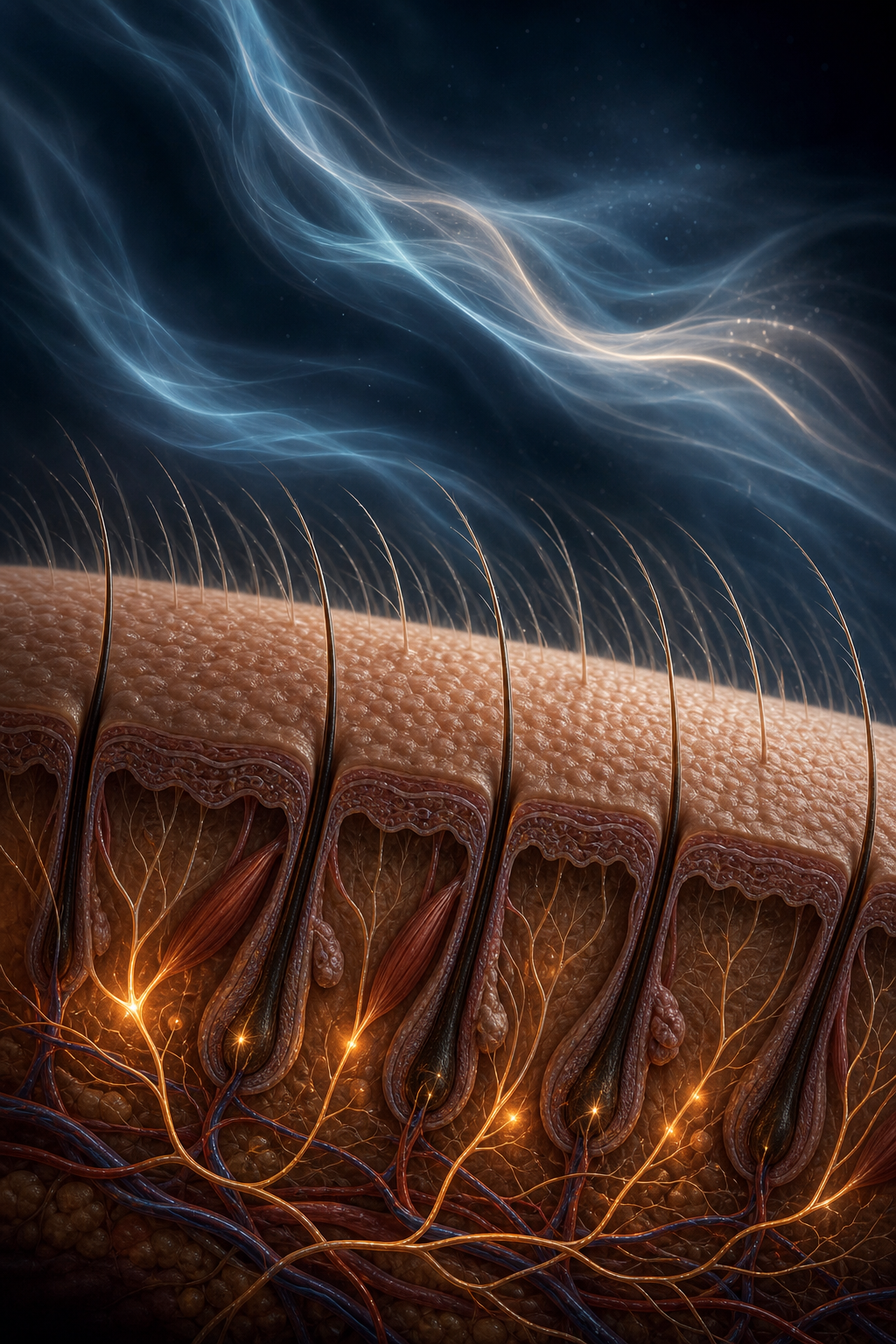
The visible bump is not the hair itself. Each hair grows from a small pocket in the skin called a follicle. Attached to the follicle is a tiny band of smooth muscle, the arrector pili muscle. When that muscle contracts, it pulls the hair more upright. At the same time, it tugs on the surrounding skin, creating the small raised mound we recognize as a goosebump.
This is not a decision you make. The response is directed through the autonomic nervous system, the network that regulates many body functions outside conscious control. Piloerection is commonly linked to sympathetic nerve activity. But it is worth being precise here. “Sympathetic” does not mean every goosebump is a full-blown emergency alarm. The sympathetic system helps coordinate responses to changing conditions, including temperature and arousal. A cold room, a sudden noise, a tense film scene, or a powerful memory can all recruit parts of this broader system in different ways.
Cold is the clearest starting point. In a densely furred mammal, hairs standing up can trap a thicker layer of air close to the skin. Air is a poor conductor of heat, so that layer can improve insulation. Raised fur can also alter an animal’s outline. In some social or threatening situations, a fluffed coat may make an animal appear larger or more imposing.
Humans retain the machinery, but we do not retain a thick body coat. That makes the insulating effect of goosebumps modest at best for most of us. Our bumps are therefore not evidence that the reflex is useless. They are evidence that a biological system can persist even when one of its original visible advantages has been greatly reduced. The Smithsonian’s Human Origins Program describes the human reaction as a reflex inherited from hairier ancestors. That broad evolutionary explanation is sensible, but it should not be inflated into certainty about every detail of our distant past.
The more surprising triggers are emotional. Fear can cause goosebumps. So can awe, suspense, grief, pride, tenderness, nostalgia, moving music, a film, a speech, or the moment a familiar story becomes newly personal. These experiences are often called chills, aesthetic chills, or frisson—a French word associated with a shiver. They can feel like a wave over the scalp, neck, back, or arms. They may include tingling, a shudder, a catch in the breath, tears, or a sense of intensity.
But here is an important distinction: chills and visible goosebumps are related, not interchangeable. Someone may report a powerful emotional chill without obvious piloerection. Another person may get visible bumps in the cold without any feeling of emotion. Even during the same moving song, a person might have a sensation of chills at one moment and visible raised hairs at another. Research on this topic has often relied on people describing what they felt afterward, which is valuable but not the same as directly observing the skin response.
A recent open-access study took that problem seriously. Researchers recorded episodes of piloerection while measuring several bodily signals in a small group of participants. Thermal, tactile, and audio-visual stimuli all triggered piloerection. The bodily patterns differed by trigger: audio-visual episodes were associated with stronger sympathetic arousal measures, while tactile episodes showed a different autonomic pattern. The study also found that piloerection occurred as skin temperature decreased and was associated with a rise in skin temperature during episodes.
That is intriguing, but it is not a final map of every goosebump. The study observed many episodes, yet it involved only a small number of people. Its value is in challenging a lazy explanation: goosebumps are not simply an emotional phenomenon, and they are not adequately explained by repeating “fight or flight.” They are a flexible reflexive response, shaped by the kind of stimulus, the sensory pathway involved, the setting, and the individual.
So why can a song do what cold air does? The careful answer is that the same outward skin response can be reached through different routes. Music and stories are not physically cold, but they can create anticipation, surprise, meaning, tension, release, and emotional salience. The brain and autonomic nervous system coordinate changes across the body during such moments. Sometimes that coordination includes piloerection. We do not need to claim that goosebumps prove a song is objectively profound, that they reveal musical talent, or that they carry a hidden spiritual message. They show that an experience has engaged a bodily response. What that experience means to the person is a separate question.
The skin mechanism has another twist. Research highlighted by the National Institutes of Health examined mice and found a close working relationship among sympathetic nerves, arrector pili muscles, and hair follicles. In the experiments, the nerves did more than trigger the short-term lifting of hairs. They also influenced hair-follicle stem-cell activity through signaling involving norepinephrine. The arrector pili muscle appeared to help maintain the physical relationship between nerve endings and those stem cells.
When mice were exposed to cold, the researchers observed the immediate goosebump response and later changes connected to new hair production. It is an elegant example of how a quick reflex and a slower adaptation may be linked within the same patch of skin. If cold persists, an animal with fur may benefit not only from lifting the coat it already has, but from cues that support renewal of that coat.
Still, this is where headlines can run ahead of evidence. Mouse skin is not human scalp treatment. The findings do not prove that inducing goosebumps will regrow human hair, prevent baldness, or heal skin. They identify a biological relationship worth studying. That is exciting enough without turning a laboratory result into a promise.
There are also popular claims that deserve a calmer response. Goosebumps do not reliably tell you whether someone is lying. They do not diagnose a particular emotional depth. They do not establish a health benefit. And although people often attach strong personal or cultural meanings to chills, the physical mechanism itself is well described without needing to make claims science cannot test.
For most people, ordinary goosebumps are brief and harmless: the skin rises, the moment passes, and the hairs settle back down. But bodies deserve context. If unusual or persistent symptoms are unexplained, distressing, or appear with severe illness, high fever, fainting, chest pain, trouble breathing, confusion, or other worrying symptoms, seek medical assessment rather than trying to interpret a skin reflex alone.
Goosebumps are tiny, but they sit at the meeting point of skin, muscle, nerves, temperature, memory, and emotion. They are not a mystical decoder ring, and they are not merely an obsolete quirk. They are a visible flash of an involuntary system that has adapted across mammals and still responds to the world around us.
The next time your skin rises during a cold wind or a perfect line in a song, notice the scale of what just happened. A muscle smaller than a grain of rice tightened beside a hair follicle. Nerves carried a signal. Your skin changed shape. And for a few seconds, something ancient and automatic surfaced where you could see it.