

Free text
ReWio Short
The hidden nerve response beneath wet skin
The next time your fingers turn into little prunes in the bath, notice the strange implication: your skin is not simply waterlogged. Your nervous system has joined in.
For generations, the obvious explanation seemed perfectly reasonable. Water soaks into the outer layer of skin. That layer swells. Since the surface now has more material than the tissue underneath, it buckles into wrinkles. End of mystery.
It is a satisfying story. It is also incomplete in the most surprising possible way.
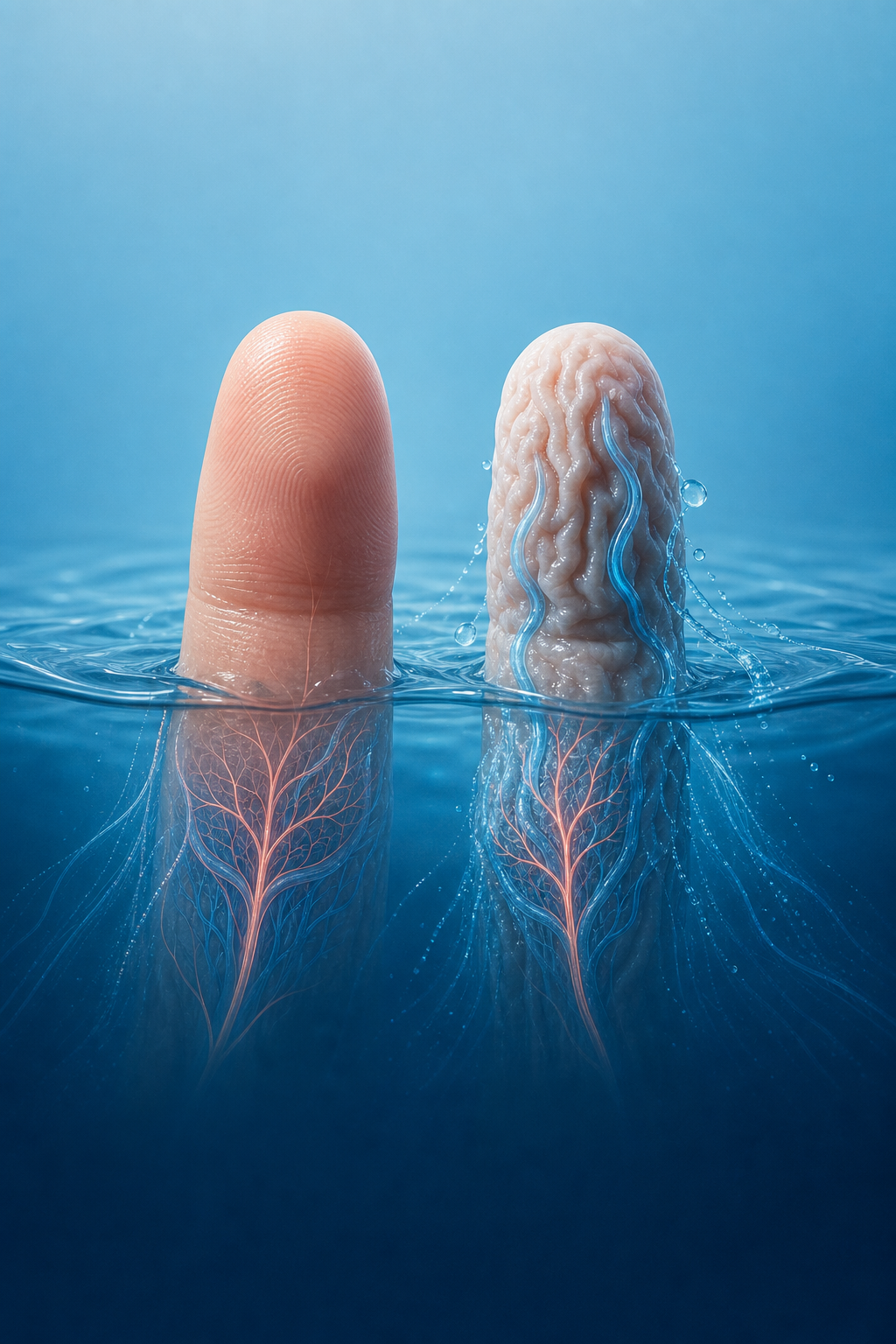
The wrinkles that appear on the pads of your fingers and toes are not merely a passive swelling effect. They depend on intact sympathetic nerves: the branch of the autonomic nervous system that controls many involuntary body functions, including the tightening of tiny blood vessels.
So when you sit in warm water long enough, the body does something counterintuitive. Rather than simply puffing the fingertip outward, it narrows blood vessels inside the fingertip pulp. That process is called vasoconstriction. With less blood volume in the soft tissue beneath the skin, the fingertip pulp slightly decreases in volume. The skin is pulled down into a characteristic landscape of ridges and valleys.
In other words, a wrinkled fingertip is less like a sponge expanding and more like fabric settling over a cushion that has gently deflated.
Water still matters. It is the trigger. The leading physiological account is that water enters through the many sweat-duct openings in the glabrous skin of the palms, soles, fingertips, and toes. That alters conditions in the outer skin enough to set off a nerve-mediated vascular response. But the visible folding is not explained by absorbed water alone.
How do we know nerves are essential? Medicine provided an unusual natural experiment.
Consider a finger that has been completely severed and then surgically replanted. Modern microsurgery can reconnect vessels and restore the finger itself. But its nerve supply may be absent or incomplete for a long time. That creates a remarkable comparison: one person can have a replanted finger beside an ordinary, normally innervated finger, exposed to the same warm saltwater at the same moment.
Researchers examined exactly this situation in people with successfully replanted fingers. In the unaffected fingers, water immersion brought the familiar combination: blood flow fell, and the skin wrinkled. In the replanted, denervated fingers, the result reversed. Blood flow increased rather than decreased, and the skin did not wrinkle.
That is powerful evidence because it rules out a simple story in which water acts only on the skin from the outside. The same liquid was touching both fingers. The major difference was the nerve connection.
Earlier clinical observations had already pointed in this direction. Fingers lacking normal nerve function often failed to wrinkle after immersion. The replantation research went further by measuring circulation directly. It linked the missing wrinkles to the missing vasoconstriction.
This is why the phrase “pruney skin” can mislead. A prune wrinkles because it loses internal water over time. Your submerged finger does not become a literal prune. Yet the geometry has a family resemblance: reduce the support under a flexible surface, and folds emerge. In fingertips, specialized skin, dense tissue, sweat ducts, and a network of small vessels turn a small internal volume change into a highly organized pattern.
And organized is the key word. The wrinkles are largely confined to glabrous skin, the hairless, high-contact skin of fingertips, palms, soles, and toes. These are the surfaces that grip a glass, hold a tool, pick up a stone, or keep footing on wet ground.
That distribution raises an irresistible evolutionary question. If the body actively produces these wrinkles, what are they for?
One appealing possibility is the rain-tread hypothesis. Think of the grooves in a tire. On a wet road, tread channels help move water away so that more useful contact can be maintained. Finger wrinkles might do something similar: create channels that drain water from the narrow interface between fingertip and object, reducing slippery lubrication and improving grip.
It is a clever idea. But clever ideas need experiments.
A study published in Biology Letters tested people moving a collection of objects, including marbles and fishing weights, from one container to another. Participants performed the task with wrinkled or unwrinkled fingers, and with dry or submerged objects. In the underwater condition, they transferred the objects faster with wrinkled fingers. The reported improvement was about twelve percent. Crucially, wrinkles did not speed performance with dry objects.
That result fit the rain-tread idea beautifully. The benefit appeared where a water-drainage solution ought to matter.
But science does not settle because one result is elegant.
Another study tested whether water-induced wrinkles affected touch acuity and dexterity during wet-object handling. It found no evidence of a dexterity advantage. It also found that wrinkling did not impair the measured touch sensitivity. This mattered for two reasons. First, it challenged the idea that faster object transfer was a universal or easily reproduced effect. Second, it weakened one proposed explanation for why our fingers are not permanently wrinkled: a simple loss of tactile acuity.
Then a later study looked at the question differently. Instead of asking only how fast someone could move an object, it measured grip force relative to load force while people handled an object. Wet, unwrinkled fingers needed more grip force, as you might expect when surfaces are slippery. Wrinkled fingers brought the required grip closer to the dry-finger condition. The interpretation was not necessarily that people became faster or more skillful in every task. It was that they could hold a wet object more efficiently, using a smaller excess safety margin of force.
That distinction is important. “Better grip” can mean different things: fewer drops, faster transfers, steadier control, less force, or less energy. A study may find one benefit and not another, especially when the task, object surface, water conditions, and participant group all differ.
So what is the honest conclusion?
Water wrinkles are very likely an active, nerve-controlled response involving vasoconstriction and a reduction in fingertip-pulp volume. The case for that mechanism is much firmer than the case for its evolutionary purpose.
The wet-grip explanation is plausible. It has experimental support from faster handling in one submerged-object task and from improved grip-force efficiency in another. But a separate experiment did not reproduce a dexterity benefit. The evidence suggests a useful function may exist under particular wet conditions; it does not yet prove the precise evolutionary story, or prove that drainage channels are the only mechanism involved.
Perhaps the grooves channel water. Perhaps they also alter how the skin deforms around an object, increase effective contact, or change friction in subtler ways. Maybe toes gain a related advantage on wet ground. These remain questions, not finished answers.
There is one boundary worth recognizing. Ordinary immersion wrinkling is common. But very rapid, excessive wrinkling of the palms, especially with white or translucent bumps, swelling, burning, pain, or itch, can belong to a distinct dermatologic phenomenon called aquagenic wrinkling of the palms. That is not the same thing as the everyday bath-time response, and this description is not a diagnosis.
The ordinary version, though, is a small masterpiece of biological misdirection. What looks like your fingertips surrendering to water is actually your body changing the shape of a grip surface from the inside.
So those bath-time wrinkles are not just what water does to you. They are, in part, what you do in response to water: tiny valleys sculpted by nerves and blood vessels, possibly preparing your hands and feet for a world that has suddenly become slippery.