

Free text
ReWio Short
The invisible forces behind a very visible cabin reaction
The cabin is quiet enough to hear a page turn. Then the floor seems to rise beneath your feet. A drink trembles in its cup holder, a few gasps move through the rows, and the seat-belt sign chimes on.
For a few seconds, your body delivers an urgent verdict: something is wrong.
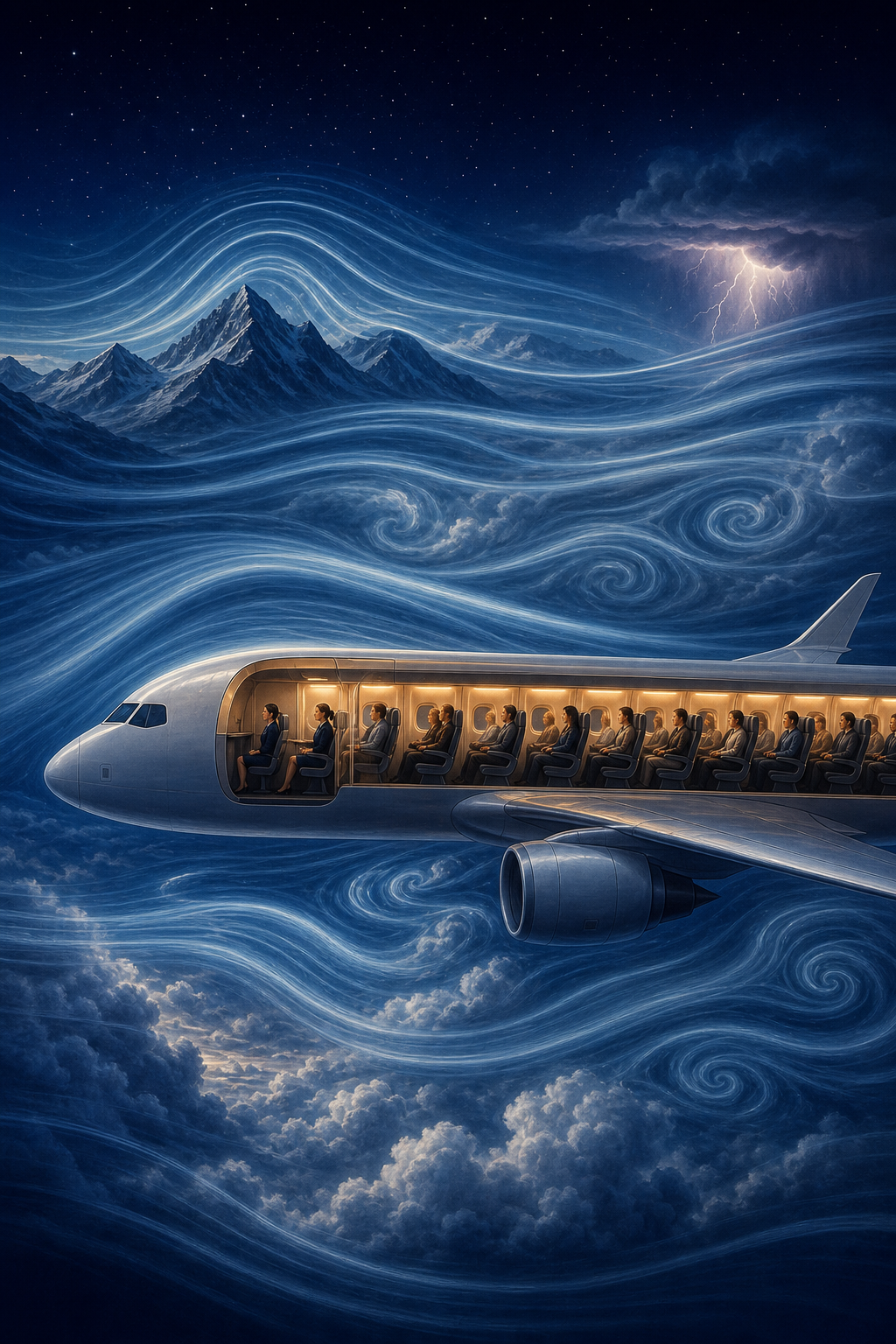
But turbulence is not an airplane plunging into an empty hole in the sky. There are no “air pockets” waiting like trapdoors. Turbulence is irregular motion in the air itself: changing wind speed, changing wind direction, and swirling eddies that make the aircraft move up, down, or sideways more abruptly than smooth air does.
An airplane is always moving through an atmosphere that is in motion. Most of the time, that motion is gentle enough that the ride feels nearly still. But the atmosphere is not a solid, uniform ocean. It is a constantly shifting fluid shaped by sunlight, terrain, fronts, storms, temperature differences, and fast-moving rivers of wind high above the ground. When an airplane passes from one moving stream of air into another, the ride can turn rough.
That distinction matters. The aircraft is not normally dropping because the air has disappeared beneath it. It is responding to forces in moving air. Sometimes the movement is so quick that your inner ear interprets it as a dramatic fall. Your stomach may lurch, even when the actual change in altitude is far smaller than your senses suggest.
Why does it feel so frightening? Partly because people are exceptionally sensitive to unexpected acceleration. We cannot see the disturbed air outside. We have no steering wheel, no direct view of the pilots’ instruments, and often no warning beyond a sudden jolt. A quick upward or downward acceleration changes the pressure between your body and the seat. Your brain reads that change as instability. The emotional reaction can be immediate, even when the flight crew has anticipated the rough air and the airplane remains under control.
There are several major ways turbulence forms.
One is convection: rising and sinking air driven by heating. On a sunny day, the ground does not warm evenly. Some surfaces heat the air above them more strongly than others, creating rising currents called thermals. These can make for a bumpy ride at lower altitudes, especially in warmer conditions. In and around thunderstorms, convection becomes much more powerful. Storms contain strong updrafts and downdrafts, and their influence can extend well beyond the visible cloud. That is why crews give thunderstorms generous space rather than simply trying to pass through a gap that looks harmless from a distance.
Another source is wind shear: a sharp change in wind speed or direction over a relatively short distance. Near jet streams, narrow bands of very fast winds high in the atmosphere, adjacent layers of air can move differently enough to generate turbulence. This is a common setting for clear-air turbulence, often called CAT. It can occur in clear skies, with no obvious cloud to point at. That makes it especially unsettling for passengers and especially challenging to predict perfectly.
Mountains can create another kind of invisible roughness. When strong wind flows across a mountain range, the air can be forced upward and then oscillate downstream in waves, much like water passing over a submerged rock. These mountain waves can extend far from the peaks and reach high altitudes. Under some conditions, distinct bands of clouds reveal the rising and sinking pattern. Under others, the waves are largely invisible.
Closer to the ground, wind flowing around buildings, trees, ridges, and other obstacles breaks into smaller, chaotic eddies. This is mechanical turbulence. It is one reason a breezy approach or departure can feel more active than a cruise at altitude.
Then there is wake turbulence, which is related but different. Ordinary atmospheric turbulence comes from the weather and the landscape. Wake turbulence is created by another aircraft. Every aircraft generating lift leaves behind two counter-rotating vortices trailing from its wings. They are organized swirling flows, not random rough air. A strong wake encounter can impose a rolling force on an aircraft that follows, which is why air traffic procedures and pilots pay close attention to spacing, flight path, wind, and the aircraft ahead—particularly during takeoff and landing. Wake vortices can be hazardous, and they deserve to be treated separately from the bumps caused by the atmosphere.
Pilots describe turbulence by intensity, and the words are more precise than they may sound in a passenger announcement.
Light turbulence means slight, erratic changes in the airplane’s attitude or altitude. You may feel a gentle strain against the seat belt, but service and walking are usually still manageable.
Moderate turbulence brings more definite changes. The bumps are stronger, and it can become difficult to walk or work safely in the cabin. This is often when the crew stops service and asks everyone to sit down.
Severe turbulence involves large, abrupt changes in altitude or attitude, with potentially substantial variations in airspeed. The airplane may be momentarily difficult to control.
Extreme turbulence is the most serious category. The aircraft can be violently displaced and may be impossible to control for a time. Structural damage is possible.
Those categories are a useful reminder that honesty matters. It would be wrong to say turbulence is always harmless. Severe or extreme encounters can be dangerous, and wake turbulence can be dangerous. Aircraft can require inspection after significant encounters. But the ordinary turbulence most passengers experience is not evidence that the airplane is coming apart or falling from the sky.
Modern transport airplanes are engineered for a dynamic environment. Their wings are meant to flex. In fact, some flexibility is part of how a wing distributes aerodynamic loads as air conditions change. Seeing a wing bend can look alarming through a window, but flexing by itself is not a sign of failure. It is a visible part of an aircraft doing the job it was designed to do.
The bigger immediate danger inside the cabin is often not the airplane’s structure. It is the sudden movement of people and objects.
The National Transportation Safety Board found that, in many airline turbulence accidents, serious injuries occurred without aircraft damage. People who are standing, walking to the lavatory, reaching into an overhead bin, or working in the aisle can be thrown before they have time to react. Flight attendants are particularly exposed because their work requires them to be upright during the very phases when an unexpected encounter may occur. Loose items can become hazards too.
That leads to the simplest and most effective passenger action: whenever you are seated, keep your seat belt fastened. Not tightly enough to be uncomfortable, but snug enough to hold you in place if the ride changes without warning. The seat-belt sign is important, and crew instructions should always be followed. But clear-air turbulence can arrive with little warning. A buckled belt is protection already in place.
Avoiding turbulence is a constant, layered effort. Before departure, airline dispatchers and pilots review forecasts, weather charts, reports from other aircraft, and the expected conditions along the route. In flight, crews receive updates from air traffic control, company operations, onboard systems, and other pilots. Pilot reports are valuable because they describe what crews are actually encountering at a particular place, altitude, and time.
Forecast tools also combine atmospheric models with observations from aircraft and weather systems. The goal is not merely to predict that turbulence might exist, but to estimate where it is likely, how intense it may be, and at what altitudes a smoother route might be available. That can lead to a route change, a different cruising altitude, a delay in beginning descent, or a request to air traffic control for a safer ride.
Weather radar is an important tool, especially around precipitation and convective storms. But it is not a magic detector for every type of turbulence. Clear-air turbulence may have no rain cloud for conventional radar to see. Forecasting it depends on understanding wind patterns and atmospheric structure, then improving the picture with reports and measurements from aircraft already flying through the region.
This is also why a pilot may say, “We expect some rough air ahead,” and then the ride is smoother than expected—or why a smooth forecast can still include a surprise bump. Aviation does not treat that uncertainty casually. It manages it through preparation, conservative decisions, shared information, procedures, training, and constant adjustment.
The wider safety system works the same way: identify hazards, collect data, learn from encounters, and turn that knowledge into better decisions before the next flight. Turbulence is a good example of aviation safety at work not as a single perfect prediction, but as many overlapping layers of protection.
So the next time the cabin shakes, remember what is happening. You are not crossing a hole in the sky. You are moving through an atmosphere alive with invisible currents. The feeling can be intense because your body is built to notice sudden motion. The risk is real enough to take seriously, especially for anyone unrestrained. And the best response is wonderfully simple: stay seated when instructed, keep that seat belt fastened whenever you are in your seat, and let the people trained to read the air do the work of finding the safest path through it.
The bumps may be invisible. The preparation behind them is not.