

Free text
ReWio Short
The hidden journey of sunlight through the atmosphere
The atmosphere performs the same trick every day: it turns the sky blue at noon, then can set the horizon on fire by evening. Nothing inside the Sun suddenly switches from blue to red. Nothing in the air is dyeing light like paint. A sunset is a changing journey of sunlight through the atmosphere—and a changing view from where you stand.
Start with sunlight. It may look white, but white sunlight contains a blend of visible colors. Those colors correspond to different wavelengths. Red and orange are toward the longer-wavelength end of visible light; blue and violet are toward the shorter-wavelength end.
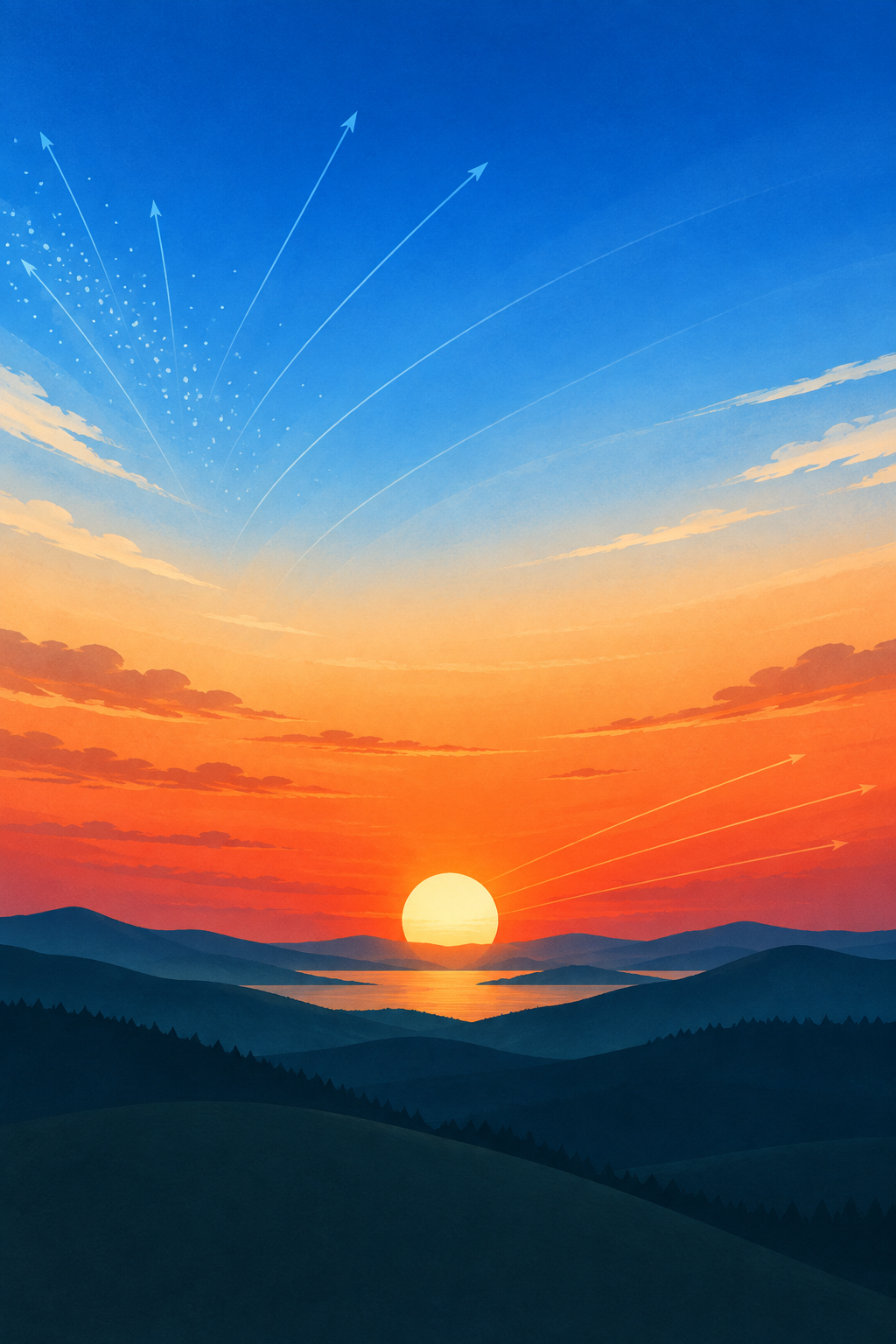
As sunlight enters Earth’s atmosphere, it encounters tiny gas molecules, mainly nitrogen and oxygen. These molecules scatter light: they redirect some of it away from its original path. They scatter shorter visible wavelengths much more effectively than longer ones. That process is called Rayleigh scattering.
During the day, when the Sun is high, blue light is scattered in many directions across the sky. Look away from the Sun, toward a clear patch overhead, and some of that scattered blue light enters your eyes from every direction. That is why the sky appears blue.
It is not a reflection of the ocean. The ocean can look blue for its own optical reasons, but the daytime sky would still be blue above a continent, a desert, or a planet-wide cloud deck, as long as the atmosphere scattered sunlight in the same way.
But if violet is scattered even more strongly than blue, why is the sky not violet? Ozone is part of the broader story of how sunlight is filtered, but it is not the complete answer. The Sun’s incoming light is not equally intense at every visible color, and human vision is much more sensitive to blue than violet. The blue scattered light therefore makes the stronger visual impression.
Now bring the Sun down toward the horizon. At midday, sunlight arrives on a relatively direct route through the atmosphere. Near sunset, it reaches you along a far more slanted path. That longer path means the light has many more opportunities to encounter air molecules.
More blue and violet light is scattered out of the direct beam between the Sun and you. Some is redirected elsewhere in the sky. The beam that continues toward the horizon and your eyes is consequently depleted in those shorter wavelengths. Orange, yellow, and red become a larger share of what remains visible in the direct sunlight.
That wording matters. Blue photons are not turning into red photons. The Sun itself has not changed color. The atmosphere is selectively redistributing light, changing the mix that survives along your particular line of sight.
Here is an analogy—but only an analogy. Imagine a crowd leaving through several exits, where the quickest walkers are repeatedly diverted into side corridors. The people remaining in the main corridor are not transformed into slower walkers; the balance changes because the quicker group was redirected more often. In the real atmosphere, light is not a crowd and colors are not people. But the idea of selective removal from the direct path is useful.
Direction matters enormously. The strongest warm colors often appear near the horizon in the direction of the setting Sun because that is where you are looking through the long, filtered beam. Yet the whole sky can participate. Farther from the Sun, you may see pink, purple, or pale gold, produced by a complicated mix of scattered light, viewing angle, clouds, and particles in the air.
Clouds can turn a good sunset into a remarkable one. A cloud is not simply white at all times. Near sunset, a cloud positioned to receive sunlight can be illuminated from below, because the low Sun’s rays travel beneath or around the cloud layer before reaching its underside. Those cloud bases can glow orange, red, or rose against a darker sky.
Other clouds look charcoal gray or nearly black because they are in shadow. If a cloud blocks the sunlight that would otherwise illuminate it, there is much less light coming from that cloud toward you. A dark cloud beside a glowing one is not necessarily made of darker material. It may simply be receiving far less light.
Then there are aerosols: tiny airborne particles such as dust, sea salt, smoke, and pollution-related particles. They can alter sunset colors because they scatter light differently from individual gas molecules. Under some conditions, aerosols can help produce rich warm colors, especially when sunlight travels a long route near the horizon.
But more pollution does not automatically mean a prettier sunset. Thick haze can dim the Sun, blur contrast, and mute the colors into a flat, washed-out glow. Smoke can create dramatic scenes, but it can also block so much light that the sky loses its brightness and detail. And clean air is not boring: it can produce exceptionally vivid sunsets, especially when the geometry, moisture, and cloud placement cooperate. There is no single ingredient called “better sunset.” It is a balance.
This is also why sunsets are hard to predict from one glance at the afternoon sky. A nearly cloudless evening may offer a clean, intense band of color near the horizon. A well-placed layer of broken clouds may catch the last sunlight and spread color across a much wider canvas. A solid cloud bank can hide the show entirely. The atmosphere is not just a filter; it is a shifting, three-dimensional scene.
What about the old saying, “Red sky at night, sailor’s delight; red sky in morning, sailor take warning”? It has a limited basis in regions where weather systems commonly move from west to east. In those places, a red sunset toward the west can sometimes be associated with clearer, drier conditions approaching. A red sunrise in the east can sometimes suggest that those conditions have already passed and a wetter system may be on its way.
But it is not a universal forecast. Winds, pressure systems, coastlines, mountains, seasons, and latitude all matter. In the tropics, prevailing wind patterns differ. Local weather can change the outcome quickly. Treat the saying as a clue tied to particular weather patterns, not a reliable prediction rule for every place.
The best way to watch a sunset is also the simplest: look at the broad sky, the clouds, and the changing landscape. Avoid staring directly at the Sun, especially while it is still bright, and never use binoculars, telescopes, or cameras without proper solar protection. The most interesting colors are often around the Sun, not in the Sun itself.
So the next time the horizon glows, remember what you are seeing. Daytime blue and sunset red are not opposite mysteries. They are two views of the same atmosphere, sorting sunlight by wavelength and sending different parts of that light along different paths. The sunset is not the Sun changing. It is the air revealing the journey light had to take to reach you.