

Free text
ReWio Short
The hidden route sound takes through your skull
Introduction.
You press play on a voice note you sent five minutes ago—and for a split second, you wonder who is speaking. The voice may sound thinner, brighter, more nasal, or simply less like “you.” Then comes the familiar reaction: Is that really my voice?
Yes. But it is not the same version of your voice that you normally experience while speaking.
That distinction matters. A recording is not a cruel reveal, and your everyday inner version is not an illusion. They are two different listening situations. When you speak, your brain receives a rich package of sound, vibration, movement, and expectation. When you hear a recording, it receives a sound signal delivered by a device in a room, through speakers or headphones. The gap between those experiences is large enough to feel personal.
Air and Bone.
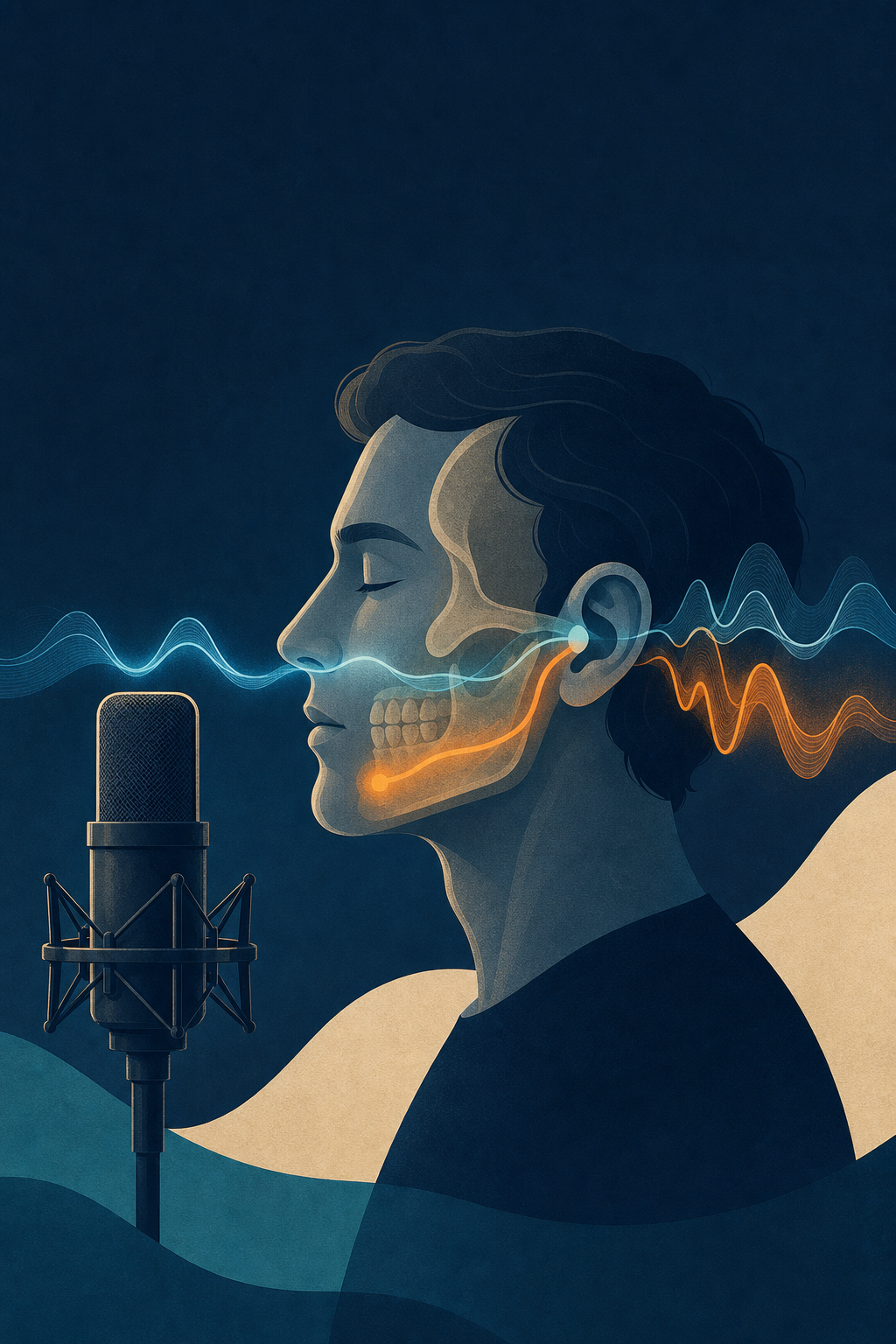
Start with the path sound takes. When you talk, some of the sound leaves your mouth, moves through the air, and reaches your outer ears. This is air conduction—the route other people mainly receive when they hear you speak.
But your voice also travels inward. Speaking creates vibrations that move through soft tissue and the bones of the head. That bone-conducted pathway contributes auditory and vibration-related information that is present while you are producing speech. It changes the physical signal reaching your hearing system and adds a bodily sensation that an ordinary recording does not contain.
Research on self-voice perception describes this as more than a technical footnote. Natural self-voice is fundamentally multimodal: it includes air-conducted sound alongside bone-conducted and vibrotactile cues. In experiments using voice morphs, adding bone-conduction stimulation improved people’s ability to distinguish their own voice from another person’s voice. The same advantage was not simply a general boost for recognizing any familiar voice. It was especially relevant to recognizing oneself.
That helps explain why playback can feel so disorienting. The recording carries mostly the air-conducted part of the event. It leaves out the internal vibration cues that have accompanied your speech for your entire life.
What Actually Changes.
People often say, “My real voice is deeper than the recording.” That can point toward something real, but it is easy to turn it into an oversimplified myth. Bone conduction is associated with relatively stronger low-frequency information in the self-voice experience, which can contribute to a fuller or lower-sounding impression. Yet it does not mean bone conduction lowers every person’s pitch in a simple, identical way.
It also helps to separate a few terms that are often bundled together.
Pitch is the quality that lets you hear a voice as higher or lower. Timbre is its texture or color—the difference that lets a flute and a violin play the same note yet sound unlike each other. Resonance refers to how the vocal tract and surrounding spaces emphasize parts of the sound. Familiarity is different again: it is the feeling that a voice belongs to someone you know, perhaps most importantly, yourself.
A recording can alter your impression in all of these areas without changing your identity as a speaker. You may notice pitch differently. You may hear less of the low-frequency richness you associate with speaking. And a change in timbre can make the same voice feel surprisingly foreign, because timbre carries so much of a voice’s recognizable character.
The microphone itself also matters. A microphone is not an ear, and it is not a neutral window into reality. Its distance from your mouth, its angle, its frequency response, and the room around you all shape the captured sound. Close placement can emphasize some qualities. A reflective room can add echoes and coloration. Automatic noise reduction or compression can smooth, sharpen, or flatten details. The speaker in a phone, a laptop, a pair of earbuds, or a studio headset then changes the result again.
So a recording is not exactly what everybody else hears. Other listeners hear your air-conducted voice, yes, but they hear it from their own position, in a particular room, through their own hearing. A recording is another version: useful, often revealing, but never the sole final verdict.
The Prediction Inside Speech.
There is another reason the mismatch feels bigger than a mere change in audio quality. Speaking is an action. Before and during speech, the brain does not wait passively for sound to arrive. It uses speech motor commands to predict the sensory consequences of what you are about to say, then compares expected feedback with incoming feedback.
Research on speech self-monitoring shows that when feedback matches prediction, the brain’s response to that normal feedback can be reduced. When the feedback deviates, the system produces a stronger response that reflects the mismatch. This is part of how speech remains adjustable in real time. You can notice when a word comes out oddly, when your voice cracks, or when you are speaking too loudly in a quiet room.
A recording disrupts the usual arrangement. You are no longer making the movements that create the sound. The timing is different. The sound arrives from outside your body. And the internal vibration information that normally accompanies your speech is absent. Your listening system is receiving something related to your voice, but outside the package it has learned to treat as self-generated.
This does not mean your brain is literally mistaking the recording for a stranger every time. Often you know immediately that it is you. But recognition and familiarity are not the same experience. You can identify the speaker while still feeling that the voice does not match the deeply learned internal template of “me speaking.”
Self, Memory, and Recognition.
Your voice is unusual because it is both a sound and a signature of the self. It is linked to memories of conversations, emotional moments, habits of expression, and the ordinary physical act of forming words. Studies of self-other voice discrimination suggest that self-recognition depends on both acoustic information and familiarity. A voice can be acoustically close to yours, yet the social familiarity of the comparison voice can also make the judgment more difficult.
Brain-recording research adds another layer. In a self-other voice task, researchers identified a pattern of brain activity that was specific to processing one’s own voice. Its occurrence was related to task performance and was affected by bone-conduction stimulation. That does not provide a single, complete map of identity. But it supports the broader idea that self-voice recognition is not just a matter of measuring sound frequencies. It involves how the brain connects voice cues to a representation of the self.
That representation can adapt. In controlled experiments, prior exposure to a person’s own unaltered recording improved performance on a later task that required distinguishing self from other voices. The likely lesson is modest but useful: repeated listening can make a recorded version of your voice easier to recognize and work with. It does not erase the difference between speaking and playback. It gives your brain more experience with this particular external version.
Why the Reaction Feels So Personal.
Disliking a recording is not proof of insecurity, vanity, or poor confidence. It can be a normal response to unfamiliarity and mismatch. You are hearing a familiar identity through an unfamiliar route.
Of course, recordings can also reveal things worth improving. Maybe your words rush together. Maybe your volume drops at the end of a sentence. Maybe a room makes you hard to understand. But those are communication observations, not a verdict on whether your voice is acceptable.
The most useful question is not, “Does this sound like the voice in my head?” It may never match perfectly, because the voice in your head is built from sound plus bodily vibration plus the act of speaking. A better question is, “Can people understand me, and does my voice carry what I mean?”
Listening More Wisely.
If you want recordings that are more helpful, make the comparison fair. Record in a reasonably quiet, non-echoey room. Keep the microphone at a consistent, sensible distance rather than pressing it right against your mouth or leaving it far across the room. Make several short recordings in different situations. Listen through more than one playback device if you can.
Then listen repeatedly. The first playback often produces the strongest sense of surprise. Give familiarity time to catch up. Notice practical features: clarity, pace, articulation, volume, warmth, and whether your message lands as intended. If you are preparing a presentation, a podcast, a lesson, or an important conversation, those are qualities you can adjust.
And resist chasing one supposedly true sound. There is no single microphone, room, or speaker that captures every aspect of your voice. There is the voice you experience while speaking, the voice others hear in person, and the many recorded versions created by particular tools and spaces.
Final Summary.
Your recorded voice sounds strange because speaking normally lets you hear yourself by two routes: through the air and through vibration in tissue and bone. It also ties sound to movement, prediction, and a lifetime of self-recognition. A recording removes much of that internal context and replaces it with a device-shaped air signal.
That surprise is not evidence that something is wrong with your voice. It is evidence that your voice is more than a sound file. The next time a voice note makes you ask, “Who is that?” remember the answer: it is you—heard from the outside.