

Free text
ReWio Short
The hidden chemistry of soil, microbes and tiny bubbles
The next time rain begins after a dry spell, pause before you look up. That rich, earthy smell arriving on the breeze is not really the scent of water falling from the sky. In a very literal sense, it is the ground answering back.
We call this familiar smell petrichor. The word sounds as if it ought to name one rare chemical, tucked inside every raindrop. But petrichor is not a single molecule, and rainwater itself does not come preloaded with a universal rainy fragrance. It is a changing mixture of airborne compounds released when rain strikes dry surfaces. The recipe depends on what is underfoot, how long it has been dry, what grows there, and how the rain arrives.
Think of a dry landscape as a cupboard full of scents with the doors closed. Soil, rocks, leaves, roots, and microbes have all contributed something. The first rain does not create those ingredients from nothing. It helps open the cupboard and sends some of its contents into the air.
One major ingredient is geosmin, a compound with an unmistakably earthy character. Geosmin is made by soil microorganisms, including members of the bacterial genus Streptomyces. Streptomyces are common residents of soil, where they help break down organic material. Their name may be unfamiliar, but their handiwork is not. That damp-earth aroma in a garden, on a forest trail, or beside a freshly turned field often carries geosmin’s signature.
But geosmin is only part of the story. Dry ground can also hold plant-derived oils and residues. During dry periods, compounds associated with vegetation can accumulate on surfaces such as rocks, soil particles, and pavement. When rain arrives, those materials can contribute to the overall scent. This is why petrichor is best understood as a blend: more like a soup made from local ingredients than a perfume made from one bottle.
The truly elegant part is how that blend gets from the ground to your nose.
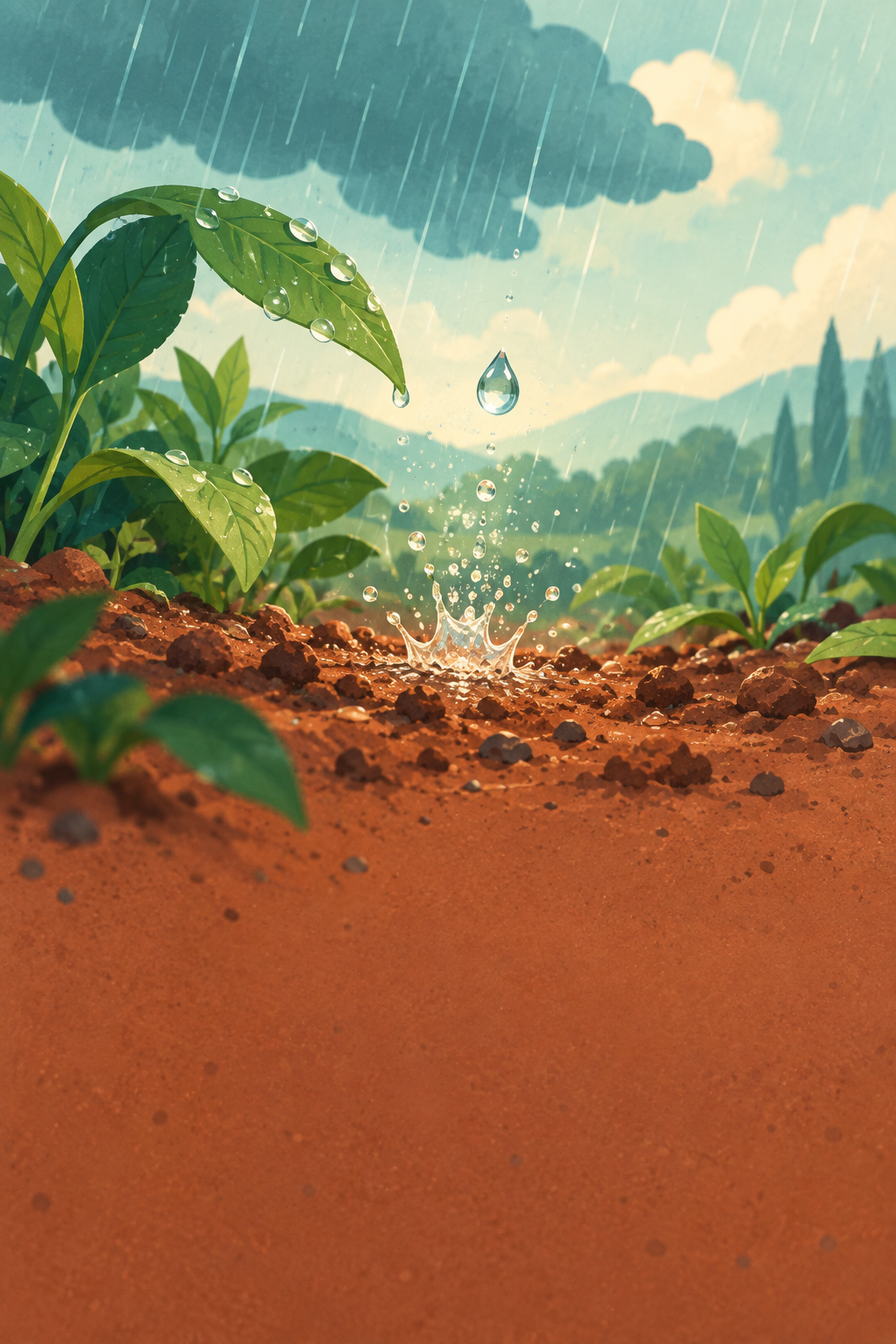
A raindrop strikes a porous surface — loose soil, sand, clay-rich ground, or weathered pavement with tiny spaces and textures. At impact, the drop spreads outward. In the same instant, tiny pockets of air can become trapped beneath it. Those bubbles rise through the drop and burst at its surface, releasing a spray of microscopic droplets into the air. Scientists call those suspended droplets aerosols.
Here is an analogy, not the literal mechanism: imagine pressing a sponge into a shallow dish of water. Tiny pockets of air escape and pop at the surface. With rain, the event happens far faster, on a much smaller scale, and again and again across the ground. Each bursting bubble can help loft minuscule droplets containing material from the surface or soil. Air currents can then carry those droplets — and the molecules associated with them — toward you.
High-speed imaging has made this invisible process easier to see. A raindrop impact can produce a brief, busy cloud of aerosols. The bubbles form, grow, and burst in tiny fractions of a second. What seems peaceful from beneath an umbrella is, at ground level, a rapid series of microscopic splash-and-launch events.
This also explains why the first light rain can sometimes smell stronger than a downpour. Light or moderate rain often creates conditions that favor aerosol release from porous ground. The drops have enough energy to interact with the surface, but not so much that the process is overwhelmed by fast, forceful impacts and rushing water. Very heavy rain can quickly soak the ground, wash material downward, and change the surface conditions. The delicate bubble-making process is not necessarily as effective then.
Porous ground matters for the same reason. A raindrop landing on dry, crumbly soil encounters lots of tiny gaps that can hold air. A dense, smooth, already-wet surface offers a different stage for the impact. That is why a shower over a dusty garden may smell strikingly earthy, while rain on a downtown street may smell more like wet concrete, asphalt, vegetation in curbside planters, and whatever else has collected on the city’s surfaces.
Place changes petrichor. A forest after a dry week may release notes shaped by leaf litter, fungi, moss, and rich organic soil. A desert storm may awaken dust, sparse vegetation, and sun-baked rock. A farm field may have its own mix of soil minerals and plant material. Coastal air can mingle with salt and marine odors. Even two neighborhoods only a few miles apart can smell different after rain, because their surfaces and living communities are different.
Timing changes it too. A brief shower after a long dry period can mobilize compounds that have been sitting near the surface. Rain after several wet days may offer a softer, less dramatic contrast because the ground has already been rinsed and dampened. Temperature, wind, humidity, the size and speed of drops, and how quickly the soil absorbs water all help shape what reaches your nose.
Then there is another smell people sometimes associate with rain: a sharp, clean, almost electric scent before a storm. That is different from petrichor.
In some storm conditions, ozone can be produced high in the atmosphere by electrical activity. Ozone is a molecule made of three oxygen atoms. Strong downdrafts may bring ozone-rich air closer to the ground, where some people notice its pungent smell. But that pre-storm edge is not guaranteed. Not every storm produces noticeable ozone near you, and not every smell before rain is ozone. Wind may simply be carrying scents from wet ground far away, vegetation, dust, or the changing air around an approaching weather system.
So smell is not a reliable weather forecast. It can hint that rain has arrived nearby, or that air is moving in from a rain-soaked area, but it cannot tell you exactly when a storm will begin, how severe it will be, or whether thunder and lightning are coming. For that, look to weather alerts and forecasts, not your nose.
And one important caution: an earthy smell after rain is not proof that nearby water is safe to drink. The aerosols involved can carry natural materials from soil, but landscapes can also contain pollutants, pathogens, or chemicals. A pleasant scent says something about molecules reaching the air. It says nothing dependable about the quality of water in a puddle, stream, roof runoff, or reservoir.
Petrichor is often described as the smell of rain. That shorthand is understandable, but it misses the wonder. Rain is the messenger, not the message. The real source is a quiet partnership between dry earth, living microbes, plant material, trapped air, and the physics of a falling drop.
A storm does not merely wet the world. For a moment, it turns the landscape into an aerosol maker — lifting a local history of soil and life into the air. And when you catch that earthy breath after the first drops fall, you are not smelling rain itself. You are smelling the ground, briefly made airborne.