

Free text
ReWio Short
The hidden chemistry behind a familiar kitchen mystery
The first slice is usually quiet. A knife touches the glossy curve of an onion, the papery skin rustles, and the kitchen smells suddenly sharper—green, sweet, and almost metallic. Then, perhaps halfway through dicing, your eyes begin to sting. You blink. The sting becomes a flood. It can feel strangely personal, as if this small vegetable has picked a fight with you.
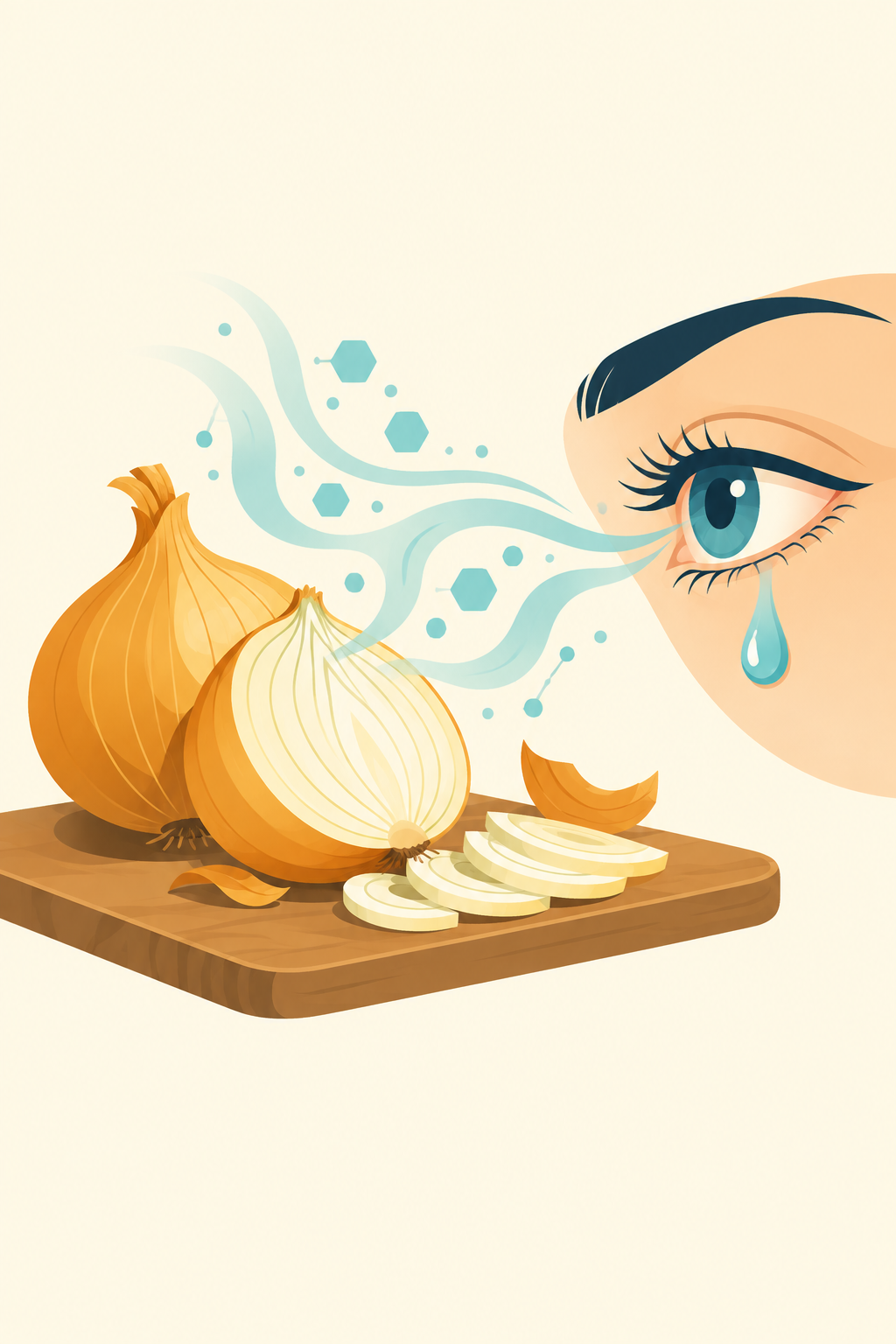
But the onion is not sending sadness into the room. It is setting off a compact chemical alarm, one that stays carefully contained until its cells are broken.
An intact onion is a layered package of water, sugars, flavor-building materials, and sulfur-containing chemical precursors. Think of those precursors as ingredients stored in one part of a tiny cellular kitchen. Another ingredient, an enzyme called alliinase, is kept apart from them. Enzymes are proteins that help chemical reactions happen quickly. They do not need to be mysterious. In this story, alliinase is simply a molecular tool that works when the onion’s internal compartments are torn open.
That separation matters. While the onion is whole, the stored materials and the enzyme are largely prevented from meeting. Bite marks, crushing, or a knife blade change that. Cells rupture. Fluids mingle. Alliinase begins transforming the sulfur-containing precursor into a short-lived reactive intermediate.
If that sounds like a lot of chemistry for dinner, picture a sealed two-part packet. One side holds a starting material. The other holds the activator. The packet is harmless while sealed. Tear it open, mix the contents, and a new reaction begins. Chopping an onion performs that tear-open step again and again, cell after cell.
For a long time, the familiar explanation stopped there. Scientists thought alliinase alone set the tear-inducing chemical on its path, with the final change happening by itself. That was a reasonable early model, but it was incomplete.
Researchers later identified a second onion enzyme with an unusually direct name: lachrymatory-factor synthase. “Lachrymatory” means tear-causing. This enzyme helps turn the reactive intermediate made after alliinase acts into the onion’s main tear-inducing compound, propanethial S-oxide.
That correction is more than a trivia upgrade. It changes the shape of the story. Alliinase starts the chain after injury. Lachrymatory-factor synthase guides a key next conversion. The final tear-inducing molecule is a small, volatile sulfur compound. It is the compound that can reach your eyes—not the synthase enzyme itself. The enzyme does its work in the disrupted, wet onion tissue. It is a worker at the source, not a tiny airborne messenger flying across the cutting board.
Imagine two cooks making the same soup. In one kitchen, Maya splits an onion neatly with a sharp chef’s knife and makes deliberate downward cuts. In another, Jordan presses a dull blade through the onion and rushes, squashing layers before the blade gets through them. Both onions have the same basic chemical system. Both can make their cooks cry. But the physical way the onion is cut can affect how much material is sent outward from the damaged layers.
That physical part is important because chemistry tells us what is produced, while mechanics helps explain how it spreads.
Recent peer-reviewed work from Cornell examined onion cutting with high-speed imaging. The researchers captured tiny droplet outbursts from cut onion layers. As a blade presses into a layer, pressure can build beneath its surface. When that surface gives way, small droplets can burst out as a mist. In their experimental setup, sharper blades and slower, more controlled cuts reduced the spray compared with blunter blades and faster cutting.
That does not mean a sharp knife is a magical anti-tear device. It does not promise dry eyes with every onion, every cutting style, or every kitchen. And it is not a clinical trial proving every popular onion trick. It is a useful observation about the mechanics of cutting: less crushing and less abrupt pressure can mean less droplet spray under the conditions studied.
The droplets are only part of the journey. Propanethial S-oxide is volatile, meaning it can readily move from the onion material into the surrounding air. It may travel in air near the cutting board and may also be associated with the fine material released during cutting. A nearby face, leaning directly over the onion, sits in the path of that exposure.
Now the eye responds exactly as an eye should. The surface of your eye is exquisitely sensitive. When the irritant reaches it, sensory nerves register trouble. Signals prompt the tear system to produce reflex tears. Those tears dilute and wash away the irritant from the eye’s surface.
So crying over an onion is not an emotional failure, and it is not because sulfuric acid forms in your eyes. That popular claim is wrong. The immediate event is irritation from propanethial S-oxide, followed by the body’s protective tear response. The tears are cleanup.
There is a neat irony in all this. The onion’s storage strategy is protective for the plant because its potent sulfur chemistry is activated when tissue is damaged. For the cook, that same damage is unavoidable: the goal is often to cut the onion into pieces. The question is not whether the onion’s internal chemistry can be persuaded to remain entirely asleep. Once you cut, you have begun the process. The practical question is how to limit what reaches your eyes.
The simplest options are physical, not theatrical. Use a sharp knife that you can handle safely, and cut with measured, controlled motions rather than crushing through the onion. Keep your face back from the board instead of hovering over the cut surface. Good ventilation can help reduce the concentration of irritant around your workspace: an exhaust fan, open window, or gentle airflow directed away from your face may be useful.
If onions reliably make cooking miserable, eye-protecting goggles are the most straightforward answer. They create a physical barrier between the irritant and your eyes. They may look more at home in a workshop than beside a skillet, but the principle is solid and uncomplicated.
Consider another illustration. Sam is making a large pot of chili for friends and needs several onions. Rather than treating watery eyes as an inevitable kitchen ordeal, Sam sharpens the knife before starting, turns on the range hood, works steadily, and wears clean, close-fitting protective goggles. The onions still release their chemistry when cut. The room may still smell pungent. But much less reaches the eyes.
And that is the real lesson hidden inside the tears. An onion is not a single chemical bomb, and tears are not caused by a single simple event. First, cutting breaks cellular boundaries. Then separated ingredients meet. Alliinase begins the reaction sequence. Lachrymatory-factor synthase helps create propanethial S-oxide. That volatile irritant escapes from damaged onion material, including the fine spray produced by cutting. Finally, your eyes answer with tears to clear it away.
The next time an onion makes you cry, remember what is happening: you are watching a plant’s hidden compartments become a kitchen-scale chemical alarm. Meet it with a sharp blade, calm cuts, moving air, and, when needed, a pair of goggles. The onion may still have its alarm. But you can choose how close you stand when it goes off.