

Free text
ReWio Short
Blue blood and the remarkable engineering of an ocean mind
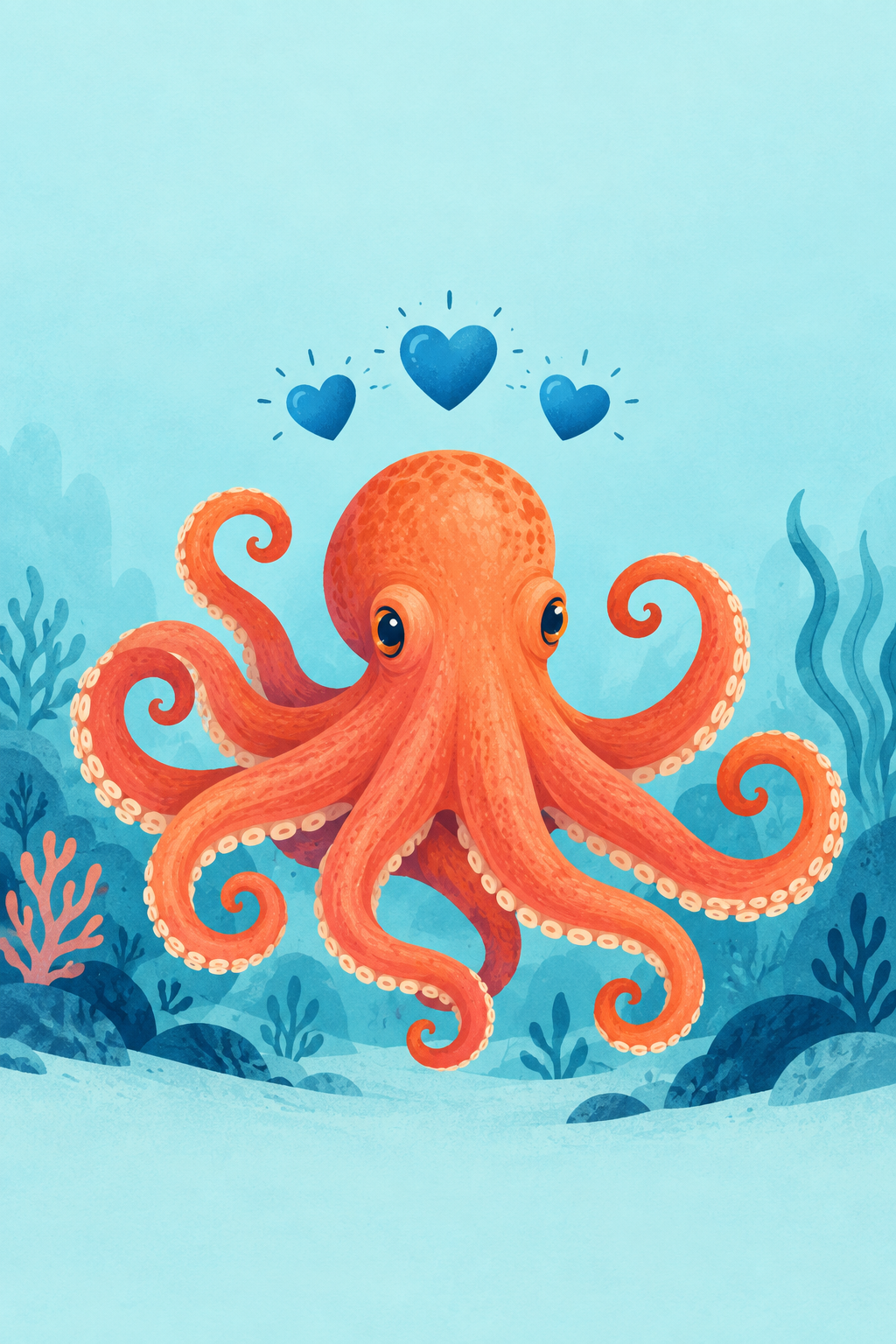
An octopus has three hearts, and its blood can look blue. That sounds like the opening line of a sea monster story. It is not. It is a precise piece of living plumbing, built around the challenge of pulling oxygen from water and delivering it to a body that can crawl, camouflage, squeeze through cracks, and occasionally blast away on a jet of water.
Start by following one tiny drop of octopus blood.
It has just returned from the body. Its oxygen supply has been used by working tissues, including the muscles of the mantle and arms. The drop travels back through blood vessels toward the gills. Unlike the blood of many other molluscs, octopus blood stays inside a network of vessels. This is called a closed circulatory system. It allows blood pressure to be directed and controlled more tightly, but it also means the system must keep overcoming resistance along the route.
Before this oxygen-poor drop reaches either gill, it meets one of two branchial hearts. Branchial simply means related to gills. Each of these hearts serves a particular side of the animal, pushing blood through one gill. They are not two backup pumps waiting politely in case the main heart fails. They have a different job, at a different point in the circuit.
Why put pumps before the gills? Because gills are wonderful exchange surfaces, but they are not effortless passageways. Their fine, folded tissues create a large area where blood and seawater come very close together. That closeness is exactly what makes gas exchange possible. Yet sending blood through countless narrow vessels and thin layers costs pressure. Like water losing force as it is pushed through a dense shower head, blood loses pressure as it crosses the gill circulation.
The two branchial hearts provide an extra push into that difficult part of the route. They deliver oxygen-poor blood to the gills under pressure. On the other side of the gills, the blood has changed.
Seawater contains oxygen dissolved between its molecules. As water moves across the gill surfaces, oxygen diffuses into the blood, moving from where it is more available to where it is less available. At the same time, carbon dioxide can move in the opposite direction. Diffusion is not an octopus choosing to inhale through its blood. It is a physical process, guided by differences in concentration and pressure across an extraordinarily thin boundary.
But oxygen does not travel efficiently through a body merely by dissolving in fluid. It needs a carrier. In us, that carrier is hemoglobin, a protein containing iron. In octopuses and many other molluscs and arthropods, the carrier is hemocyanin, a protein containing copper.
That chemical difference changes the color. When hemocyanin binds oxygen, its copper-containing sites give the oxygenated blood a blue appearance. When it has released much of that oxygen, hemocyanin is nearly colorless. The blue is not dye, and it is not the same thing as a human vein appearing bluish through skin.
Human blood is never truly blue. Blood returning to our heart in veins is darker red than oxygen-rich arterial blood, but it is still red because hemoglobin remains red in both states. Veins can look blue through skin because light travels, scatters, and is filtered by skin and tissue before reaching our eyes. An octopus’s blue blood is chemistry in the circulating fluid itself.
Now our drop has crossed the gill, picked up oxygen, and become part of that blue oxygenated flow. It enters the third heart: the systemic heart. Systemic means serving the body as a whole. This heart sends oxygenated blood out through major vessels to the brain, mantle, digestive organs, skin, and all eight arms.
That division of labor is the point of having three hearts. Two branchial hearts handle the pressure-demanding trip through the gills. One systemic heart drives blood onward through the body. Three specialized pumps do not mean three interchangeable spare hearts. Think less of three identical engines and more of a relay in which each stage prepares the flow for the next.
It would be tempting to declare hemocyanin either better or worse than hemoglobin. Nature is rarely that tidy. The performance of an oxygen carrier depends on conditions, including temperature, acidity, and the species using it. Experiments on octopus hemocyanin show that oxygen binding can be strongly affected by pH, and temperature also changes how the system behaves. Different octopuses occupy different environments, from shallow coastal waters to deep seas, from cooler regions to warmer ones. Blue blood is not a universal badge of deep, freezing water.
The body around this circulation is equally dynamic. An octopus can move by crawling, using its arms to pull, probe, and push across the seafloor. It can also use jet propulsion. Muscles in the mantle draw water into the mantle cavity, then contract to force it out through the siphon, sending the animal in the opposite direction. It is an impressive escape mechanism, but it creates a physiological complication.
A widely repeated claim says that an octopus’s hearts stop whenever it swims. That is too broad. In research on freely moving common octopuses, pauses in the systemic heartbeat were observed during forceful jet propulsion. The proposed explanation was mechanical: high pressure in the mantle during a strong jet can interfere with blood returning to the systemic heart. A heart cannot pump effectively if it is not being refilled.
That observation should not be inflated into a rule for every octopus species, every swimming movement, or every flick of the siphon. Nor does it mean an octopus becomes instantly helpless whenever it leaves the bottom. It shows how a powerful escape jet can briefly compete with the circulation that keeps the body supplied. Crawling and jetting are not simply slow versus fast; they place different demands on the same animal.
Even the arms reveal a version of this distributed design. Octopus arms contain substantial local neural circuitry, allowing them to handle immediate sensing and movement while remaining connected to the central brain. That does not make each arm an independent conscious brain. It means control is shared across a body that must coordinate eight flexible, constantly changing limbs.
Then there is the skin. Beneath it sit chromatophores, tiny pigment sacs controlled by muscles and nerves. When the sacs expand, their colors become more visible; when they contract, the color recedes. Together with reflective cells and changes in skin texture, this lets an octopus rapidly alter its appearance for camouflage and communication. Again, it is not magic. It is fast, fine-grained body control.
So the strange truth is more interesting than the viral version. Three hearts are not extravagance. Blue blood is not a fantasy detail. The gill hearts, the systemic heart, the copper-based oxygen carrier, the flexible arms, and the muscular mantle all belong to one demanding reality: an active marine animal must keep oxygen moving while its body changes shape, direction, color, and pressure.
An octopus is not primitive because its system differs from ours, and it is not magical because it seems unfamiliar. It is a reminder that life does not solve every problem with one blueprint. Sometimes, to understand an animal, you only need to follow a drop of blood—and discover that even a heartbeat can take an unexpected route.