

Free text
ReWio Short
How tides trade Earth’s spin for lunar distance
Here is a fact strange enough to change the way you look at the night sky: the distance between Earth and the Moon changes by an amount we can measure within a human lifetime.
The Moon is moving away from us at roughly four centimetres each year. That is about the pace at which fingernails grow. It sounds tiny, because it is tiny. Yet across many decades, the change adds up to several metres. And scientists do not infer it from a vague celestial hunch. They measure it with pulses of laser light.
So why is the Moon leaving? Is it a threat to eclipses, tides, or life on Earth? And how can an object hundreds of thousands of kilometres away be tracked closely enough to reveal a change smaller than the width of a hand?
The answer begins with tides.
When people hear that the Moon causes tides, they usually picture seawater rising along a beach. That is part of the story, but not all of it. The Moon’s gravity pulls differently on the near side and far side of Earth, creating tidal distortions. Earth’s oceans respond dramatically because water can flow. But the solid Earth also flexes, very slightly, under the Moon’s pull.
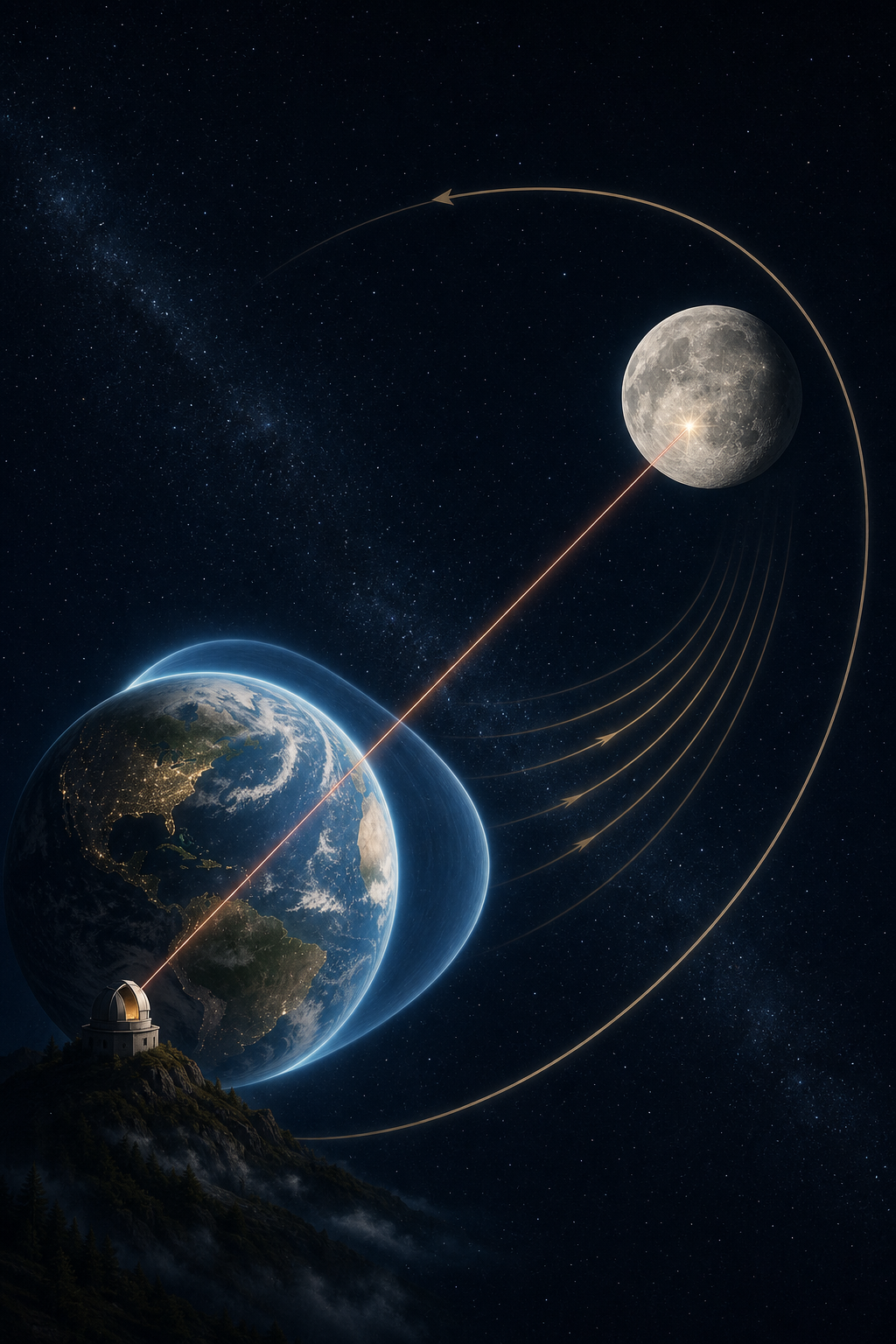
If Earth did not rotate, those tidal bulges would line up more simply with the Moon. But Earth spins much faster than the Moon travels around it. A day on Earth passes far sooner than one lunar orbit. As Earth turns beneath the Moon, friction in the oceans, along coastlines, and within Earth’s materials prevents the tidal bulges from responding instantly. The most prominent part of the tidal pattern is carried a little ahead of the Earth–Moon line.
That small offset matters enormously.
The bulge ahead of the Moon has gravity of its own. Its pull gives the Moon a subtle forward tug along its orbit. A forward tug adds orbital angular momentum. The Moon responds not by plunging outward in a straight line, but by settling into a slightly wider orbit around Earth.
Angular momentum has not appeared from nowhere. Earth pays the bill.
As the Moon is pulled forward, it pulls back on the offset tidal bulge. That braking influence takes a minute amount of rotational angular momentum from Earth. Earth’s spin gradually slows, while the Moon’s orbit gains angular momentum and expands. It is a long, ongoing trade: a little of Earth’s rotation, exchanged for a little more lunar distance.
The energy involved is not perfectly preserved as neat orbital motion. Tidal friction turns part of it into heat, especially through the movement and stirring of ocean water. The system is therefore not a frictionless clockwork. It is a slow transfer with losses along the way.
NASA describes the present recession as about an inch and a half, or about four centimetres, per year. That modern rate is real, but it is crucial not to treat it like a permanent setting on a machine.
Earth’s oceans have not always had their current shape. Continents shift. Seaways open and close. Coastlines, ocean basins, water depth, ice, and the details of tidal flow all change. Those changes can alter how effectively tides dissipate energy. The solid Earth changes too. So the Moon’s history cannot be reconstructed by simply multiplying today’s roughly four centimetres per year by billions of years. The rate has varied, and it will continue to vary.
How do we know the Moon is receding at all?
The most direct long-running method is lunar laser ranging. It should not be confused with using a laser to track a spacecraft orbiting the Moon. That is a related but different technique.
For lunar laser ranging, observatories on Earth send extremely brief pulses of light toward retroreflector arrays sitting on the lunar surface. A retroreflector is built to send incoming light back toward its source. The arrays placed on the Moon during Apollo missions, along with reflectors delivered by Soviet lunar missions, gave scientists durable targets on the lunar surface. Newer lunar retroreflectors add to that capability.
A detector on Earth records the faint returning light. Scientists measure the round-trip travel time: out to the reflector and back again. Since light travels at a known speed, that travel time reveals the distance.
This sounds simple in principle. In practice, it is extraordinarily demanding. The beam spreads as it crosses space. Earth’s atmosphere scatters light. The return signal is tiny. The Moon is rotating and moving, Earth is rotating and moving, and the reflector arrays are not all at the same location. Researchers must account for orbital motion, the shapes and orientations of the bodies, atmospheric effects, Earth’s changing rotation, and many other details.
But repeated observations over decades create an exceptionally powerful record. The data do more than measure a changing Earth–Moon distance. They help refine the Moon’s orbit, reveal aspects of lunar rotation and interior structure, test gravitational physics, and study the dynamics of the entire Earth–Moon system.
There is another Moon-related idea that often gets mixed into this story: tidal locking.
We usually see the same lunar hemisphere because the Moon rotates once on its axis in the same time it takes to orbit Earth. This is called synchronous tidal locking. It does not mean that the Moon does not rotate. It absolutely does rotate. If it did not, observers on Earth would eventually see every side as the Moon went around us. Instead, its rotation keeps pace with its orbit, so the same broad face remains pointed our way.
That synchronization arose through tides too, but it is not identical to the Moon’s present outward drift.
Early in its history, the Moon was closer to Earth and likely rotated much more freely. Earth’s gravity distorted it. Because the Moon’s response to that pull was delayed, its shape was slightly misaligned with Earth. That misalignment created a torque that dissipated energy inside the Moon and slowed its spin. Eventually, the Moon reached the stable rhythm in which one rotation matched one orbit.
Today, the Moon remains tidally locked, while Earth’s rotation is still faster than the Moon’s orbital motion. Earth’s tidal bulges therefore continue to help transfer angular momentum outward into the lunar orbit. Related physics, different parts of a much longer story.
Now for the fears this fact can inspire.
The Moon is not about to escape Earth. It is not on a path to collide with us. It is not suddenly abandoning its role in the tides. Its recession is gradual, and the interaction weakens as the Moon gets farther away. The process slows.
In a highly hypothetical future, if the Earth–Moon system could continue undisturbed for tens of billions of years, Earth’s rotation and the Moon’s orbit could approach a state in which Earth also kept one face toward the Moon. But NASA notes that this distant possibility assumes Earth and the Moon somehow avoid the Sun’s eventual evolution. They will not have that unlimited span of unchanged conditions.
It is also reasonable to wonder about total solar eclipses. The Moon and Sun happen to appear similar in size in our sky because the Moon is much smaller but vastly closer. As the Moon very gradually moves farther away, it will appear slightly smaller on average. Over immense spans of time, that changes the geometry that can produce total eclipses. But this is not a human-timescale loss, and it is not a reason to treat the Moon’s current recession as a crisis.
One final distinction matters. You may have heard that the Moon is shrinking. That refers to something else: the Moon’s interior slowly cools, and its physical body contracts, helping form faults and surface features. A shrinking Moon and a receding Moon are not opposites, but they are not the same phenomenon. One concerns the Moon’s own changing size. The other concerns the widening of its orbit around Earth.
So the Moon is neither fleeing nor failing. It is participating in a patient gravitational exchange that has been running for ages. Ocean tides and solid ground flexing, friction and rotation, laser pulses and returning photons—all combine to reveal a universe where even the most familiar objects are quietly in motion.
The Moon may look fixed above the horizon. But every year, by about four centimetres, Earth gives it a little more room to roam.