

Free text
ReWio Short
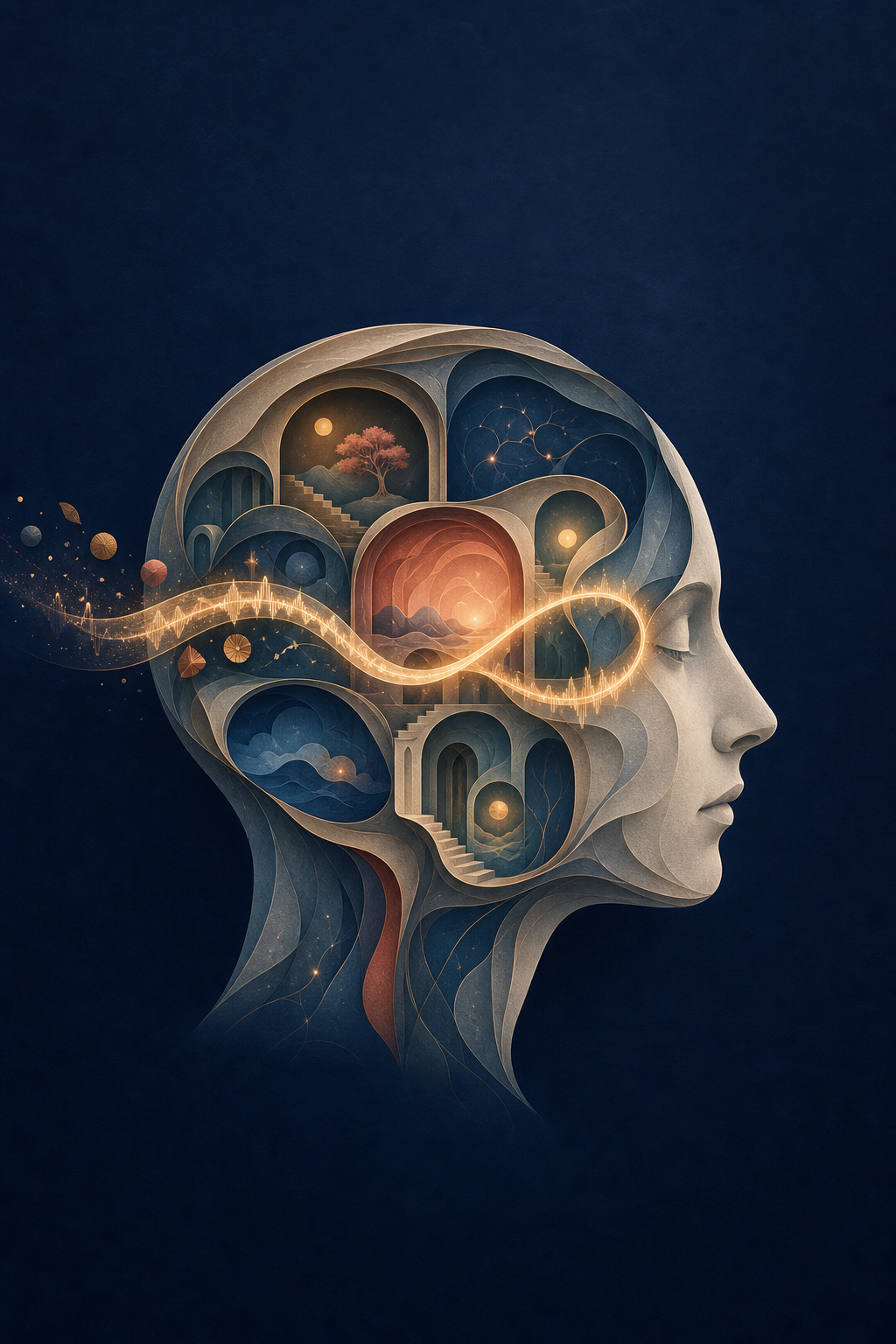
Inside the looping memory behind an earworm
It begins with almost nothing: four notes while you wait for coffee, a rhythm leaking from someone else’s headphones, a phrase attached to an old memory. Hours later, the room is quiet—but the music is not. A tiny piece of a song is circling inside your mind, playing again and again, apparently without your permission.
That experience has a scientific name: involuntary musical imagery, often shortened to INMI. Most of us simply call it an earworm. Despite the creepy nickname, an ordinary earworm is not a parasite in the brain, not a sign that your mind is broken, and not necessarily a song you even like. It is a familiar feature of everyday cognition: music comes into awareness without a deliberate decision to imagine it, and a short fragment repeats.
The strange part is not that the mind can imagine music. You can probably summon a favorite melody on purpose right now. You may hear its contour internally, anticipate the next beat, or sense an imagined singer’s timing without any sound in the room. That is auditory imagery: the mind’s capacity to represent sound in its absence. Earworms use much of the same basic capacity, but the entry point is different. Instead of choosing the music, you notice that it has already arrived.
Researchers increasingly treat earworms as part of ordinary music cognition, where perception, memory, attention, language, emotion, and imagination overlap. A song is not stored in the mind as a single frozen recording. It is linked to a network of cues: its sound, its words, the place you heard it, the people you were with, what you were feeling, even a phrase or situation that resembles it. When one of those cues is activated, a musical memory can be retrieved with surprising speed.
That helps explain why earworms appear at such inconveniently ordinary moments. Recent exposure is a common trigger. Hear a tune several times, especially near the end of a listening session, and it may be more available for the mind to replay later. Repetition matters too. Music that has been encountered often has more opportunities to become linked with routines, locations, moods, and other memories.
But exposure is not the whole story. A word in conversation can activate a lyric or title. A smell, street, holiday, advertisement, workout, or childhood object can revive a song associated with it. Emotion can do the same. A melody connected to excitement, longing, embarrassment, grief, or joy may have a particularly efficient route back into awareness—not because every emotional song becomes an earworm, but because emotionally meaningful memories are richly connected.
Then there is the state of your attention. Earworms often show up during activities with relatively low cognitive demand: showering, walking a familiar route, folding laundry, waiting in line, drifting before sleep. When attention is not fully occupied by a demanding task, spontaneous thoughts have more room to surface. Music is one of the forms they can take. This does not mean a wandering mind is malfunctioning. It means the mind is continuously retrieving, combining, and simulating information, even when you are not consciously directing every detail.
So why do some songs seem especially likely to stick? Studies comparing tunes people named as earworms with comparison songs have found statistical tendencies, not a magic recipe. Earworm songs are often familiar and popular. They may be recent in the listener’s life. They often have lyrics, and they tend to be relatively fast. Their melodies may combine patterns that feel easy to recognize with a few features that stand out—such as distinctive interval jumps or repetitions.
That combination makes intuitive sense. A melody needs enough familiarity to be quickly represented and remembered. Yet a small surprise may give it an identity sharp enough to separate it from thousands of other tunes. Still, this is not an instruction manual for writing an irresistible song. Plenty of fast, popular songs with lyrics never become earworms for a particular person. And an obscure tune, a jingle, a childhood melody, or even a piece of instrumental music can become stubbornly persistent when the right cue and moment arrive.
The earworm is usually not the full song. It is a slice: perhaps a hook, a refrain, a transition, or a rhythmic gesture. That may be because memory retrieval is often fragmentary. A cue does not have to unlock an entire musical work; it can activate the most accessible, distinctive, or recently rehearsed section. Repetition itself may then strengthen the accessibility of that fragment in the moment, making it easier to return to than the verses or ending around it.
But we should be careful with the story we tell about that loop. You may hear claims that the brain repeats music simply because it needs to finish an incomplete pattern or achieve closure. That idea can be a plausible hypothesis in certain cases, especially when a familiar continuation feels expected. It is not a settled universal explanation. The exact function of earworms, and the neural process that keeps a particular passage recurring, remain incompletely understood. Research points to the interaction of memory, auditory imagery, attention, and cues from the environment and body. It does not yet offer one final switch labeled “song stuck.”
The looping can feel oddly physical. Some people silently sing along; others sense the beat, mouth fragments, tap a foot, or imagine the sound with vivid detail. This may be one reason tactics involving speech or movement have attracted researchers’ interest. If an earworm uses mental resources involved in inner hearing, verbal rehearsal, or rhythmic prediction, another activity may compete with it. But “may” is important here.
People report many ways of responding. One is to engage attention with a genuinely absorbing task: a conversation, a puzzle, reading, planning, or work that demands enough focus to interrupt the loop. Another is to listen to the whole song, perhaps hoping that hearing its progression and ending will reduce the urge to replay one fragment. Some people intentionally replace the tune with another song. Others chew gum, a strategy explored in limited experimental work, possibly because the movement interferes with the processes involved in inner singing or auditory imagery.
These approaches are interesting, but none is a universal cure. Much of what we know about coping comes from self-reports, where a strategy may work for one person, one song, or one context and fail in another. Experimental studies can test narrower questions under controlled conditions, but they do not establish a reliable clinical treatment for every persistent tune. Trying hard to suppress the song can also backfire for some people: monitoring whether it is gone may keep attention tied to it. A more useful approach may be to experiment gently—shift to a meaningful task, allow the tune to fade in the background, or try a different strategy without treating the earworm as an emergency.
For most people, that is all an earworm is: a temporary, sometimes amusing, sometimes irritating mental replay. It is useful, though, to distinguish it from experiences that can sound similar in casual conversation.
Persistent distressing musical obsessions are not the same as an ordinary earworm. They may be experienced as intrusive, difficult to dismiss, time-consuming, upsetting, or disruptive to daily life. Musical hallucinations are different again: they can feel like music is actually being heard externally, rather than recognized as music occurring in the mind. These experiences can have varied contexts and causes, and a brief description cannot determine what any individual is experiencing.
If music in the mind is severe, unusually persistent, causing distress, interfering with sleep, work, relationships, or daily functioning—or if it seems externally heard or occurs alongside other concerning symptoms—it is reasonable to discuss it with a qualified clinician. That is not a diagnosis. It is simply a sensible way to get a careful, individualized assessment.
For everyone else, the earworm offers a small lesson in how unfinished our sense of control really is. The mind is not a silent room waiting for commands. It is an active system, constantly predicting, retrieving, associating, and rehearsing. A few notes can travel through that system because they are familiar, meaningful, recently heard, distinctive, or simply encountered when attention leaves a door open.
So the next time a tiny melody takes up residence in your thoughts, you do not need to defeat it with panic. Notice the cue. Notice the moment. Give your attention somewhere else if you want to. And remember: the loop is not proof that the song has captured your brain. It is proof that memory can make music feel alive—even after the speakers go quiet.