

Free text
ReWio Short
What ethanol can change, from one night to long-term health
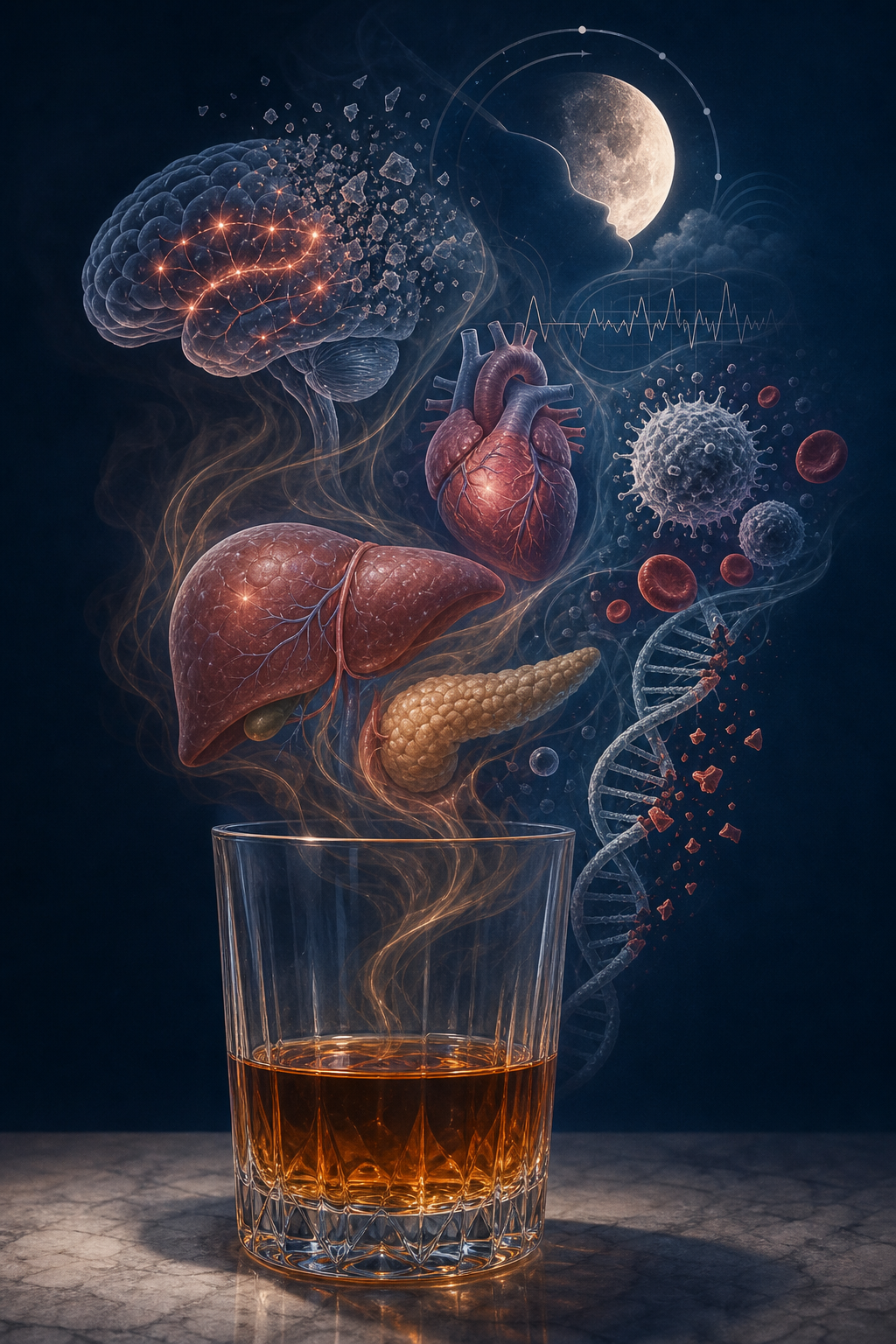
Alcohol is often framed as a way to relax, celebrate, connect, or take the edge off a difficult day. But behind the familiar glass is a substance that can affect the brain, sleep, judgment, immunity, organs, and cancer risk. The important question is not whether every person who drinks will become ill. They will not. The question is simpler, and more useful: what is alcohol doing in the body, and how does risk change as exposure adds up?
The alcohol in beer, wine, spirits, and mixed drinks is ethanol. Ethanol is a psychoactive and toxic chemical. Psychoactive means it changes how the brain functions. It can alter mood, attention, reaction time, coordination, memory, and decision-making. Toxic means the body has to process it as a potentially harmful substance.
Once alcohol is absorbed, it enters the bloodstream and reaches the brain quickly. It interferes with the brain’s communication pathways. That is why a person may feel less inhibited while becoming less coordinated, less able to judge risk, and less able to respond quickly. The feeling of confidence can rise at the very moment that the capacity to make safe decisions falls.
This matters far beyond driving. Alcohol can increase the risk of falls, burns, drowning, violence, unsafe sex, injuries at work, and accidents involving vehicles or machinery. It can also affect other people. A crash, an assault, or a family emergency may be linked not only to the drinker’s health, but to someone else’s drinking as well.
At high enough levels, alcohol poisoning can become a medical emergency. Alcohol can suppress parts of the brain that regulate breathing, heart rate, temperature, and protective reflexes. Warning signs can include confusion, inability to stay awake, vomiting, seizures, slow or irregular breathing, clammy skin, and very low body temperature. Someone who is unconscious after drinking is not necessarily safe to simply sleep it off. Alcohol can continue moving from the stomach and intestine into the bloodstream after drinking stops. Suspected alcohol poisoning needs urgent emergency help.
Alcohol is also commonly misunderstood as a sleep aid. It may make some people drowsy at first, but falling asleep is not the same as getting restorative sleep. Alcohol can disrupt the structure of sleep, including rapid eye movement sleep, and it may worsen sleep-related breathing problems. The result can be fragmented sleep, early waking, fatigue, and a cycle in which someone drinks again because they feel exhausted or anxious. A nightcap can feel like relief while quietly making tomorrow’s sleep worse.
The longer-term effects reach far beyond sleep. In the brain, repeated heavy exposure can affect thinking, mood, behavior, and coordination. Alcohol can also damage nerves outside the brain and spinal cord, contributing to symptoms such as numbness or painful burning sensations. These effects do not define a person’s character. They reflect the ways a drug can alter the nervous system.
The liver carries much of the burden because it processes most absorbed alcohol. As the body breaks down ethanol, it produces acetaldehyde. Acetaldehyde is toxic, and it is a key part of why alcohol is linked to cancer. The liver can develop fat buildup, inflammation, scarring, cirrhosis, and liver cancer in the setting of harmful alcohol use. Damage may develop silently for a long time. Feeling fine is not always proof that the liver is unaffected.
Alcohol can harm the pancreas as well. The pancreas helps with digestion and blood-sugar regulation. Alcohol misuse over time can lead to pancreatitis, a dangerous inflammation that can be sudden and severe or become chronic. Chronic pancreatitis can interfere with digestion and blood-sugar control, and it is also a risk factor for pancreatic cancer and diabetes.
The heart and circulation are affected too. Long-term heavy drinking can weaken the heart muscle. Alcohol misuse can contribute to high blood pressure, irregular heart rhythms, and other cardiovascular problems. The immune system is also vulnerable. Heavy alcohol use can weaken immune defenses, impair recovery from injury, promote inflammation, and leave the body less able to resist infection.
Then there is cancer. This part deserves clarity, not fearmongering. Major health authorities agree that alcohol causes cancer. The World Health Organization states that there is no risk-free level of alcohol consumption in relation to cancer risk. Alcohol is linked to cancers of the mouth, throat, voice box, esophagus, liver, colorectum, and female breast.
Why can alcohol raise cancer risk? One important pathway is metabolism. The body converts ethanol into acetaldehyde. Acetaldehyde can damage DNA and proteins. DNA is the body’s instruction system for cells. When DNA is damaged, cells can begin to grow or behave abnormally. Alcohol can also promote oxidative damage, alter hormones including estrogen, interfere with the handling of nutrients connected with cellular health, and make tissues in the mouth and throat more able to absorb harmful chemicals from tobacco smoke.
Alcohol and tobacco together are especially harmful for cancers of the mouth, throat, voice box, and esophagus. The combined risk is greater than simply adding one risk to the other. This is one reason alcohol risk is never only about the drink itself. It also depends on the wider context: smoking, health conditions, medicines, age, sex, genetic differences in alcohol metabolism, drinking pattern, and the total amount consumed over time.
Risk is dose-responsive. In plain language, the more alcohol a person drinks, especially regularly over time, the higher the risk tends to be. But individual risk is not a calculator. It cannot predict exactly what will happen to one person. “No risk-free level” does not mean that one drink guarantees cancer, liver disease, or another illness. It means there is no amount that can be described as completely without cancer risk. Lower exposure means lower risk; higher exposure means higher risk.
That distinction matters because people deserve accurate information, not false reassurance and not fatalism. A person who has been drinking does not need to assume that harm is inevitable. And a person who drinks only occasionally should not be told that their risk is identical to someone who drinks heavily every day. The evidence points in one direction: reducing exposure is a meaningful way to reduce risk.
What about red wine? It is often presented as an exception, especially because grapes contain compounds such as resveratrol. But a potentially interesting compound in grapes does not cancel the effects of ethanol. The National Cancer Institute reports no difference between red and white wine in overall cancer risk. Claims that moderate drinking is broadly “healthy” can also confuse association with causation. People who drink small amounts may differ from non-drinkers in many ways, including income, diet, physical activity, access to health care, and past illness. Those differences can distort simple comparisons.
Health authorities do not recommend that people who do not drink begin drinking for health benefits. No type of alcoholic beverage removes the cancer risk created by ethanol. Beer, wine, and spirits differ in flavor and concentration, but ethanol is the common factor.
Dependence deserves the same compassion and seriousness as any other health condition. Some people find alcohol increasingly difficult to control despite harms to health, work, relationships, or safety. This is not a moral failure, and it is not solved by shame. Effective support and treatment exist. A conversation with a qualified health professional can be a practical first step for someone concerned about their drinking or someone else’s.
There is one crucial safety point. For a person who has been drinking heavily over a long period, suddenly stopping can cause dangerous withdrawal. Withdrawal can involve symptoms such as shaking, sweating, anxiety, nausea, insomnia, a rapid pulse, seizures, or severe confusion. In some cases, it can be life-threatening. Anyone who may be physically dependent should seek professional guidance to plan a safer change rather than trying to manage abrupt withdrawal alone.
There are also situations in which avoiding alcohol is particularly important: during pregnancy; before driving, swimming, operating machinery, or other activities requiring judgment and coordination; when alcohol could interact with medicines or other drugs; and when a health professional has advised against it. Combining alcohol with opioids, sedatives, sleeping medicines, or certain anti-anxiety medicines can dangerously suppress breathing.
The most useful takeaway is not a label, a lecture, or a promise of perfect health. It is a clear understanding of exposure. Alcohol is not merely a social ritual. It is ethanol, a drug the body must process, and its harms can be immediate or gradual. Less alcohol means less exposure to impairment, injury, organ damage, and cancer risk. For some people, cutting down is the right next step. For others, stopping with appropriate support is safer. In either case, informed choices begin with seeing alcohol clearly.