

Free text
Summary and key ideas
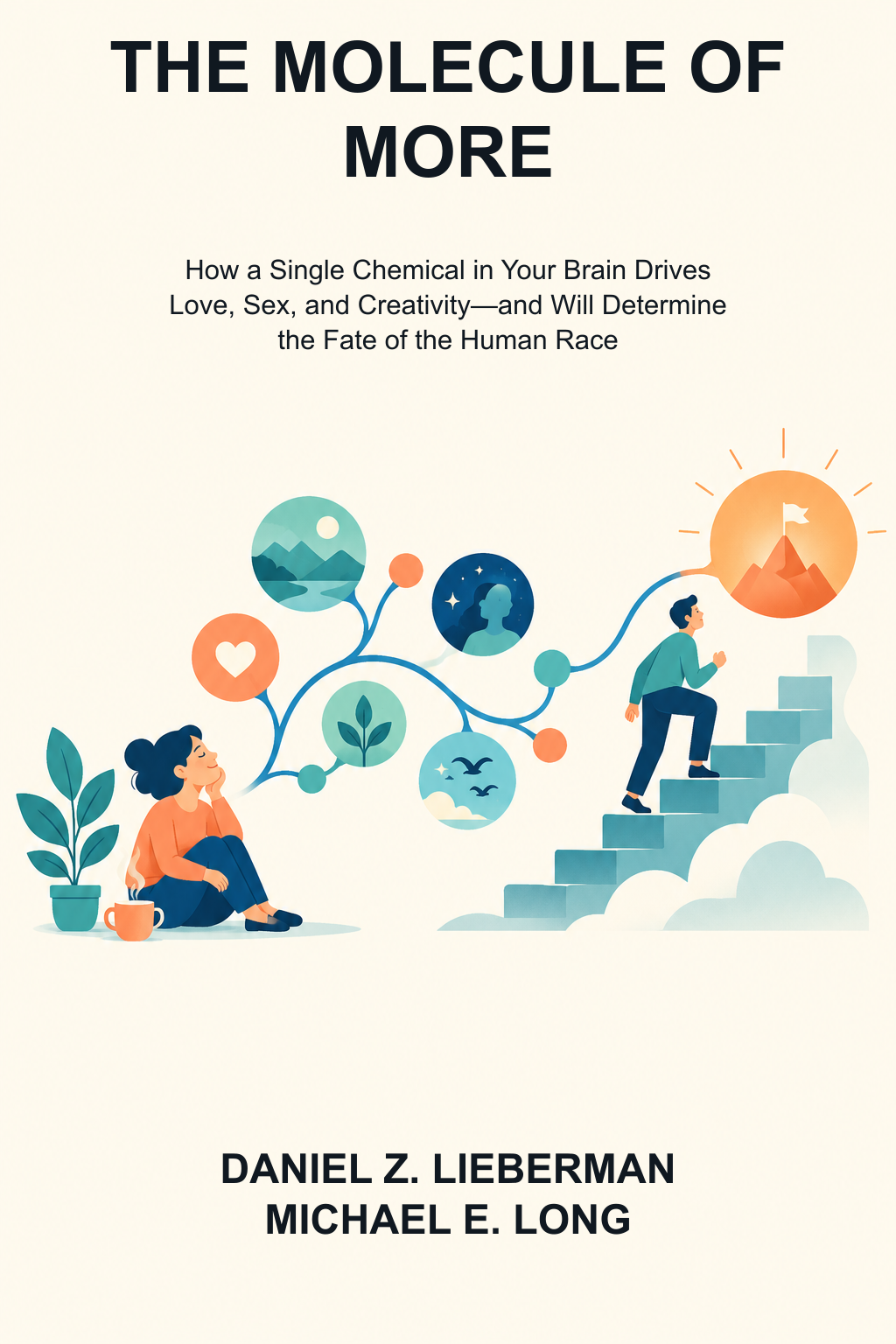
Book summary prepared by ReWio. Original book author: Daniel Z. Lieberman, Michael E. Long.
Introduction
The Molecule of More, published in 2018, begins with an everyday puzzle: why can we be intensely excited by something before we get it, then quickly adapt once it is ours? Daniel Z. Lieberman and Michael E. Long propose that dopamine helps illuminate this pattern. In their telling, dopamine is deeply involved in motivation, learning, attention to possibility, and the pull of the new. It helps turn the future into something emotionally vivid.
That is a useful starting lens, but the authors also acknowledge an important limit: a popular book must simplify an extraordinarily complex brain. Their later discussions, particularly those connecting dopamine to large social and political patterns, are more speculative. Not every study agrees, and no single chemical can serve as a complete explanation of character, ideology, happiness, genius, illness, or human destiny.
The book’s most durable insight is less grand than its title. Human experience often contains a tension between two modes. One mode asks, “What else could I get, make, solve, or become?” The other asks, “What is happening here, and can I actually receive it?” The authors associate the first strongly with dopamine. The second includes sensory enjoyment, attachment, embodied comfort, and appreciation of what is already present. Neither mode is dispensable. Without future-oriented striving, we might not learn, invent, plan, or persist. Without the capacity to value the present, success can become an endless relay race in which every finish line creates another starting line.
So this is not a book about defeating dopamine. It is about noticing its invitations. When an opportunity, a person, a purchase, or an achievement starts glowing in the imagination, we can ask a more precise question: am I pursuing something that matters, or am I mistaking the thrill of pursuit for the life I hope it will provide?
The Promise of Elsewhere
Lieberman and Long describe dopamine as especially responsive to possibility. It is not simply a “pleasure chemical,” a phrase that is catchy but misleading. The authors’ emphasis is on pursuit: dopamine can help make a potential reward compelling before it arrives. It directs attention toward gaps between the current situation and an imagined better one.
Consider a hypothetical designer with a stable job. She begins sketching an app idea during her commute. The project is exciting partly because it is unfinished. In her mind, it contains freedom, recognition, financial security, and creative fulfillment. The uncertainty does not necessarily weaken the attraction; it may amplify it. A completed reality has limits, chores, and tradeoffs. A possible future can absorb nearly any hope.
This capacity is not a defect. Anticipation can organize effort across time. It can help someone save for training, practice a skill, leave an unsafe situation, or continue a demanding project when today’s payoff is small. The problem begins when the imagined future is treated as the only place where life will finally start.
The authors’ practical challenge is to separate a meaningful goal from a permanent state of postponement. A meaningful goal has a purpose beyond the rush of chasing it. It might enable more freedom, service, mastery, or security. Permanent postponement sounds different: “Once I have the next thing, then I will be enough.” That sentence has no natural endpoint because the standard keeps moving.
A useful check is to ask what the goal will change on an ordinary Tuesday. If the answer is concrete—more time with family, work that fits your values, the ability to create something useful—the goal may be well grounded. If the answer remains vague—status, finally feeling superior, never feeling uncertain—the pursuit may be carrying more emotional weight than any outcome can bear.
Wanting Is Not Enjoying
One of the book’s clearest distinctions is between wanting and liking. We often speak as if desire proves enjoyment: if we crave something strongly, surely we must love having it. But the two can come apart. You may repeatedly refresh an inbox without enjoying what you find. You may obsess over buying a device, then feel surprisingly neutral after opening the box. You may hunger for praise yet feel uneasy or empty when it arrives.
The authors use dopamine to explain why anticipation can be gripping even when the actual experience is modest. In broad scientific terms, dopamine participates in learning from rewards and from cues that predict rewards. A notification sound, a familiar street, a logo, or a time of day can acquire motivational force through repetition. The cue can energize seeking before the reward itself is present.
This helps explain why a person can be pulled toward a behavior even while knowing it will not feel as good as imagined. The pull is real, but it is not a trustworthy forecast of satisfaction. That distinction is liberating. It means that a strong urge does not automatically reveal what you value most.
Try a small experiment. Before acting on a recurring desire, name the promise being made. Perhaps it is, “This will relax me,” “This will make me feel connected,” or “This will solve my boredom.” Afterward, assess the lived result rather than the fantasy. Did it bring calm, connection, or relief? For how long? Did it create costs that the anticipation conveniently ignored?
This is not an argument for turning life into self-surveillance. Spontaneity and pleasure matter. It is an invitation to become a better witness of your own experience. When we learn the difference between the signal that says “go get it” and the experience that says “this nourished me,” we can make choices with less autopilot.
Love Beyond Novelty
The book applies this distinction to romantic love. Early attraction often carries an exhilarating sense of discovery: another person appears full of promise, mystery, and imagined future. The authors associate that phase with dopamine-driven novelty and anticipation. As familiarity grows, the intensity of uncertainty and exploration naturally changes.
That does not mean every relationship follows a fixed timetable, or that passion has a universal expiration date. People and relationships vary widely. Nor does it mean attachment is a disappointing substitute for romance. The authors’ larger point is that enduring love requires capacities different from the thrill of first pursuit: curiosity about the real person, reliability, generosity, shared rituals, conflict repair, and the ability to enjoy ordinary closeness.
Imagine two partners who interpret the fading of constant excitement differently. One concludes, “Something is wrong; I no longer feel the charge I felt at the beginning.” The other notices, “The relationship is becoming more familiar. What kind of bond do we want to build now?” The second response does not deny desire. It recognizes that a relationship cannot be sustained solely by the chemistry of uncertainty.
Novelty can still have a place. Couples may seek new experiences, new conversations, and new ways to show attention. But novelty is most constructive when it serves connection rather than replacing it. A surprise trip will not repair chronic contempt; a new dating profile will not automatically solve loneliness.
The practical lesson is to avoid judging a stable relationship by the standards of its opening scene. Ask whether the partnership offers safety, respect, aliveness, shared growth, and room for each person’s individuality. Future-oriented desire can help lovers imagine possibilities together. Present-oriented appreciation helps them notice that care is often expressed not in dramatic intensity, but in the repeated choices that make a life feel trustworthy.
Ambition Needs a Steering Wheel
The authors distinguish aspects of dopamine-related functioning that support desire from those involved in planning, evaluation, and self-control. Their model is deliberately simplified, so it should not be read as a neat map of two separate brains. Still, the practical contrast is valuable: wanting a goal and organizing yourself to reach it responsibly are different abilities.
A student may feel a powerful desire to become a physician, entrepreneur, artist, or athlete. That energy can launch the journey. But desire alone does not schedule practice, revise a budget, tolerate feedback, or choose rest over burnout. In fact, a highly attractive distant goal can sometimes undermine good judgment. The person becomes so focused on being exceptional that they ignore relationships, ethics, health, or intermediate learning.
Lieberman and Long warn that dopamine does not supply a moral compass. A goal can feel urgent without being wise. The desire to win can tempt people to bend rules, treat others as obstacles, or measure their worth only through comparison. That is not an inevitable consequence of ambition, and it is not a moral verdict on ambitious people. It is a reminder that motivation needs values and structure.
A practical response is to convert grand hopes into commitments that can be inspected. Instead of asking only, “How do I get more?” ask: “What am I willing to trade for this?” “Who might bear the cost?” “What would success look like if I also protected my health and relationships?” “What rules will I not break, even when the prize is close?”
Good planning makes room for course correction. It treats goals as tools, not masters. An ambitious life can be deeply satisfying when achievement is connected to craftsmanship, contribution, and chosen boundaries. Without those anchors, achievement can become an appetite that consumes the very life it was supposed to improve.
Cues, Compulsion, and Support
The book discusses addiction as a powerful example of why pursuit should not be confused with pleasure or moral weakness. The authors emphasize craving, conditioned cues, and the way a substance or behavior can become disproportionately important to a person’s motivational system. Their humane message is that shaming someone for loss of control is neither accurate nor helpful.
Current addiction science supports the need for nuance. Dopamine is important in reward learning and cue-driven seeking, but addiction reflects multiple influences: neural adaptation, genetics, development, stress, environment, access to substances, social support, and psychological distress. In addiction, the drive to seek can become intense even when the actual experience of using is less rewarding than expected. That does not reduce the problem to dopamine, and it does not make recovery a simple matter of willpower.
Picture someone who has decided to stop an unwanted behavior. They feel steady in the morning. Then, at the end of a stressful workday, they pass a familiar store, see an online prompt, or sit in the same chair where the habit usually happens. Suddenly the urge feels like a command. The cue is not destiny, but it can make a previously distant choice feel immediate.
That is why practical support matters. Helpful steps may include reducing predictable cues, adding friction to an automatic behavior, telling a trusted person, arranging alternative routines, and seeking evidence-based professional help. None of these steps is a universal cure. They are ways of changing the situation so that a momentary urge does not have to carry the whole decision.
This book should not be used to justify “dopamine detoxes,” supplements, self-directed drug dosing, or treatment promises. If cravings, substance use, gambling, sexual behavior, shopping, gaming, or another pattern feels out of control or is causing harm, a qualified clinician or addiction-support service can help assess options without judgment. Asking for support is not evidence of failure; it is a way to widen the choices available.
Creativity Without Mythmaking
The authors connect dopamine with creativity by focusing on novelty and association. A creative act often joins ideas that were not previously linked: a chef combines traditions, an engineer applies a natural pattern to a machine, or a teacher finds a fresh analogy that suddenly makes a difficult concept clear. The book suggests that a mind attracted to new possibilities may be especially ready to notice unusual connections.
That is an intriguing proposal, not a diagnosis of creative people. Creativity has many ingredients: knowledge, practice, persistence, social opportunity, collaboration, chance, and the willingness to revise poor first ideas. It is also wrong to romanticize suffering by treating mental illness as proof of genius or genius as a sign of illness. The authors discuss possible overlaps and vulnerabilities, but no neurotransmitter level can explain a particular person’s talent, diagnosis, or identity.
The useful takeaway is behavioral. Creative work needs both expansion and selection. In expansion mode, collect ideas without judging too early. Change environments, read outside your specialty, ask odd questions, and make room for connections that do not yet look practical. In selection mode, test those connections against reality. Edit the draft. Build the prototype. Invite criticism. Learn the craft.
Imagine a team trying to improve a public service. One group keeps generating daring possibilities but never chooses. Another rejects every new suggestion because it is unfamiliar. Neither group creates much. Progress requires an alternating rhythm: open the field, then narrow it; imagine the future, then do the present work.
In that sense, creativity mirrors the book’s central tension. Attraction to new possibilities can initiate exploration. Appreciation for what is concrete—the materials, the audience, the constraints, the people affected—turns imagination into something useful. The goal is not endless originality. It is a meaningful connection that survives contact with the world.
Big Claims About Society
In its broadest sections, The Molecule of More argues that future-oriented desire may help explain human progress, exploration, technological change, and recurring social conflict. These are the book’s most provocative ideas, and they should be held most lightly. Societies are shaped by history, institutions, material conditions, culture, power, education, family life, and countless individual choices. It would be misleading to assign political beliefs or social groups a biological label, or to reduce disagreement to one brain chemical.
Still, the authors raise a worthwhile philosophical question: what happens when a culture becomes highly skilled at generating new wants? Innovation can improve health, communication, safety, and opportunity. But the same systems can also monetize attention, intensify status competition, and make every quiet moment feel like an opportunity missed.
The answer is not anti-progress nostalgia. New tools and new ambitions can solve real problems. The question is whether we can pair innovation with institutions and habits that protect attention, dignity, relationships, and shared responsibility. A society that pursues only expansion may lose sight of what expansion is for. A society that refuses change may fail people whose present conditions are unjust.
That tradeoff appears in personal life as well. We need vision to improve what harms us. We need gratitude and care to avoid treating people, places, and accomplishments as disposable once the next possibility appears. The authors’ social claims are best used as prompts for reflection, not as a biological theory of who is right.
Final Summary
The Molecule of More offers a memorable framework: dopamine can help make the future feel urgent, promising, and worth pursuing. Lieberman and Long use that framework to explore achievement, romance, addiction, creativity, and social change. Their strongest practical contribution is the distinction between seeking and savoring. Wanting can be intense without guaranteeing enjoyment. Anticipation can be useful without becoming a reliable guide to what will satisfy us.
Read the book as a lens, not a total theory. Dopamine is one contributor among many in a complex brain and an even more complex life. It does not determine your personality, political views, relationship fate, moral choices, mental health, or future. Broad claims about groups and society remain speculative, and individual behavior always has more than one cause.
What can you do with the lens? First, notice the promises attached to your desires. When you want a promotion, a purchase, attention, or a new relationship, identify the emotional need you expect it to meet. Second, check the result after the pursuit. Did the outcome create the nourishment you predicted, or only a brief release before the next chase? Third, give present experience deliberate status in your life: meals without distraction, conversations that are not optimized, time outdoors, physical rest, appreciation, and small acts of care.
Fourth, design ambition rather than surrendering to it. Choose goals with a reason, define ethical boundaries, and include relationships and health in your definition of success. Finally, take compulsive patterns seriously and compassionately. Strong cue-driven urges are not a character verdict. If control is slipping or harm is growing, reach out to qualified support.
The balanced life imagined by this book is not one without desire. It is one in which desire serves a life you can actually inhabit. Dream about what comes next. Build toward it. But do not let the promise of elsewhere make you absent from the people, work, and moments that are already here.