

Free text
Summary and key ideas
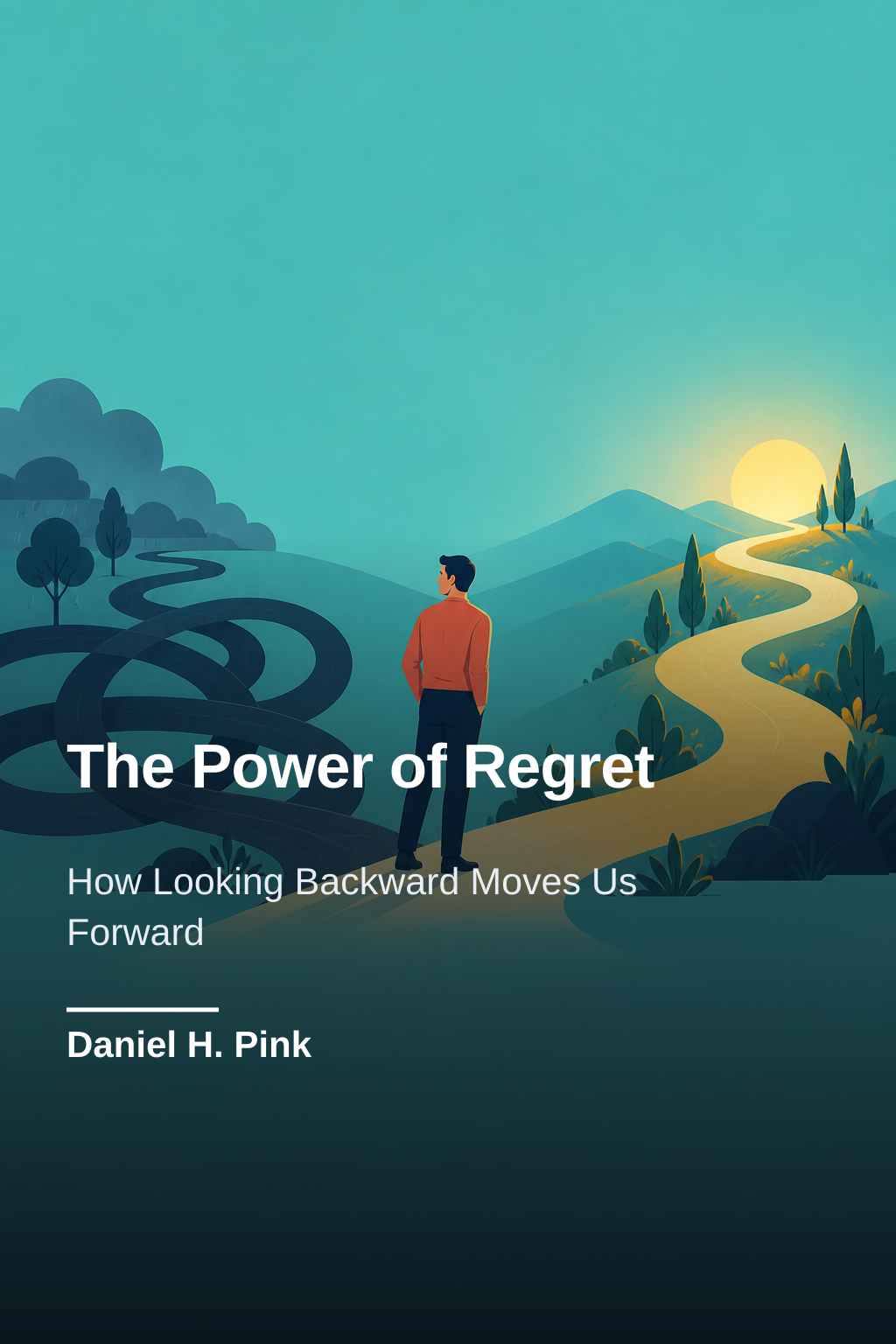
Book summary prepared by ReWio. Original book author: Daniel H. Pink.
Introduction
Regret is an awkward emotion. It arrives with an unwanted picture of another life: the conversation we could have handled better, the course we might have taken, the person we failed to call, the warning we brushed aside. Because it hurts, many of us reach for a slogan: no regrets. It sounds strong, free, and decisive.
Daniel H. Pink argues that this slogan confuses denial with resilience. His central claim is not that regret feels pleasant, or that every regret contains a hidden gift. It is that regret is a normal human response to recognizing that a past choice may have produced a worse outcome than an available alternative. Handled well, that uncomfortable recognition can improve later choices, clarify priorities, and strengthen relationships.
The key phrase is handled well. Regret can turn toxic when it becomes a permanent prosecution of the self. It can become escapism when we spend all day revising an imaginary past. And it cannot undo damage, restore a lost opportunity, or guarantee reconciliation. But neither does refusing to look back make us wiser. A person who claims never to regret anything may be protecting an image of invulnerability rather than learning from experience.
Pink, an American nonfiction writer rather than a psychiatrist or neuroscientist, brings together research and survey material to make a practical argument: our regrets are not random debris. They often point to deeply held needs and values. The question is not whether you should have regrets. The more useful question is: what is this regret trying to teach me, and what can I responsibly do next?
This is a book about turning hindsight into guidance. It asks us to look backward for a limited, purposeful time—long enough to understand, not so long that we get trapped there.
Beyond the No-Regrets Slogan
Pink’s challenge begins with a distinction between reflection and rumination. Reflection is focused and constructive. It says: something happened; what does it reveal; what lesson transfers to the next situation? Rumination is repetitive and self-absorbed. It says: why am I such a failure; why can’t I stop replaying this; how could the world let this happen? Reflection looks for meaning and action. Rumination circles pain without an exit.
Regret depends on counterfactual thinking: mentally comparing reality with a possible alternative. You missed a deadline and imagine starting earlier. You were abrupt with a friend and imagine pausing before you spoke. These alternatives can be useful because they expose a choice point. Yet they are never a perfect recording of what would truly have happened. Perhaps the other job would have been disappointing. Perhaps the friendship had difficulties you could not see. The imagined better past is a model, not proof.
That uncertainty calls for humility. We can say, “I wish I had acted differently,” without claiming certainty that everything would now be ideal. The purpose is not to win a fictional trial about the past. It is to identify the part of the situation you can carry forward: prepare sooner, ask a question, save regularly, speak honestly, reach out kindly.
Illustration: Maya regrets declining an invitation to apply for an internal role. She tells herself she would certainly have received it and would now be thriving. That conclusion goes beyond the evidence. A more grounded reflection is that fear of being judged kept her from trying. The durable lesson is not that she lost a guaranteed perfect job. It is that, next time, she wants to submit the application before deciding she is unqualified.
Pink’s larger point is that regret is valuable precisely because it stings. The feeling highlights a gap between what happened and what we believe matters. The task is to let that signal inform us, without letting it define us.
The Hidden Map of Regret
Pink reports that his survey work found recurring patterns in people’s regrets. He organizes them into four broad types: foundation regrets, boldness regrets, moral regrets, and connection regrets. He presents this framework as a hidden architecture beneath many apparently different stories.
It is a useful map, not a diagnostic test. Survey findings can reveal strong patterns, but they cannot prove that every individual, community, or culture experiences regret in exactly four universal categories. People’s lives overlap categories. A financial mistake can involve family loyalty. A career decision can also be about courage. Cultural conditions shape which choices are available and which losses feel most urgent. So the framework works best as a set of questions, not labels to impose on yourself.
Pink’s interpretation is that the categories form a kind of negative image of a good life. In other words, what people most painfully wish they had done can reveal what they care about most. Foundation regrets reveal a desire for stability. Boldness regrets reveal a desire for growth. Moral regrets reveal a desire for goodness. Connection regrets reveal a desire for love and belonging.
That reframing matters. Instead of asking only, “What is wrong with me for regretting this?” we can ask, “Which value is this pain protecting?” A person who regrets reckless spending may be grieving security. A person who regrets staying silent may be grieving growth. Someone ashamed of cruelty may be affirming integrity. Someone who misses an old friend may be recognizing the value of connection.
The four categories also help separate a broad life lesson from a narrow replay of events. The details may be unchangeable. The underlying need may still be honored. You cannot return to every earlier crossroads. But you may be able to build stability now, take a proportionate risk, choose honesty today, or offer care in a relationship that is safe enough to approach.
Stability and Growth
Foundation regrets begin with small acts of neglect that accumulate. They often sound like, “If only I had done the work.” The work might mean saving a little, studying consistently, attending to health, learning a basic skill, or maintaining an obligation before it becomes a crisis. Pink connects these regrets with the need for stability: the dependable platform that makes freedom and choice possible.
The trap is to interpret a foundation regret as evidence that it is too late. Sometimes consequences are real and options are limited. But “too late to erase the past” is not the same as “too late to improve the foundation.” A useful response is specific and modest. Automate a small transfer. Make the overdue appointment. Create a calendar reminder. Ask for help understanding debt. Begin the course lesson. Stability is often rebuilt through ordinary repeatable actions, not dramatic declarations.
Illustration: Luis regrets ignoring his professional certification for years. Instead of repeatedly calculating the opportunities he may have lost, he identifies the present obstacle: the material feels overwhelming. His next step is not to promise an entire career transformation by Friday. It is to register, reserve a regular study period, and tell one trusted person his plan. The regret has become information about preparation.
Boldness regrets point in a different direction. They sound like, “If only I had taken the chance.” Pink emphasizes that people often regret inaction more than action over the long run. These regrets can involve work, creativity, travel, love, speaking up, or simply allowing oneself to be seen. They reveal the need for growth.
Boldness does not mean reckless leaps or ignoring responsibilities. Taking a chance can be a conversation, an audition, a proposal, a class, or a carefully researched experiment. The question is often not, “Can I guarantee success?” It is, “Can I live with never finding out?”
Illustration: Asha regrets never showing her design work. Rather than quitting her job impulsively, she shares a small portfolio with a mentor and enters one local call for submissions. That is a bounded act of courage. It respects her responsibilities while interrupting the habit of self-rejection.
Goodness and Love
Moral regrets arise when people believe they failed to do what was right. They may involve dishonesty, betrayal, cruelty, exploitation, cowardice, or staying quiet when someone needed support. Their core message is, “If only I had done the right thing.” Pink connects them with goodness: the wish to be a person whose actions match their ethical standards.
This category requires care because regret should not become performative self-punishment. Feeling terrible is not the same as making repair. Where repair is possible and welcome, it may involve acknowledging harm plainly, apologizing without excuses, returning what was taken, correcting a record, or changing a recurring behavior. Where direct repair would reopen harm or create pressure for the other person, accountability may need another form: restitution through appropriate channels, sustained changed conduct, or work that supports the value previously violated.
Illustration: Devon regrets taking credit for a colleague’s contribution. A useful next action is not a vague message about being a bad person. It may be to correct the attribution with the relevant team, apologize privately without demanding forgiveness, and establish a practice of documenting contributions accurately. The regret reveals a commitment to fairness; the repair must make that commitment visible.
Connection regrets concern relationships that weakened, broke, or never deepened. They often sound like, “If only I had reached out.” Pink notes that many relationships do not end in dramatic conflict. They drift apart through busyness, assumptions, awkwardness, distance, and the belief that too much time has passed. Such regret reveals love, belonging, and the need to matter to others.
A reconnection attempt can be wonderfully simple: a brief note, a call, a memory shared without demand. “I was thinking of you and hope you are well” can be enough. But reconnection is an invitation, not an entitlement. It does not require returning to a relationship that was abusive, manipulative, or unsafe. It does not override another person’s wish for distance. Nor must you contact every person from your past to honor the value of connection. You can invest care in safe relationships available now.
Illustration: Priya misses a former friend but knows the friendship became volatile and harmful. Rather than reopening direct contact, she writes an unsent letter that names what she misses and what she will no longer accept. Then she invites a supportive neighbor for coffee. The value is connection; the boundary remains intact.
Turning Regret into Instruction
Pink offers a practical sequence for working with regret: treat yourself with kindness, disclose the regret through conversation or writing, step back to gain perspective, and convert the insight into a concrete next action. The sequence is simple, but it asks for discipline.
Begin with kindness to yourself. This is not letting yourself off the hook. It means speaking to yourself as you might speak to a decent friend who made the same mistake: honestly, but without contempt. Shame says, “I am permanently defective.” Self-compassion says, “I made or faced something painful; I can acknowledge it and choose my response.” This stance makes learning more possible because it reduces the urge to hide.
Next, put the regret into words. Telling a trusted person can reduce the sense that the regret is a private, unbearable secret. Writing can do something similar. Try a short structure: describe what happened; name what you wish had been different; identify the value underneath; state the lesson; choose an action. The aim is coherence, not a polished confession. If sharing would be unsafe or would burden someone inappropriately, private writing is a valid alternative.
Then create distance. Imagine advising a friend in your situation, or picture your future self looking back at this moment. Distance changes the question from “How can I stop feeling this immediately?” to “What response would I respect later?” It also helps distinguish responsibility from fantasy. You may be responsible for a careless choice, but not for every later event that your mind has attached to it.
Finally, make the action concrete. “Be better” is too vague. “Send the corrected document today,” “schedule the medical checkup,” “put a recurring savings transfer in place,” “ask for feedback before the next presentation,” or “write a respectful message with no expectation of reply” are actions a real person can take.
Illustration: After realizing she dismissed a junior coworker’s idea, Elena does not spend weeks labeling herself a terrible manager. She writes down what happened, notices that fairness matters to her, asks how she would advise a friend, and decides to acknowledge the interruption at the next meeting. She also creates a personal habit: after every discussion, she will check whose ideas were not heard. Regret becomes a behavioral design problem.
Limits, Boundaries, and Better Questions
The promise of this approach should remain modest. Regret is not a diagnosis, a cure, or a guarantee of growth. Some regrets are connected to grief, trauma, addiction, depression, discrimination, financial hardship, or harm that cannot be resolved through a journal entry and a next step. Professional support, legal advice, medical care, community resources, or protection from danger may be more important than self-help reflection.
Nor should the framework be used to judge other people. A parent’s regret may be shaped by impossible demands. A worker’s missed chance may reflect unequal access rather than a lack of courage. A person’s estrangement may protect them from real harm. Asking what a regret reveals is more humane than assuming it reveals a character flaw.
A few better questions can keep reflection grounded. What part of this story is actually within my control? What evidence do I have about the alternative I imagine? Which value feels threatened here: stability, growth, goodness, or connection? What would repair look like without pressuring anyone else? What is one small action that fits my real circumstances?
Those questions prevent regret from becoming a fantasy of total control. The past cannot be edited. But the present can still be shaped by what the past has taught us.
Final Summary
The Power of Regret asks us to retire the shallow ideal of a life without backward glances. Pink’s argument is that regret is a common, painful, potentially useful emotion. It becomes constructive when we meet it with honesty rather than denial, kindness rather than self-contempt, perspective rather than obsession, and a specific action rather than empty intention.
The four categories offer a practical compass. Foundation regrets call attention to stability. Boldness regrets point toward growth. Moral regrets remind us of goodness. Connection regrets reveal the enduring importance of love and belonging. The categories are patterns, not rigid laws, and no survey can capture every life exactly. Still, they can help turn a blurry ache into a clearer question.
When an “if only” appears, do not automatically obey it or silence it. Examine it. Name the value beneath it. Remember that your imagined alternative is uncertain. Make room for accountability without turning yourself into the whole problem. Respect safety and boundaries, especially in relationships. Then choose one responsible next move.
That is the book’s durable lesson: regret need not be a place to live. It can be a signal to listen to, a value to honor, and a direction for moving forward.