

Free text
Summary and key ideas
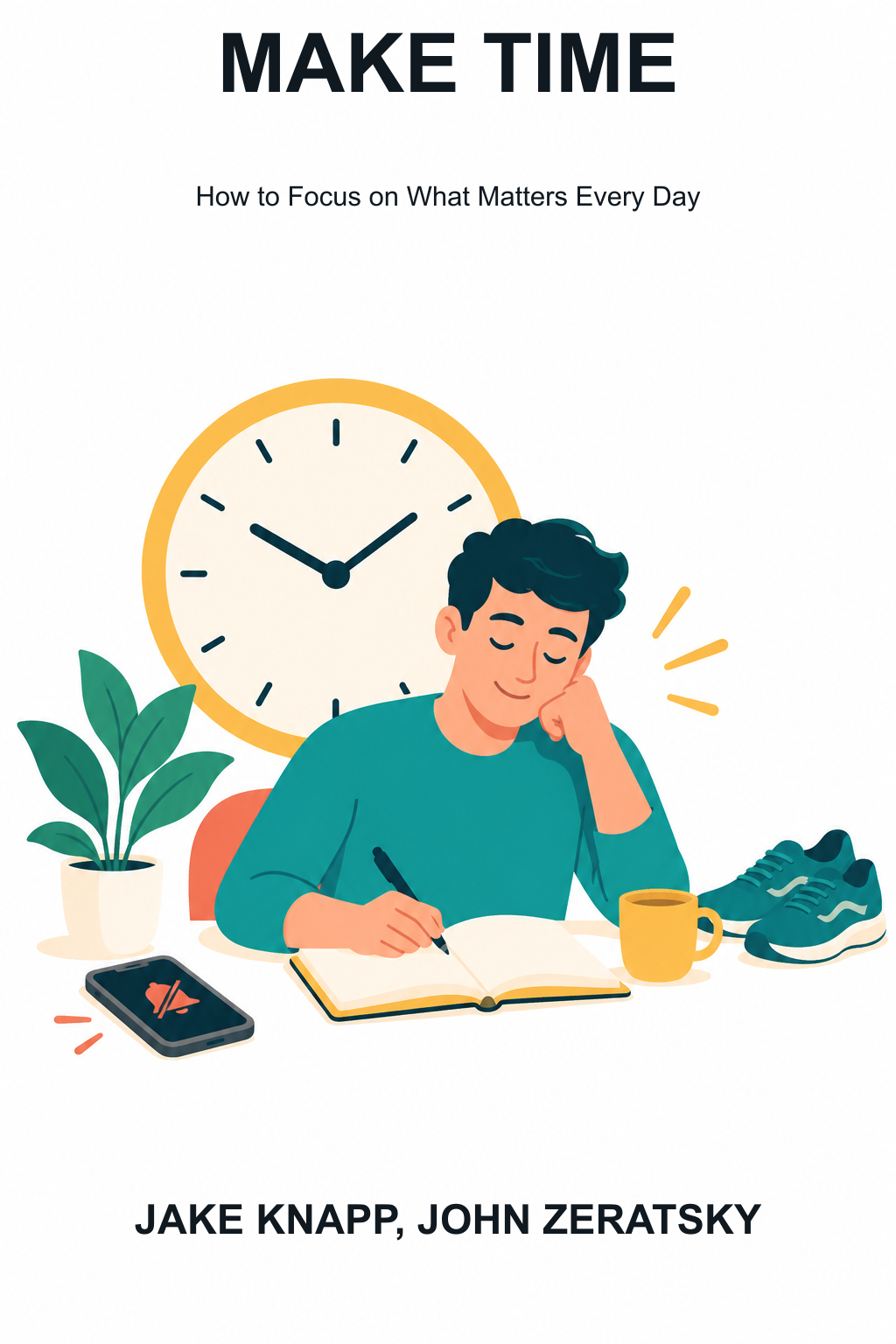
Book summary prepared by ReWio. Original book author: Jake Knapp, John Zeratsky.
Introduction
Make Time begins with a reassuring challenge to familiar productivity advice. Jake Knapp and John Zeratsky do not say that a worthwhile life comes from squeezing more tasks into every spare minute. Their argument is that many people feel rushed and scattered because their days have been designed by defaults they did not consciously choose.
The authors give those defaults two memorable names. The Busy Bandwagon is the social pressure to appear permanently occupied: full calendars, fast replies, mounting lists, and the sense that stopping means falling behind. Infinity Pools are the sources of content that never truly end: feeds, videos, news, games, inboxes, and other systems that always offer one more item. The labels are the authors’ framing, not scientific categories, but they describe a recognizable tension. Busyness drains attention; then infinite entertainment offers easy escape; then the unfinished work produces more busyness.
Their response is not to blame people for weak willpower. Modern workplaces, devices, and habits make reacting easy. Yet the authors also insist that individuals can take responsibility for changing some conditions around them. The goal is modest and personal: make a little more room, every day, for something that matters.
Their daily loop has four parts: Highlight, Laser, Energize, and Reflect. It is a design process for ordinary life, not a demand to become perfectly organized. Some days will be disrupted. Some tactics will fail. The central question remains useful: instead of letting the day happen by default, what could you deliberately make time for today?
The Daily Highlight
The first move is to choose a Highlight: one activity that would make the day feel meaningful when you look back on it. It is not necessarily the only important thing you will do, and it is not a grand life goal. It is a concrete focal point for today.
Knapp and Zeratsky suggest three ways to choose. An urgent Highlight handles something consequential with a real deadline: perhaps finishing a proposal before a client decision. A satisfying Highlight advances a valuable project that keeps slipping into “someday”: outlining a portfolio, repairing a bicycle, or beginning a course application. A joyful Highlight protects something worthwhile simply because it makes life better: cooking with a partner, reading with a child, practising music, or seeing a friend.
This distinction matters because task lists flatten everything. A list can contain a critical decision, a trivial errand, and an ambition that has waited for months. Checking off small items may feel productive while the activity you care about never gets started. A Highlight does not eliminate administration. It stops administration from being the only story of the day.
The authors recommend choosing a priority that is substantial enough to deserve focus but limited enough to fit realistically into a day. Then put time for it on the calendar. Scheduling is important because an intention without a place often loses to whatever arrives next.
Consider a customer-support lead who cannot control every meeting or incoming issue. Her Highlight might be to write the first version of a recurring-problem guide for her team. She cannot guarantee an uninterrupted morning. But she might reserve a protected window, tell colleagues what she is working on, and define success as a workable draft rather than a flawless manual. That is a realistic use of the method: create a clear target and a finish line, then work with the constraints you actually have.
Creating Laser Time
After deciding what deserves attention, the next challenge is protecting it. The authors call focused attention Laser mode. Their key claim is that concentration should not depend entirely on heroic self-control. It is more reliable to alter the surroundings so distraction becomes less convenient.
A finish line helps. “Work on presentation” is vague and therefore easy to abandon. “Choose the three recommendations and draft their headings before lunch” gives the session a boundary. A defined outcome also makes it easier to decide how much time to reserve and when enough is enough.
The authors are especially skeptical of default phone design. A phone can remain a useful tool for maps, calls, photographs, music, messaging, and practical coordination without also serving as a portable casino of infinite feeds. Their suggested direction is to remove or hide the apps that repeatedly capture attention, turn off nonessential alerts, keep tempting tools off the home screen, and make the phone physically inconvenient during focused work. For one person, deleting social media may be appropriate. For another, logging out, using a browser only at a computer, or keeping the device in another room may be enough.
Friction is the principle. If distraction takes only one effortless tap, it will often win when you are tired, bored, or uncertain. If it requires retrieving a device, entering a password, or waiting until a planned time, you gain a small pause in which to choose.
This is not an argument that every digital tool is bad, or that everyone should be unreachable. A parent may need calls from school. An on-call worker may have a genuine duty to monitor a channel. The practical question is narrower: which alerts and apps are essential for your role, and which merely create an automatic habit of checking? Design the default around the first group, not the second.
Email Without Constant Reaction
Email receives special attention because it feels productive even when it fractures the day. A new message may be important, pleasant, or urgent. That uncertainty makes checking compelling. But seeing a request when you cannot act on it can leave part of your attention stuck on the request while you try to do something else.
Zeratsky’s low-tech approach favors fewer places to check and deliberate windows for dealing with messages. The purpose is not to reach an immaculate inbox at every moment. It is to separate quick scanning for genuinely time-sensitive matters from longer periods of replying, organizing, and turning real work into scheduled commitments.
In practice, this can mean removing work email from a personal phone if your job permits it, closing the inbox during a Highlight session, and putting one or more email blocks on the calendar. A simple inbox may be preferable to elaborate systems that create still more folders, queues, and dashboards to monitor. The authors’ broader lesson is that a tool designed to receive other people’s requests should not be allowed to set the agenda all day.
But constraints matter. A nurse, incident responder, executive assistant, or small-business owner may need faster response times. In those cases, a workable experiment might be narrower: check at agreed intervals, create an emergency route that is not the ordinary inbox, assign coverage during a focus block, or announce availability expectations to colleagues. The method works best when it is honest about obligations rather than pretending they do not exist.
Communication also benefits from clear boundaries. If you promise an answer by a certain time, people need less reason to interrupt you before then. If a task requires a long response, schedule the task instead of leaving the message open as a mental burden. The aim is responsiveness with intention, not silence or neglect.
Energy Is Part of Attention
Make Time treats energy as a practical foundation for focus. The authors’ basic observation is straightforward: a calendar system cannot fully compensate for a depleted body. When you are underslept, sedentary, hungry, overstimulated, or isolated, the easiest distraction becomes more persuasive and difficult work becomes harder to begin.
Their suggestions point toward familiar, sustainable basics: more everyday movement, better sleep conditions, screen-free moments, food habits that support steady energy for the individual, daylight and fresh air when possible, and time with other people. Walking is a recurring example because it can be folded into ordinary life rather than treated as an extreme fitness project. A brief walk after a meeting, a farther parking space, or part of a commute on foot can change the rhythm of a day.
The authors encourage environmental design here too. Put a charger outside the bedroom if the phone keeps delaying sleep. Keep a book nearby if reading is a better wind-down habit. Place food you actually want to eat within reach. Arrange a standing or movement break around an existing routine. Small changes reduce the number of decisions that must be made when energy is low.
These are not medical prescriptions. The book’s tactics do not replace individualized advice from qualified health professionals, and no single diet, sleep rule, exercise habit, or caffeine strategy works for everyone. Shift workers, caregivers, people with disabilities, and people managing illness may have very different options.
The useful principle is gentler: notice which conditions help you feel sufficiently alert and calm to do what matters, then build one realistic support into the day. Energy is not a reward you earn after work. It is part of the capacity that makes meaningful work, rest, and connection possible.
Reflect, Adapt, Repeat
The final part of the loop is Reflect. At the end of the day, ask a few simple questions: Did I make time for my Highlight? What helped me focus? What distracted me? How was my energy? What small change would I try tomorrow?
Reflection prevents the framework from becoming another system that judges you. A missed Highlight is information, not proof of failure. Maybe the priority was too large. Maybe the time block was placed after exhausting meetings. Maybe the phone was not the real issue; perhaps a vague task, unclear decision, or low energy made avoidance attractive. The next day is a chance to adjust one variable.
This experimental mindset is central to the authors’ approach. They present many tactics, but they do not argue that every reader must adopt all of them. One person might benefit from a distraction-free phone. Another might find that paper planning, a regular walk, or a scheduled email window makes the biggest difference. The point is to test tactics in real life and keep what works.
That flexibility also protects against an all-or-nothing trap. You do not need a pristine morning routine, an empty calendar, or total freedom from screens before starting. You can begin with one calendar block, one removed app, one conversation about availability, or one walk around the block. The authors’ philosophy favors changing days gradually over waiting for a dramatic future reset.
Over time, the loop can reveal patterns. You may learn that creative work belongs before meetings, that late-night scrolling harms tomorrow’s attention, or that a joyful Highlight restores motivation better than another administrative task. These are not universal conclusions. They are discoveries about your own life, made through repeated observation.
Final Summary
Make Time offers an alternative to the idea that a good day is a day in which every task gets done. Knapp and Zeratsky argue that busyness and endless content have become powerful defaults, often without our deliberate consent. Their answer is not perfect discipline. It is intentional redesign.
Choose one daily Highlight that is urgent, satisfying, or joyful. Give it a real place in the day and a clear finish line. Protect it by creating friction around the distractions that most reliably pull you away: infinite feeds, alerts, casual browsing, and always-open email. Support attention through realistic care for energy, including movement, sleep, food, rest, and connection. Then reflect briefly, learn from the result, and try again.
The framework does not promise control over every meeting, emergency, deadline, or family responsibility. Nor does it require you to reject technology or become a relentless optimization project. Its practical promise is smaller and more credible: by changing a few defaults, you may increase the odds that each day contains at least one piece of time you chose on purpose.
That is why the book emphasizes today rather than someday. Major ambitions are built from repeated sessions of attention. Meaningful relationships are built from time that is actually present. A more intentional life may not begin when the calendar finally clears. It can begin when you decide what matters today, make a little room for it, and treat tomorrow as another experiment.