

Free text
Summary and key ideas
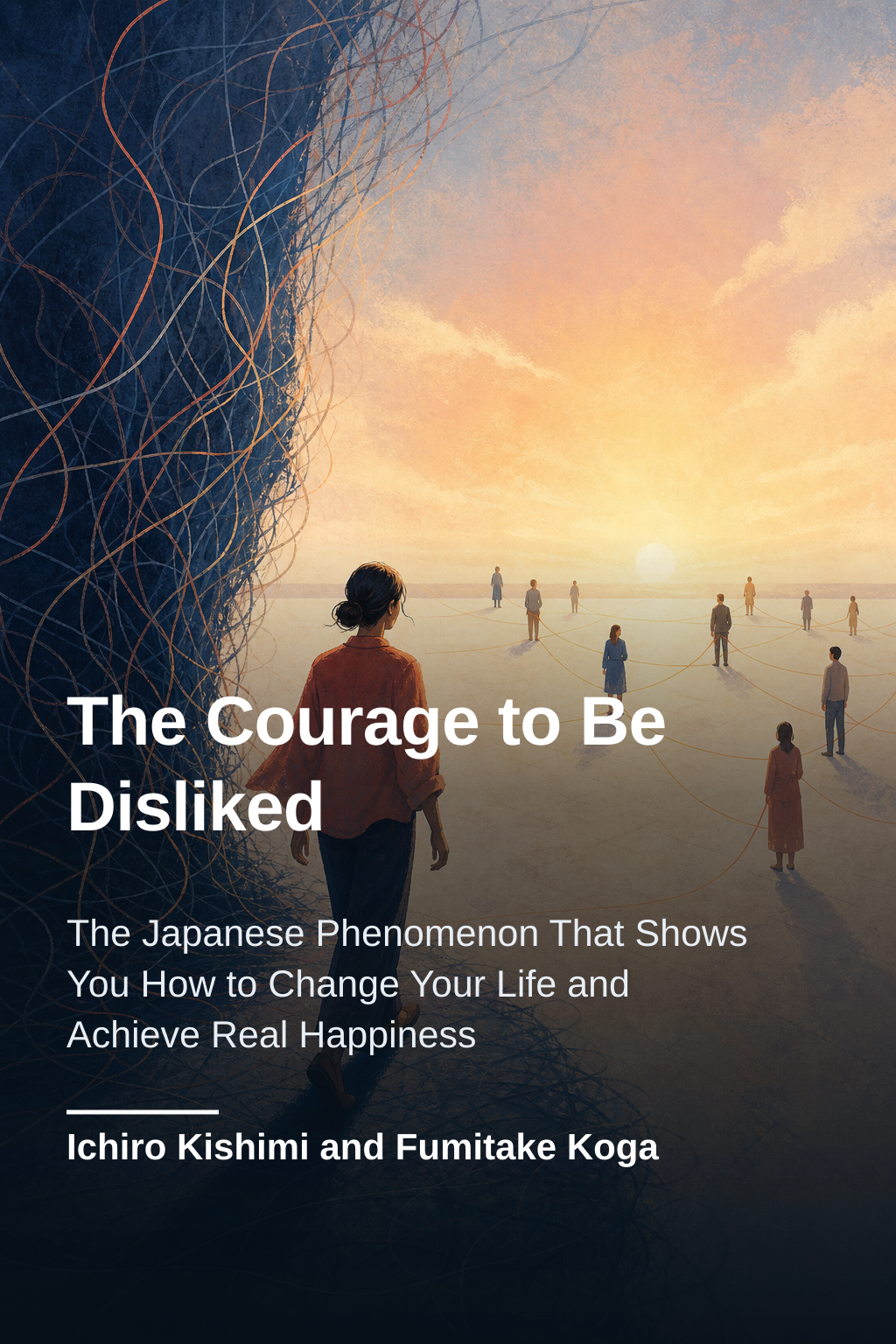
Book summary prepared by ReWio. Original book author: Ichiro Kishimi and Fumitake Koga.
Introduction
The Courage to Be Disliked is built as a Socratic-style confrontation. A young man arrives furious at a philosopher’s claim that people can change and become happy. The young man sees a world shaped by personality, family, bad luck, humiliation, and pain. The philosopher introduces Alfred Adler’s individual psychology as an alternative lens: a person is not merely a product of what happened before. They are also an active interpreter of their circumstances, moving toward aims they may not fully recognize.
That setup explains both the book’s power and its risk. Its power is that it challenges fatalism. If every current limitation is treated as an unchangeable verdict from the past, agency can disappear. Its risk is that a forceful argument for agency can sound as if it erases the force of trauma, social conditions, disability, poverty, violence, or mental illness. The book is most useful when read as philosophical provocation, not as a complete account of psychology or a substitute for care.
Kishimi and Koga present Adler through dialogue rather than academic exposition. The philosopher’s answers are deliberately blunt, and the young man speaks for the reader’s objections. The central question is not simply, “What caused me to become this way?” It is, “What direction am I taking now, and what might become possible if I changed that direction?” The book’s answer centers on purpose, relationships, contribution, and the willingness to endure disapproval.
From Causes to Purposes
The book’s first major reversal concerns causation. Ordinary explanation often moves backward: a person avoids groups because they were embarrassed; they rage because they were hurt; they feel powerless because they failed. Adlerian thinking, as presented here, asks a second question: what does the present behavior accomplish? Avoiding groups might protect someone from further embarrassment. Rage might create distance or force another person to retreat. Feeling powerless might justify not attempting a difficult task.
This is called teleology: interpreting behavior partly in terms of goals or purposes. It does not have to mean that people calmly calculate every reaction. Much of human behavior is automatic, learned, emotional, and outside conscious awareness. The book’s point is narrower and potentially useful: a past event alone does not explain why one person responds one way today and another responds differently. Meaning, current context, habits, and perceived goals matter too.
The authors push this argument into a controversial rejection of simple trauma-based explanations. Their philosopher argues that trauma does not mechanically dictate the present. As a challenge to strict determinism, this can remind readers that a painful history need not cancel all future possibility. But it should not be confused with modern clinical consensus. Serious trauma can affect memory, threat perception, sleep, relationships, bodily stress, and emotional regulation in enduring ways. Abuse is never the survivor’s fault, and mental illness is not a failure of courage or choice.
A humane way to use the idea is to ask: “Given what I have survived, what protective purpose might this pattern serve now?” That question respects the past while opening room for change. A harmful way is to say, “You are choosing your suffering.” The book’s philosophy may illuminate agency; it cannot diagnose trauma or prescribe treatment.
Lifestyle and the Possibility of Change
In Adlerian language, lifestyle does not mean clothing, income, or fashionable habits. It means a broad, often early-formed pattern for interpreting oneself, other people, and life: what feels dangerous, what earns belonging, what success means, and how one tries to avoid failure. A person might live by an unspoken rule such as, “I must be exceptional to matter,” “I must never burden anyone,” or “I must stay distant before I can be rejected.”
The philosopher describes lifestyle as chosen, which is another deliberately sharp formulation. The charitable interpretation is that these patterns are not destiny. Even if they became deeply familiar under conditions a person did not choose, they can be examined and gradually revised. The book asks readers to stop treating a familiar pattern as their essential self. You are not identical to your fear, your role in the family, or your preferred excuse.
Still, “chosen” needs care. Children do not choose neglect, racism, violence, unstable homes, neurodevelopmental differences, or the resources available to them. Adults may also face symptoms and constraints that cannot be shifted by insight alone. Change may require safety, time, accommodation, medicine, therapy, practical support, or collective action. The authors’ useful contribution is not a promise of instant reinvention. It is an invitation to identify one next action that does not simply repeat the old rule.
Try translating lifestyle into everyday observation. Notice the sentence that appears before you withdraw, overwork, appease, compete, or attack. Then ask what it protects you from, what it costs, and whether a slightly different response is safe enough to practice. That is more realistic than demanding a total personality transformation.
The Tasks That Belong to You
One of the book’s most practical ideas is the separation of tasks. A task is something whose consequences ultimately belong to a particular person. Your task may be to speak honestly, prepare well, set a boundary, or make a decision. Another person’s task may be whether to approve of you, follow your advice, take responsibility, or change their behavior.
This distinction is designed to break the exhausting attempt to manage everyone else’s mind. You can offer help, make a request, explain your reasons, and behave with care. You cannot make another adult like you, forgive you, work hard, or choose wisely. When you confuse their task with yours, the book says, control and resentment follow. Parents may try to direct every outcome for a child. Partners may seek guarantees that they will never be left. Managers may mistake supervision for ownership of another person’s motivation.
Separating tasks is not indifference. It does not mean refusing mutual responsibility, ignoring a vulnerable person, or abandoning commitments. Nor does it apply cleanly where power is unequal: workplaces, caregiving, schools, and abusive relationships involve real duties and risks. The question is not, “Can I wash my hands of this?” It is, “What can I responsibly do, and where does my control end?”
In practice, name the task before acting. If you are offering feedback, your task is to be specific and respectful; receiving it is the other person’s task. If you apply for a role, your task is preparation and application; selection is the organization’s task. This boundary cannot guarantee comfort, but it can replace compulsive control with clearer action.
Inferiority Without the Race
The authors argue that nearly all interpersonal troubles arise within relationships. That is intentionally sweeping, yet it points toward something recognizable: shame, envy, loneliness, status anxiety, and anger usually involve a social comparison or a threatened bond. Adler’s concept of inferiority feeling begins with the ordinary awareness that others may be more skilled, admired, wealthy, attractive, or experienced. Such feelings are not automatically pathological. They can motivate learning.
The problem begins when life becomes a race for superiority. If another person’s success feels like proof of your defeat, every encounter becomes a ranking. You either need to win, withdraw, belittle, or find a category in which you are above someone else. The book calls this a vertical relationship: people arranged as higher and lower.
Its alternative is not pretending differences do not exist. Expertise, achievement, authority, and unequal power are real. The alternative is refusing to make human worth depend on the scoreboard. A colleague’s promotion does not settle your value. A friend’s talent does not require you to diminish them. Your own limits do not require self-contempt.
This is a demanding shift because competition can provide a simple identity. If I am the best, I know who I am. But it is unstable: there is always someone better, and success may isolate rather than connect. The book proposes a different question: rather than asking whether you are ahead, ask whether you are moving toward a meaningful contribution. That does not eliminate ambition. It changes ambition from a contest for worth into a craft of participation.
Encouragement and Horizontal Relationships
The book distinguishes praise from encouragement. Praise often comes from above: someone evaluates another person as good, bad, clever, or disappointing. It can be pleasant, but the authors worry that it trains people to seek external judgment. Encouragement aims instead to recognize effort, participation, and capacity without turning the relationship into a hierarchy.
A horizontal relationship does not mean everyone has identical responsibilities or knowledge. A teacher knows things a learner does not. A clinician has professional duties a patient does not. A parent must sometimes make decisions a child cannot. Horizontal means that dignity is not ranked. The other person is not a tool for your control, nor a project that must validate your superiority.
In everyday language, encouragement sounds less like “You are amazing because you won” and more like “I noticed the care you put into this,” “Thank you for taking responsibility,” or “What support would help with the next step?” It can also include self-encouragement: acknowledging effort without requiring a perfect outcome.
This idea has limits. Some people need direct evaluation, corrective feedback, or explicit recognition for practical reasons. Avoiding all praise is not a moral requirement. The larger principle matters more: do not make another person dependent on your verdict. When feedback is specific, respectful, and oriented toward learning, it is more likely to preserve agency.
The deeper claim is that relationships improve when we stop asking, “How can I get this person to behave as I want?” and begin asking, “How can I meet them without denying either their autonomy or my own?” That is difficult, especially amid conflict. But it turns connection from control into cooperation.
Community Feeling and Contribution
Adler’s ideal, in the book’s presentation, is community feeling: the experience of belonging to a larger human whole and contributing to it. This is not popularity. It is not self-sacrifice until burnout. And it is not a demand to agree with everyone. It is the conviction that one’s life has value partly through participation in a world shared with others.
The book identifies three broad life tasks: friendship, work, and love. Each asks for cooperation under uncertainty. Friendship requires us to encounter equals without using them. Work requires contribution beyond self-display. Love requires intimacy without possession. None can be mastered by securing universal approval.
Contribution can be modest. It may mean doing reliable work, caring for a neighbor, listening attentively, making something useful, or declining to add cruelty to a difficult situation. The point is not to become indispensable. In fact, the book warns against making contribution another competitive performance. You do not need to rescue everyone to have a place in the world.
There is an important social nuance here. Community feeling should not become a way of telling disadvantaged people to adapt quietly to unfair institutions. Belonging also includes the right to name injustice, organize with others, request accommodation, and challenge harmful power. Contribution is healthiest when it is reciprocal: communities should make room for people, not merely demand that people prove their worth.
Taken carefully, this idea counters the lonely fantasy of total self-sufficiency. Personal freedom is not achieved by needing no one. It is achieved by relating without trying to own others’ judgments.
The Courage to Be Disliked
The title condenses the book’s emotional challenge. If you live according to your own considered values, some people will misunderstand, criticize, or reject you. The authors argue that trying to avoid all disapproval makes genuine freedom impossible, because your choices remain governed by other people’s expectations.
This is not an instruction to become abrasive, selfish, or proudly inconsiderate. Being disliked is not the goal. The goal is to tolerate the possibility of being disliked when honesty, boundaries, or meaningful action make it unavoidable. If you say no to an unreasonable demand, leave a role that is harming you, pursue work your family does not understand, or refuse a status contest, someone may object. Their objection is not automatically evidence that you chose wrongly.
The idea becomes dangerous when applied without context. In an unsafe relationship, workplace, or community, rejection can carry material consequences. Courage may mean planning, seeking allies, documenting harm, contacting professionals, or leaving carefully rather than making a dramatic declaration. Freedom is not maximized by recklessness.
A useful practice is to distinguish discomfort from wrongdoing. Before abandoning an action because someone may dislike it, ask: Is this unkind, irresponsible, or unsafe? Or am I merely anxious that I cannot control their opinion? If the action aligns with your values and obligations, disapproval may be a cost worth bearing. That is the book’s core invitation: trade the impossible project of universal acceptance for the harder, steadier work of self-directed participation.
Living in the Here and Now
The book closes by challenging the idea that life is a line leading toward a final verdict. People often live as though the present is only preparation: once I achieve enough, heal completely, gain recognition, or reach security, then real life will begin. The philosopher argues instead for a life lived in moments, like a dance whose meaning lies in being danced rather than in arriving somewhere else.
This does not require abandoning goals. Plans, savings, treatment, education, and long projects matter. The point is that a goal should guide the present, not erase it. If every day is treated only as a sacrifice for a future identity, achievement may arrive without a felt life around it.
Living in the here and now means returning to the task immediately in front of you: this conversation, this act of care, this piece of work, this boundary, this breath before a difficult decision. It means contributing now rather than waiting to become flawless. It also means allowing a day to be incomplete without calling the whole life a failure.
For readers with trauma or depression, presence may be hard or even destabilizing at times. Grounding and therapeutic support can be important. The book’s image of present-focused living is best treated as an orientation, not a demand to override symptoms. You can take one workable step while respecting the reality of your nervous system, history, and limits.
Final Summary
The Courage to Be Disliked offers a bracing Adlerian argument: we are not only shaped by the past; we also interpret, pursue purposes, and can choose different directions. It asks us to stop making life a competition, separate our responsibilities from other people’s judgments, build more equal relationships, contribute to a wider community, and accept that authenticity may bring disapproval.
Its strongest ideas are practical when softened by compassion. Ask what a pattern protects you from. Identify what is and is not your task. Replace ranking with contribution. Offer encouragement without control. Let values, rather than applause, guide a next step. And do not postpone life until you become a perfected future self.
Its strongest claims also require restraint. Trauma does not mechanically explain every present choice, but trauma can have profound and lasting effects. Agency is real, yet it is not unlimited or evenly distributed. No philosophical insight should be used to blame survivors, dismiss illness, or deny structural harm. Read the book as a challenging conversation about freedom and responsibility—not as a universal clinical theory. Its enduring value lies in the question it leaves behind: within the realities you did not choose, what is one courageous, humane action you can choose now?