

Free text
Summary and key ideas
Book summary prepared by ReWio. Original book author: Ethan Mollick.
Introduction
Co-Intelligence begins with a simple but unsettling proposition: artificial intelligence is no longer only a specialized technology used by engineers. Generative AI can converse, write, brainstorm, explain, critique, and produce material that looks surprisingly competent. That makes it feel less like ordinary software and more like a collaborator. Ethan Mollick’s central question is therefore not merely what AI can do. It is how people should live and work when a machine can participate in parts of human thought.
This is a book from 2024, written during an unusually rapid early phase of public generative AI. Its examples belong to that moment, and its claims should not be read as a ranking of today’s systems in 2026. Mollick’s more durable point is about behavior: because capabilities change quickly and unpredictably, people need to develop judgment through direct, careful experience.
He rejects two easy reactions. One is dismissal: assuming AI is a gimmick because it sometimes produces nonsense. The other is surrender: assuming that fluent output means the system understands the world and can replace human responsibility. Both reactions miss the reality that these tools can be genuinely useful while also being unreliable. The practical challenge is to build a relationship with AI that expands human capability without weakening human agency.
A Strange Kind of Intelligence
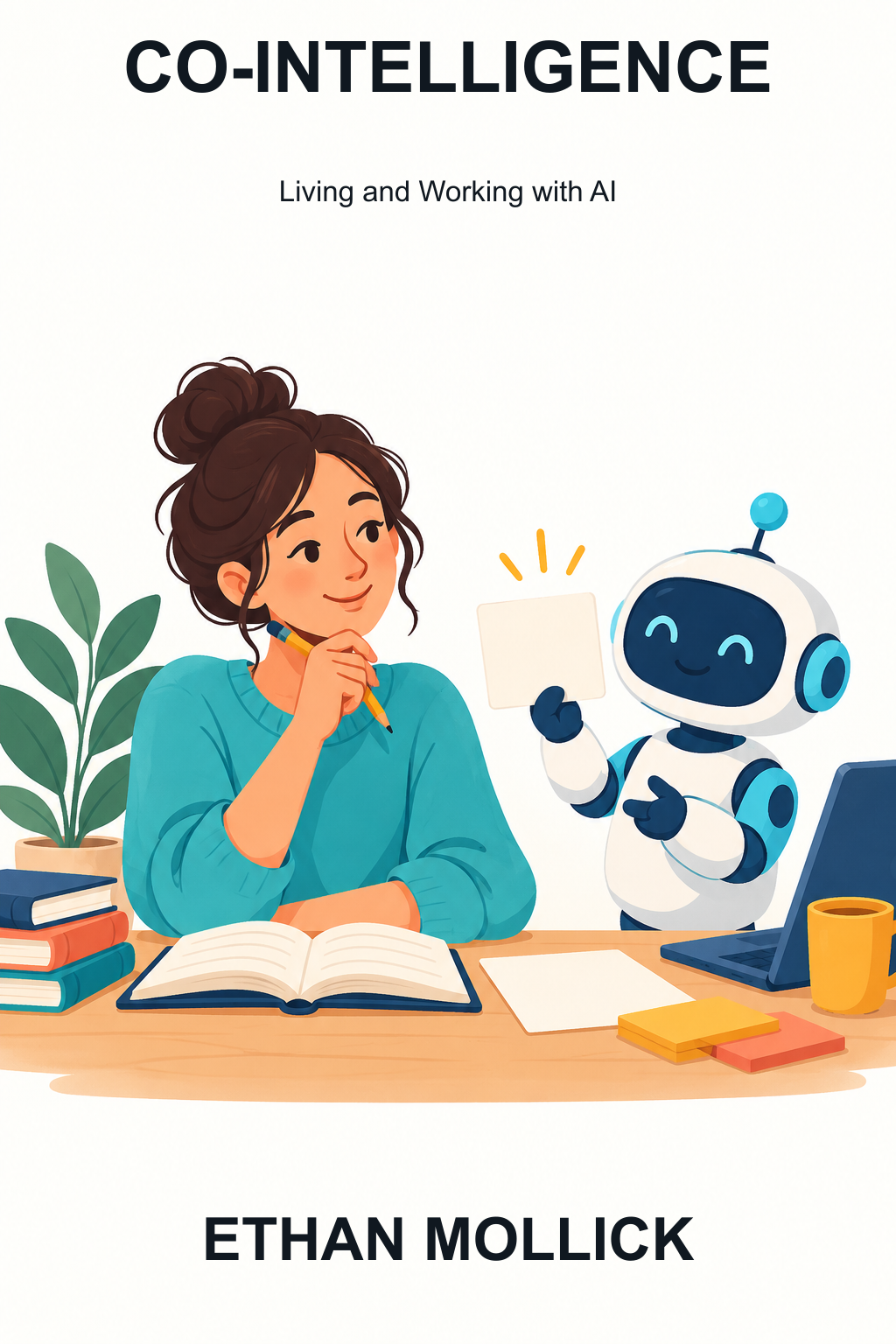
Mollick calls this relationship co-intelligence. The phrase does not mean that humans and AI have identical minds, equal moral standing, or the same kind of understanding. It means that people can increasingly accomplish work by thinking alongside an artificial system. The system supplies language, patterns, alternatives, and rapid responses. The person supplies goals, context, taste, values, lived experience, and accountability.
That division is important because AI can appear more human than it is. It speaks in a conversational voice, adapts to instructions, and can imitate expertise. These qualities make it useful to interact with it as if it were a person on a team. You can ask it to take a role, explain its reasoning, challenge a proposal, or tailor an answer to an audience. Yet treating it like a person is a working method, not a belief that it is conscious, trustworthy, or morally responsible.
Consider a hypothetical nonprofit director planning a community workshop. AI might suggest agendas, rewrite invitations for different audiences, anticipate questions, and generate a checklist. But it does not know the community’s history unless the director provides appropriate context. It cannot decide what promises are ethical, which details are confidential, or whether an apparently polished claim is true. The tool contributes possibilities. The human defines the purpose and accepts the consequences.
For Mollick, this is why AI is neither just a faster search box nor an autonomous employee. It is an unusually flexible partner whose strengths and failures must be discovered in use.
The Jagged Frontier
A key idea in the book is the jagged capability frontier. We often imagine technology improving in a neat line: simple tasks become automated first, then harder tasks follow. Generative AI does not feel like that. It may excel at a sophisticated-seeming task, such as producing several plausible marketing concepts or summarizing a long document, then fail at something a careful beginner could do, such as preserving a crucial fact or following an obvious constraint.
The boundary of competence is jagged because tasks that look similar to people may be very different for an AI system. A model might help a manager formulate ten ways to frame a difficult conversation but mishandle the names, dates, policies, or interpersonal stakes in the final message. It may offer an elegant explanation of a scientific concept while quietly mixing up two studies. Fluency is not proof.
This means job titles are a poor guide to what should be delegated. “Teacher,” “lawyer,” “designer,” “analyst,” and “manager” are bundles of many tasks. Some pieces may be enhanced by AI; others demand specialized human expertise, access to reliable evidence, ethical discretion, or genuine relationships. The sensible unit of experimentation is the task, not the entire profession.
Mollick’s practical answer is disciplined testing. Try AI on low-risk work first. Compare its output with known standards. Ask several versions of the same question. Look for repeatable value and recurring failure modes. If a tool helps create first drafts but regularly invents references, then it may be suitable for ideation, not for unsupervised research. A measured pilot teaches more than a sweeping promise that AI will automatically make everyone more productive.
Four Rules for Working Together
Mollick organizes his approach around four rules. The first is to invite AI to the table. This does not mean using it for everything or treating every output as valuable. It means exploring it widely enough to discover where it can help. People cannot reliably infer the useful applications of a new general-purpose tool from a distance. A procurement specialist, for example, might test it as a brainstorming partner for vendor questions, a formatter for meeting notes, a critic of a draft process, and a simulator of stakeholder objections. The results, rather than the buzz, should determine what stays.
The second rule is to remain the human in the loop. Humans must direct the work, inspect the result, and make the final call. This matters most when decisions affect money, health, employment, safety, rights, reputation, or other people’s lives. Verification is not a ceremonial glance at an answer. It means checking source material, calculations, assumptions, omissions, and fit with the real situation. It also means recognizing when you lack the expertise needed to evaluate the output and seeking qualified review instead of pretending the AI has solved the problem.
Third, treat AI like a person—but do not confuse that with assuming it is one. Conversation is often the most effective interface. Give the system a role, a goal, relevant background, constraints, examples, and a definition of a good answer. Asking it to act as a skeptical customer can produce a different result from asking for generic feedback. Asking it to explain a concept to a new employee, then quiz that employee, can create useful practice. Still, the persona is a prompt-design tool. It does not make the system an actual customer, expert, or colleague.
The fourth rule is to assume that this is the worst AI you will ever use. In the book’s 2024 context, this was an argument against building fixed assumptions around a rapidly moving technology. The modern implication is not that every future release will improve every task, or that organizations should chase novelty. It is that workflows, policies, and skills should be adaptable. Build habits of learning and review rather than freezing a process around one moment’s capabilities.
Creative Partner, Coworker, Tutor, Coach
Mollick explores several roles AI can play. As a creative partner, it can make abundance cheap. A blank page becomes a conversation: generate alternatives, combine two directions, propose metaphors, list objections, or write deliberately bad versions to clarify what good looks like. Its value is often not the final text. It is momentum, variation, and a prompt for the human to make sharper choices.
As a coworker, AI can take on bounded parts of knowledge work: organizing material, turning rough notes into a draft structure, translating a complex idea into several levels of explanation, or role-playing a demanding audience. But a coworker needs supervision. A team should decide what information may be entered into approved systems, what work requires review, who owns final approval, and how AI assistance is disclosed where disclosure matters.
As a tutor, AI can offer something traditional instruction often cannot: patient, immediate, individualized practice. A learner might ask for a plain-language explanation, request examples tied to a personal interest, attempt a problem, and receive hints instead of the answer. As a coach, it can help someone rehearse a presentation, identify weak assumptions, or create a realistic practice scenario.
The danger is using these roles to avoid thought. If a student asks AI to complete every assignment, the student may receive output without building understanding. If a manager lets AI write every difficult message, the manager may never develop the judgment and empathy required for leadership. Mollick’s better vision is active learning: use the system to create feedback loops, practice, and challenge, while retaining the mental effort that turns information into skill.
Centaur or Cyborg
Mollick uses two images to describe styles of collaboration. A centaur separates human and machine work. The person chooses the objective and handles the parts requiring judgment; the AI performs a distinct subtask. An analyst might decide the research question, inspect the evidence, and interpret the implications, while using AI to turn a confirmed dataset into several chart descriptions. The handoff is clear.
A cyborg approach is more intertwined. The person moves back and forth with AI in short cycles: draft a few sentences, ask for alternatives, revise them, ask for criticism from a chosen perspective, and rewrite again. In this model, the boundary shifts continuously during the task. Mollick suggests that this closer interaction can be especially powerful because it combines human direction with rapid machine iteration.
Neither style is automatically superior. Centaur work can make quality control, privacy, and accountability easier. Cyborg work can be useful for creative exploration or getting unstuck. The right choice depends on the stakes, the task, and the worker’s ability to judge what is returned. A novice may need a clearer division of labor and external review. An experienced professional may use rapid collaboration without losing control. In either case, AI should not become an invisible substitute for competence.
Responsibility, Bias, and Boundaries
The book’s optimism is conditional. AI can widen access to useful capabilities, but it can also spread errors at scale, reproduce bias, expose private information, and concentrate power in organizations that control data and computing resources. A helpful answer can still be harmful if it is based on a distorted pattern, delivered without necessary context, or used in a setting where people cannot challenge it.
Responsibility remains human even when the system produced the words. If a company uses AI to help draft customer communications, it is still responsible for accuracy and fairness. If a school uses AI-supported tutoring, educators remain responsible for learning outcomes, student privacy, accessibility, and appropriate assessment. If an employee enters confidential client material into an unapproved tool, convenience does not erase the duty to protect that information.
Practical safeguards begin with clear boundaries. Identify what data is prohibited, what uses require permission, and which decisions cannot be automated. Create review procedures proportionate to harm: a brainstormed slogan needs less scrutiny than a hiring recommendation. Keep records of consequential use when that supports auditability. Invite affected people to identify risks that designers and executives might miss.
Mollick’s framework does not promise an easy ethical formula. It asks people to become more deliberate. The more persuasive AI becomes, the more important it is to ask: Is this accurate? Whose perspective is absent? What evidence supports it? Who is harmed if it is wrong? And who, specifically, is accountable?
Final Summary
Co-Intelligence is ultimately a book about learning to collaborate with a powerful and imperfect new kind of tool. Mollick’s core advice is practical: experiment broadly, keep people responsible, communicate with AI using rich context and useful roles, and expect the technology to keep changing. The jagged frontier means that capability must be tested task by task, never assumed from polished language.
The goal is not to outsource judgment or declare humans obsolete. It is to redesign work so that AI handles some friction while people contribute purpose, expertise, care, verification, and moral responsibility. Use it to generate options, rehearse, explain, critique, and accelerate drafts. Do not let it replace the effort required to learn, decide, or stand behind a result.
Read from 2026, the book’s specific 2024 examples are historical snapshots. Its larger lesson remains timely: the advantage will not belong simply to those who have access to AI. It will belong to those who learn how to work with it thoughtfully, question it rigorously, and use it in service of distinctly human aims.