

Free text
Summary and key ideas
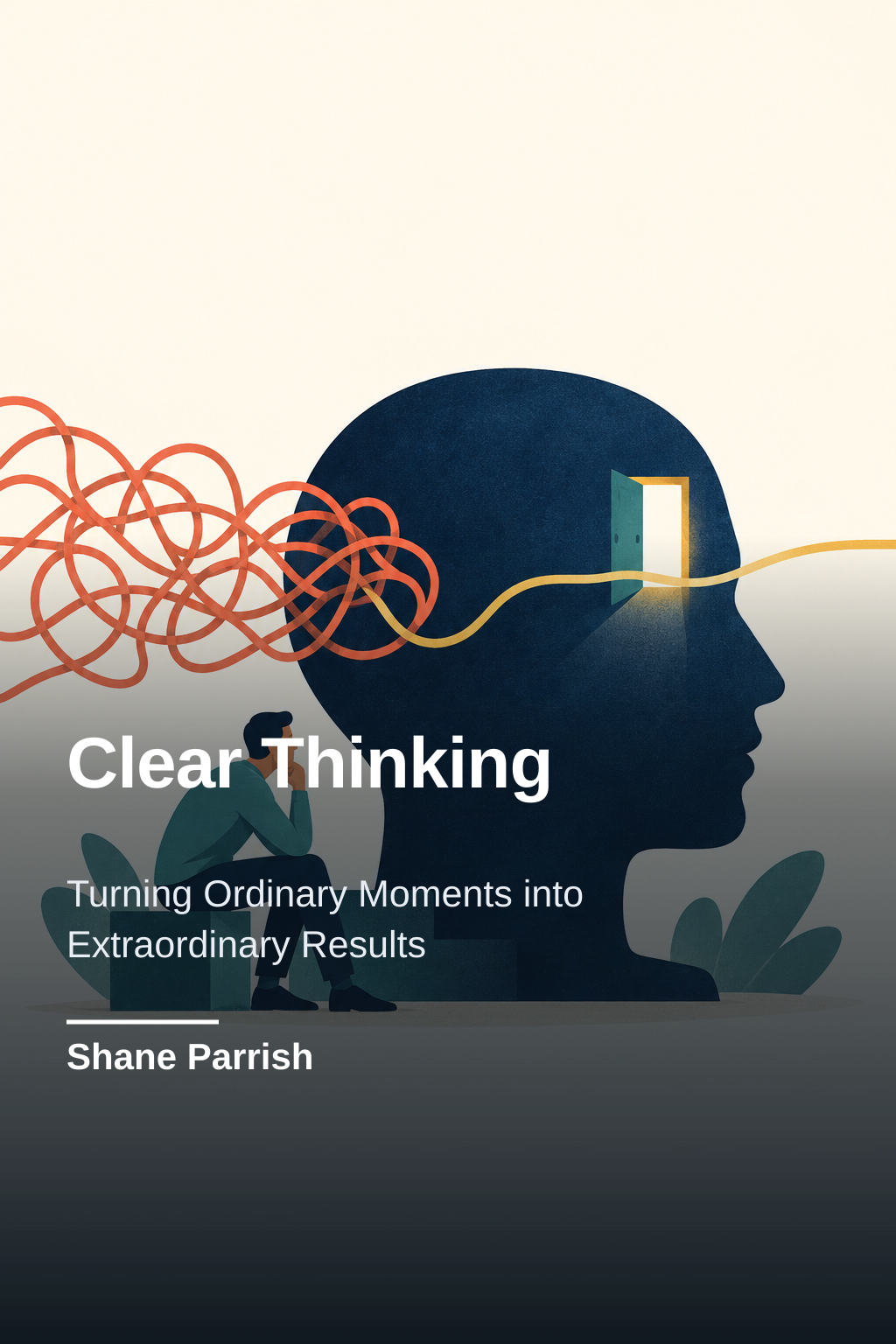
Book summary prepared by ReWio. Original book author: Shane Parrish.
Introduction
Most life-changing decisions do not arrive with a drumroll. They appear as ordinary moments: a tense remark from a colleague, an unexpected bill, an invitation, a disappointing result, a tempting shortcut, or a message that seems to demand an instant answer. Shane Parrish’s central claim is that these moments shape our direction because they invite either reaction or judgment. We often imagine that our biggest decisions happen at dramatic crossroads. In practice, our trajectory is also built from thousands of smaller choices that determine what opportunities remain open, what habits harden, and what problems grow.
The book calls the ability to meet these moments with judgment clear thinking. This is not a promise of perfect rationality. Nor is it an argument that emotions are bad or that successful people never act intuitively. Emotions can flag danger, reveal values, and energize action. Intuition can be useful when it rests on deep experience. Parrish’s concern is narrower and more practical: when pressure takes over before we recognize that a choice exists, our first impulse may make a situation worse.
His framework has a sequence. First, improve your position before difficult moments arrive. Then recognize the defaults that hijack judgment. Build the personal strengths that make a pause possible. Install safeguards so that good intentions survive bad conditions. Finally, use a disciplined decision process: identify the real problem, generate meaningful alternatives, weigh trade-offs, match the decision to its reversibility, and review your process separately from the result.
This is a useful framework, not an experimentally proven universal law of human success. Better reasoning improves the quality of choices and often improves the odds of better outcomes. Luck, incomplete information, other people, and changing circumstances still matter. The book’s deeper invitation is not to control everything. It is to become more responsible for the part of the future you can influence: the quality of your next response.
Positioning Before Pressure
Parrish begins with positioning. Before asking whether you can make a brilliant decision under stress, ask a more basic question: have you arranged your life so that fewer important decisions must be made at your worst?
Positioning means the conditions you bring into a moment. Sleep, health, preparation, financial margin, trustworthy relationships, useful information, and enough time all affect what you can see and do. A person who is exhausted, rushed, embarrassed, and cornered may technically have choices, but not the same practical freedom as someone who prepared earlier. Parrish argues that skilled decision-makers often look calm not because they possess superhuman willpower, but because they have avoided making their hardest choices from terrible positions.
This changes the meaning of preparation. Preparation is not only researching the meeting or rehearsing the presentation. It also includes building slack. Saving money creates room to say no to a damaging job. Maintaining relationships creates people to call before a crisis becomes public. Learning a skill before it is urgently needed expands future options. Leaving time between receiving a proposal and committing to it protects against pressure.
Original illustration: imagine a manager who must respond to a supplier failure. If she has ignored contracts, inventory levels, and relationships for months, she may have no realistic response beyond panic or blame. If she has cultivated alternatives and knows the risks in advance, the same failure remains unpleasant but becomes manageable. The immediate decision looks smarter because of work done long before the emergency.
Positioning does not erase hardship or imply that every disadvantage is self-created. Parrish is clear in spirit that circumstances can be unfair. The practical question is what can be improved from here. Which friction can you remove? Which capability can you build? Which recurring crisis can you prevent? Good positioning makes the desirable action easier and the damaging action harder. It turns clear thinking from a heroic performance into a more available option.
The Defaults That Take Over
The book identifies four defaults that commonly replace thinking with automatic reaction: emotion, ego, social pressure, and inertia. They are not diagnoses, and they are not separate boxes into which every human action fits. They are memorable lenses for spotting what may be steering you in a charged moment.
The emotion default is acting mainly from a current feeling rather than from considered judgment. Anger can make retaliation feel necessary. Fear can make avoidance feel prudent. Excitement can make a risky commitment look obvious. The aim is not emotional numbness. The aim is to notice that a feeling has arrived, ask what information it carries, and refuse to let it become the sole decision-maker. Feeling insulted may tell you that a boundary matters. It does not automatically tell you that sending the sharpest possible reply is wise.
The ego default protects self-image and status. We resist evidence that we were wrong, defend a failing plan because it is ours, or turn a disagreement into a contest we must win. Ego narrows the question from “What is true?” to “What makes me look competent?” Parrish’s alternative is an identity tied to learning and accuracy. If changing your mind is evidence of strength rather than humiliation, useful information becomes easier to accept.
The social default is conformity. We copy what peers do, defer to rank, or agree because disagreement could feel awkward. Belonging is a real human need, so this default cannot be solved by pretending we are independent islands. Instead, ask whether the group’s choice is actually sound, whether incentives are distorting the discussion, and whose perspective is absent. Sometimes the brave act is speaking; sometimes it is privately declining to join a crowd.
Inertia is continuing because continuation is easier than reconsideration. We stay with an obsolete project, a draining commitment, or an old routine because it is familiar, because we have already invested in it, or because changing course requires explanation. Inertia saves energy, which is often useful. But it becomes dangerous when habit substitutes for a current reason.
The point of naming these defaults is to create recognition. A useful prompt is: am I about to act because I am upset, protecting my image, following the room, or repeating yesterday? That question will not produce certainty. It can produce the small opening in which better judgment becomes possible.
Building the Capacity to Pause
Recognition alone is not enough. In a difficult moment, many people can see their impulse and still follow it. Parrish groups the capacities that support a better response under the word strength: self-accountability, self-knowledge, self-control, and self-confidence.
Self-accountability means taking ownership of your actions, abilities, limitations, and next steps. It is not the same as blaming yourself for every bad event. Some losses are caused by chance, injustice, or another person’s behavior. Accountability asks a forward-looking question: given what happened, what part is mine to understand and improve? Without that question, every review becomes a search for excuses or villains. With it, mistakes can become information.
Self-knowledge is specific rather than flattering. It means knowing where you are vulnerable. Perhaps you make reckless commitments when praised. Perhaps you become defensive with a certain family member. Perhaps you avoid financial details, overestimate your available time, or agree too quickly with senior people. General self-esteem does not expose these patterns. Honest observation does. Keeping a short record of decisions, triggers, and regrets can reveal the situations in which your defaults reliably appear.
Self-control, in this framework, is the ability to insert judgment between stimulus and response. It is not merely gritting your teeth in the moment. Parrish treats it as partly environmental: avoid predictable temptations, protect your energy, create time delays, and decide in advance what you will do. Willpower may help, but it is an unreliable foundation when fatigue, conflict, or desire are high.
Self-confidence is quiet trust in your capacity to face reality and act. It is not certainty, dominance, or pretending to know more than you do. A confident person can say, “I need time,” “I do not understand,” “I was wrong,” or “I disagree.” That independence is essential because clear thinking sometimes requires looking slow, asking a basic question, or declining approval.
These strengths reinforce one another. Accountability motivates learning. Self-knowledge identifies the danger zone. Self-control protects the pause. Confidence permits the honest action. Original illustration: before a high-stakes conversation, someone who knows they become sarcastic when anxious can write down the purpose of the meeting, ask for a pause if emotions rise, and focus on questions rather than accusations. That is not flawless composure. It is strength converted into a practical plan.
Safeguards That Work on Bad Days
Parrish’s most actionable insight may be that we should not depend on our best intentions at our worst moments. Instead, create safeguards: structures that make a damaging reaction less likely and a better response more likely.
A safeguard can prevent a problem, automate a decision, add friction, or provide a check before action. Prevention means refusing to make avoidable decisions in compromised conditions. If you know exhaustion makes you impulsive, do not schedule an irreversible negotiation at the end of a draining day. If a certain conversation predictably becomes destructive after alcohol, change the setting or postpone it.
Automatic rules replace repeated debate with a pre-chosen standard. “I wait until tomorrow before responding to hostile messages.” “I do not lend money without a written agreement.” “I save before I spend windfalls.” The quality of a rule depends on the person and context; overly rigid rules can create their own problems. But a well-designed rule stops every temptation from becoming a fresh trial of willpower.
Friction slows an unwanted behavior. Remove saved payment details if online shopping is a problem. Keep a draft rather than a send button for heated correspondence. Put distance between yourself and information feeds that repeatedly provoke outrage. Conversely, reduce friction for what you want to do: prepare healthy food, set an automatic transfer, keep a notebook ready before a meeting.
Checklists and outside perspectives are another form of safeguard. A brief pre-decision checklist can ask: What problem am I solving? What evidence would change my mind? What am I overlooking because I want this to be true? Who is affected? What happens if I wait? These are not magic questions. Their value is that they interrupt familiar blind spots.
Safeguards deserve special attention because they acknowledge human limits rather than denying them. No one pauses perfectly in every emotional moment. No one has unlimited attention. A system that relies on constant discipline is brittle. A system that assumes you will occasionally be tired, tempted, defensive, or rushed is more humane and more robust. The goal is not to build a prison around your life. It is to build guardrails around the places where one bad choice could have disproportionate consequences.
Finding the Real Problem
Once a decision requires deliberate thought, Parrish urges us to separate the problem from the first solution that comes to mind. This sounds simple, yet many bad decisions begin with a misframed question.
Suppose sales have fallen. “How do we cut costs?” may be a possible response, but it is not necessarily the problem. The actual issue might be a weak product, a changed market, a broken customer experience, a measurement error, or an unrealistic target. If a team decides on the answer before it agrees on the question, it may execute efficiently in the wrong direction.
A strong problem statement describes the gap between the present reality and the desired outcome without sneaking in a preferred solution. It identifies constraints, relevant facts, and the people affected. It distinguishes symptoms from causes. It also states what success would look like. That makes later disagreement more productive, because people can challenge assumptions instead of merely defending competing preferences.
Then explore options broadly enough to make choice real. The first option is often the path favored by convenience, habit, or whoever spoke first. Ask what else could be done, including doing nothing for now, gathering more information, running a small test, changing the goal, or walking away. Search for opportunity costs: every yes consumes time, money, attention, reputation, and alternatives. The most expensive cost may be invisible because it is the promising path you no longer have capacity to pursue.
Original illustration: a professional is offered a prestigious volunteer role. The immediate question seems to be whether the role is impressive enough to accept. A clearer question is whether it advances the person’s actual priorities and what it displaces: family time, recovery, a course, paid work, or a more meaningful commitment. The decision becomes less about status and more about trade-offs.
Clear thinking does not require endless analysis. It requires enough definition and alternatives to avoid treating an unexamined impulse as the only possible answer. Often, the greatest benefit is not finding a brilliant option. It is noticing that the apparent problem was not the real one.
Choosing Under Uncertainty
Decisions are made before outcomes are known. Parrish therefore emphasizes matching the amount of analysis to the kind of choice you face. One important distinction is between reversible and irreversible decisions.
A reversible decision can be changed at tolerable cost. You can test a marketing message, take a class, try a new workflow, or make a small purchase. These choices usually benefit from speed, experimentation, and learning. Waiting for complete certainty can waste more than an imperfect trial would cost.
An irreversible or costly-to-reverse decision demands greater care. It may involve a major relationship commitment, selling a core asset, accepting obligations that constrain future freedom, harming trust, or making a public choice that is difficult to undo. Here, a pause is especially valuable. Seek disconfirming evidence. Consider failure modes. Invite a dissenting view. Ask what you will wish you had known later. The book’s practical message is not “always go slowly.” It is “do not use the same tempo for every decision.”
Parrish also encourages evaluating decisions through process rather than outcome alone. A bad outcome can follow a sound decision because the world contains uncertainty. A good outcome can follow a careless gamble. If we judge only by results, luck teaches the wrong lessons. Review what information was available, what assumptions you made, what alternatives were considered, whether incentives distorted you, and whether your reasoning was sound at the time.
This does not mean outcomes are irrelevant. Outcomes are feedback. They may reveal that an assumption was wrong or a capability was missing. But they must be interpreted carefully. The question is not only, “Did this work?” It is also, “Was this a repeatable way to decide?”
The framework is particularly valuable in groups. Before a consequential decision, clarify who owns it, what success means, which risks are acceptable, and what would trigger a revision. Afterward, conduct a review that is honest without becoming punitive. If people fear blame, they will hide uncertainty before the decision and rewrite history after it. Better process depends on making truth safer than image management.
Pursuing What Deserves a Life
The final layer of the book is about direction. Clear thinking is not valuable merely because it makes us efficient. Efficiency can help us reach goals that were never worth pursuing. Parrish asks readers to consider what they actually want, not simply what is available, fashionable, or applauded.
This question matters because the social and inertia defaults can quietly choose our ambitions for us. A person can become exceptionally capable at chasing promotions, attention, consumption, or busyness and still discover that the activity did not create the life they hoped for. The remedy is not a universal list of worthy goals. Values differ. It is regular reflection on the trade-offs embedded in your commitments.
What are you trying to optimize? What does success cost? Which opportunities require you to become someone you do not want to be? What are you saying no to by saying yes? These questions transform decision-making from a technique for accumulating wins into a practice of living deliberately.
There is also a moral dimension to accountability. It is tempting to demand high standards from others while giving ourselves explanations. Parrish’s framework asks for the reverse discipline: hold yourself to clear standards, take responsibility for repair when you fail, and leave room for the reality that other people have constraints and defaults too. Clear thought without humility can become merely better rationalization.
Original illustration: someone may have the option to take a better-paid role that requires constant travel. The analysis should include income and status, but also energy, relationships, health, and the kind of daily life the person wants. There may be no objectively correct answer. There is, however, a more honest answer when the costs are named rather than ignored.
The destination matters because decision quality is partly about consistency between your choices and your values. A well-reasoned life is not one free of regret. It is one in which you are less likely to discover that your habits made your deepest choices without asking you first.
Final Summary
Clear Thinking offers a compact discipline for the gap between what happens and what you do next. Parrish’s argument is that ordinary moments have unusual power because automatic reactions accumulate. Improve your position before pressure arrives. Notice whether emotion, ego, social pressure, or inertia is taking the wheel. Build accountability, self-knowledge, self-control, and confidence so a pause becomes possible. Then support yourself with rules, friction, checklists, and environments designed for real human limitations.
When a decision matters, name the actual problem rather than rushing toward a familiar answer. Generate alternatives and their opportunity costs. Move quickly when choices are safely reversible; slow down when they are not. Learn from outcomes, while judging your reasoning separately from luck. Finally, ask whether the goal itself deserves your time and your life.
The book does not offer certainty, emotional detachment, or guaranteed extraordinary results. Its more credible promise is practical: deliberate preparation and better process can improve the chances that your actions reflect your values and your best judgment. The decisive resource is often not more intelligence. It is the willingness to notice the moment, create a pause, and choose on purpose.