

Free text
Summary and key ideas
Book summary prepared by ReWio. Original book author: Rolf Dobelli.
Introduction
Clear thinking is not the same as having a high intelligence score, a prestigious education, or a quick answer. Dobelli’s starting point is more humane than that. All of us rely on mental shortcuts because we must make countless judgments with incomplete information, limited time, and finite attention. Those shortcuts can be useful. They let us act without calculating every possibility from scratch. But they can also misfire when the environment is complex, emotionally charged, or designed to exploit a predictable reaction.
The book presents a popular synthesis of research on cognitive errors: recurring ways in which judgment can drift away from good evidence or sound probability. Its point is not that every intuition is wrong, nor that every named bias is equally robust in every setting. Some effects depend heavily on context, and behavioral science continually refines its conclusions. The more durable practical insight is simpler: when a decision matters, intuition alone deserves a second look.
Dobelli urges us to become less impressed by stories that arrive too easily. We naturally seek causes, patterns, heroes, villains, and confident explanations. Reality often offers noise, hidden alternatives, competing incentives, and luck. A useful response is not paralysis. It is intellectual friction: a brief pause between an appealing first impression and a committed choice.
Throughout this summary, treat the biases as warning labels, not diagnoses. Recognizing a label does not make anyone immune. In fact, knowledge can create a new form of overconfidence: the belief that biases belong mainly to other people. The aim is more modest and more valuable. Build situations in which evidence can challenge you, uncertainty can be stated plainly, and a decision can be judged by the quality of its process rather than by one fortunate or unfortunate result.
What Success Hides
We are drawn to visible winners. A thriving company, a famous artist, a successful investor, or a friend whose career took off all provide a vivid, available story. The invisible comparison group is much harder to picture: the similar companies that failed, the equally talented people who were never noticed, the strategies that produced losses, and the ventures that quietly disappeared. This is the core of survivorship bias. We learn from what remains in view while forgetting that survival itself was part of the selection process.
The practical danger is copying the surface features of winners as if those features caused the result. Perhaps a founder was relentlessly optimistic, worked extreme hours, or made a bold bet. Those traits may have helped. They may also have been shared by many unsuccessful founders whom we never hear about. Success is often a mixture of skill, timing, resources, persistence, and luck. The right lesson is not that success teaches nothing. It is that success stories are incomplete datasets.
That incompleteness also distorts causal reasoning. When two things occur together, we quickly assume one produced the other. But correlation can arise because a third factor drives both, because the apparent cause follows the effect, or because selection has filtered out inconvenient cases. A high-performing team may use a certain management practice, for example, but that observation alone cannot tell us whether the practice created performance, whether performance made the practice affordable, or whether another variable explains both.
Before adopting a lesson from an outstanding case, ask: Compared with what? Who tried something similar and did not succeed? What was filtered out before I saw this example? Seek base data, not just memorable narratives. When the comparison group is unavailable, lower the confidence of the conclusion. That is not cynicism. It is respect for the part of reality that success has hidden.
The Pull of the Crowd
Humans are deeply social learners. When a restaurant is full, a product has thousands of positive reviews, or a room agrees with apparent certainty, following the group can be sensible. Other people may possess information we do not. Dobelli’s warning is that social proof becomes dangerous when we mistake popularity for proof, especially when people are observing one another rather than independently assessing the evidence.
Crowds can create a feedback loop. Early choices become visible. Visibility makes those choices look informative. More people imitate them, making the original signal appear even stronger. In markets, workplaces, media, and online spaces, this can produce cascades: many people converge on an option not because each investigated it carefully, but because each inferred that the previous person must know something. The group may be right. It may also be collectively amplifying a weak initial cue.
Salience strengthens this effect. We overweight what is vivid, recent, dramatic, or easy to recall. A striking disaster, a viral anecdote, or a sensational headline feels more representative than dry background evidence. Availability is not the same as frequency. A risk that comes easily to mind may be common, but it may also simply have received extraordinary attention. Conversely, ordinary and gradual dangers can be underestimated precisely because they make poor stories.
A practical safeguard is to separate information from imitation. Ask what each person actually knows, what they merely believe others know, and whether independent assessment is still possible. In a meeting, collect views before the most senior voice speaks. When researching a purchase or investment, look for criticism as deliberately as praise. When an issue feels urgent because it is everywhere, ask whether the attention reflects its probability, its consequences, or merely its emotional force.
Social input is valuable. The discipline is to use the crowd as one source of evidence, not as a substitute for evidence.
The Stories We Want to Believe
Confirmation bias is the mind’s tendency to favor information that supports an existing view and to discount, reinterpret, or simply avoid information that threatens it. This is not usually a conscious fraud. Once an idea is tied to identity, hope, prior effort, or belonging, evidence can feel personal. We start acting like lawyers for our first conclusion rather than investigators of what is true.
Dobelli’s broader lesson is that beliefs should earn their confidence through exposure to resistance. Looking only for agreement may make us feel informed, but it mainly reveals how efficiently we can curate reassurance. A better question is: What evidence would genuinely change my mind? If no imaginable observation could count against a claim, the claim is insulated from learning.
Anchoring is another way early impressions shape later judgment. An initial price, estimate, target, or label can become a reference point even when it is arbitrary or weakly relevant. Contrast effects then make the next option look cheap, expensive, impressive, or disappointing relative to what came before rather than relative to its own merits. Skilled negotiators, marketers, and presenters understand this. So do our own minds when they latch onto the first number or comparison available.
The countermeasure is not to become suspicious of every fact. It is to create a competing starting point. Before seeing others’ forecasts, write down your own range and reasoning. Before negotiating, research independent benchmarks. Before choosing among candidates, establish criteria in advance rather than letting the first strong impression define the scale. Before defending a plan, assign someone the role of constructive dissenter.
The goal is not endless argument. It is to turn disagreement into a tool. Disconfirming evidence is not a threat to intelligence; it is the material from which a more accurate judgment can be made.
Confidence, Forecasts, and Probability
People often confuse the feeling of certainty with the reliability of a prediction. Dobelli emphasizes overconfidence because it affects planning, investing, hiring, medicine, and everyday promises. We tend to generate crisp narratives about an uncertain future, then mistake the coherence of the narrative for evidence that events will unfold that way. Yet many outcomes depend on variables we cannot observe, cannot control, or do not even know to include.
Forecasting is especially vulnerable when a situation is novel, complex, or far into the future. A precise estimate can look professional while concealing fragile assumptions. The appropriate response is not to reject forecasts altogether. Plans require estimates. Instead, match the precision of the claim to the quality of the evidence, use ranges rather than falsely exact point predictions, and update when reality provides feedback.
Base rates are one of the best defenses. A base rate asks what typically happens across a relevant reference class before we focus on the vivid details of a particular case. When evaluating a new venture, project, or personal goal, the unique story matters, but so does the historical pattern for similar ventures, projects, or goals. Ignoring the base rate lets an exceptional narrative crowd out the broader odds.
Probability neglect adds an emotional complication. When a possible event evokes fear, hope, or outrage, we may focus on how strongly we feel about its outcome and pay too little attention to how likely it is. Conversely, a small probability can be dismissed when it lacks drama, even if the consequences would be severe. Good risk judgment weighs both likelihood and impact.
Use an outside view before the inside view. First ask what happened in comparable cases. Then ask which concrete features make this case meaningfully different. Keep a decision journal containing the prediction, its confidence range, the evidence considered, and the assumptions made. Later, review it without excuses. Calibration grows not from feeling less confident, but from repeatedly comparing confidence with reality.
Past Costs and Present Choices
A sunk cost is a cost that has already been paid and cannot be recovered by the choice now available. Time spent, money invested, effort expended, and public commitments can all feel like reasons to continue. But they are not automatically reasons. The relevant question is forward-looking: given what I know now, would I choose this option if I were starting today?
This is easy to state and difficult to practice. Quitting can feel like admitting that earlier effort was wasted. Continuing can feel loyal, brave, or consistent. Yet persistence and rationality are not the same. Sometimes further investment is justified because future benefits remain strong. Other times, it merely transforms an old loss into a larger one. Dobelli encourages the discipline of treating the past as information, not as an invoice that the future must repay.
Incentives make this even more important. People respond to rewards, penalties, status, targets, and institutional rules, often in ways that are not visible in their stated reasons. A salesperson may emphasize short-term volume because the compensation plan rewards it. A manager may protect a failing project because cancellation harms reputation. A commentator may favor dramatic claims because attention, not accuracy, drives the reward. This does not mean everyone is cynical or corrupt. It means that good analysis includes the question: What behavior does this system make attractive?
For personal choices, use a restart test. If you had not yet spent the money, time, or pride, would you begin again? For organizations, establish stop rules before a project becomes emotionally loaded: conditions under which funding ends, assumptions that must prove true, and review points led by people who did not sponsor the original decision. For any persuasive recommendation, examine the incentive structure alongside the argument.
This creates freedom. You cannot change a past commitment, but you can decide whether it deserves another unit of your future.
Judging Decisions Fairly
A decision can be sensible and still lead to a bad outcome. A reckless decision can produce a lucky win. This distinction is central to better judgment, because outcome bias tempts us to evaluate the quality of a choice solely by what happened afterward. When luck is involved, the result is evidence, but it is not the whole verdict.
Hindsight bias compounds the problem. Once we know an outcome, it begins to feel as though it should have been obvious. We reconstruct the past as a neat path to the present, forgetting the uncertainty that existed before the event. This can make us unfairly blame decision-makers, overlearn from one success, and become overconfident about our own ability to predict the next case.
Action bias and omission bias pull in different directions. In some settings, people feel compelled to do something simply because inactivity looks irresponsible. In others, harm caused by an action feels worse than comparable harm resulting from inaction, so people avoid acting even when a change is warranted. Neither instinct is a universal rule. The important question is whether the difference between action and omission is genuinely relevant, or whether it merely changes how accountable we feel.
Dobelli’s practical implication is to judge choices with information available at the time. What alternatives were considered? What probabilities seemed reasonable? What incentives and constraints were present? Was the process designed to detect error? These questions do not excuse negligence. They make evaluation more accurate.
A pre-mortem is useful before acting. Imagine that the plan failed and describe the likely reasons. This gives concerns permission to surface before optimism hardens into commitment. Afterward, conduct a review that distinguishes process errors, unforeseeable surprises, and plain luck. The purpose is learning, not self-protection. A culture that punishes every bad outcome will soon teach people to hide uncertainty. A culture that examines decisions honestly can improve even when outcomes remain unpredictable.
Designing Better Decisions
The book’s deepest practical message is not to memorize a long catalog of mental traps. It is to build systems that reduce the cost of being human. Under pressure, memory is selective, attention narrows, and our preferred story grows louder. Procedures can create the pause that insight alone often fails to provide.
Start by classifying decisions. Small, reversible choices do not deserve exhaustive analysis. Large, irreversible, or repeated decisions do. For those, use a checklist that asks: What is the base rate? What evidence contradicts our favored view? What incentives shape the advice? What would make us stop? What is being compared, and is the comparison fair? A simple checklist is not a replacement for judgment. It is a way of ensuring that judgment addresses the questions most likely to be skipped.
Seek independent views before discussion creates convergence. Ask people to write private estimates, identify their confidence, and explain their assumptions. Then compare reasoning, not just conclusions. Invite someone who is not invested in the plan to conduct a red-team review. The aim is not theatrical skepticism or permanent opposition. It is to reveal failure modes while there is still time to change course.
Decision journals are equally powerful at an individual level. Record what you expect, why you expect it, what would prove you wrong, and how you will evaluate the choice later. The journal interrupts hindsight bias because it preserves the actual uncertainty of the moment. Over time, it exposes recurring errors in your own reasoning: perhaps you underestimate delays, overweight charismatic people, or treat a single anecdote as a trend.
Finally, create distance from urgent signals. Sleep on consequential choices when possible. Separate the first proposal from the final decision. Recalculate from zero rather than from the opening anchor. And when you cannot know enough, choose robustness: options that remain acceptable across several plausible futures. Clear thinking is less about producing certainty than about making uncertainty visible and manageable.
Final Summary
The Art of Thinking Clearly offers a memorable map of ways judgment can go astray. Its enduring value is not the promise that a person can eliminate bias through awareness. Nobody becomes neutral simply by learning a vocabulary of errors. The value lies in changing the questions we ask when confidence rises too quickly.
What are we not seeing because failures vanished from view? Are we mistaking an association for a cause? Are we following a crowd that is following itself? Are we defending a belief because we tested it, or because we collected support for it? Has an early number set the scale? Are we respecting base rates, or allowing a vivid story to overpower them? Are we continuing because the future is promising, or because the past feels expensive? And are we evaluating a decision by its process, or by one outcome that luck helped shape?
Dobelli’s framework should be used with proportion. Heuristics can be efficient. Expert intuition can be valuable in environments with reliable feedback. Some labels in popular behavioral writing are simplified, debated, or context-sensitive. But the central discipline remains sound: important decisions improve when they are made in ways that can be examined, challenged, and revised.
So aim for better architecture, not a flawless mind. Write down assumptions. Use checklists. Consult independent views. Conduct pre-mortems. Establish exit criteria. Track forecasts. Look for the missing comparison group. Treat incentives as evidence. And give yourself permission to change course when the facts change.
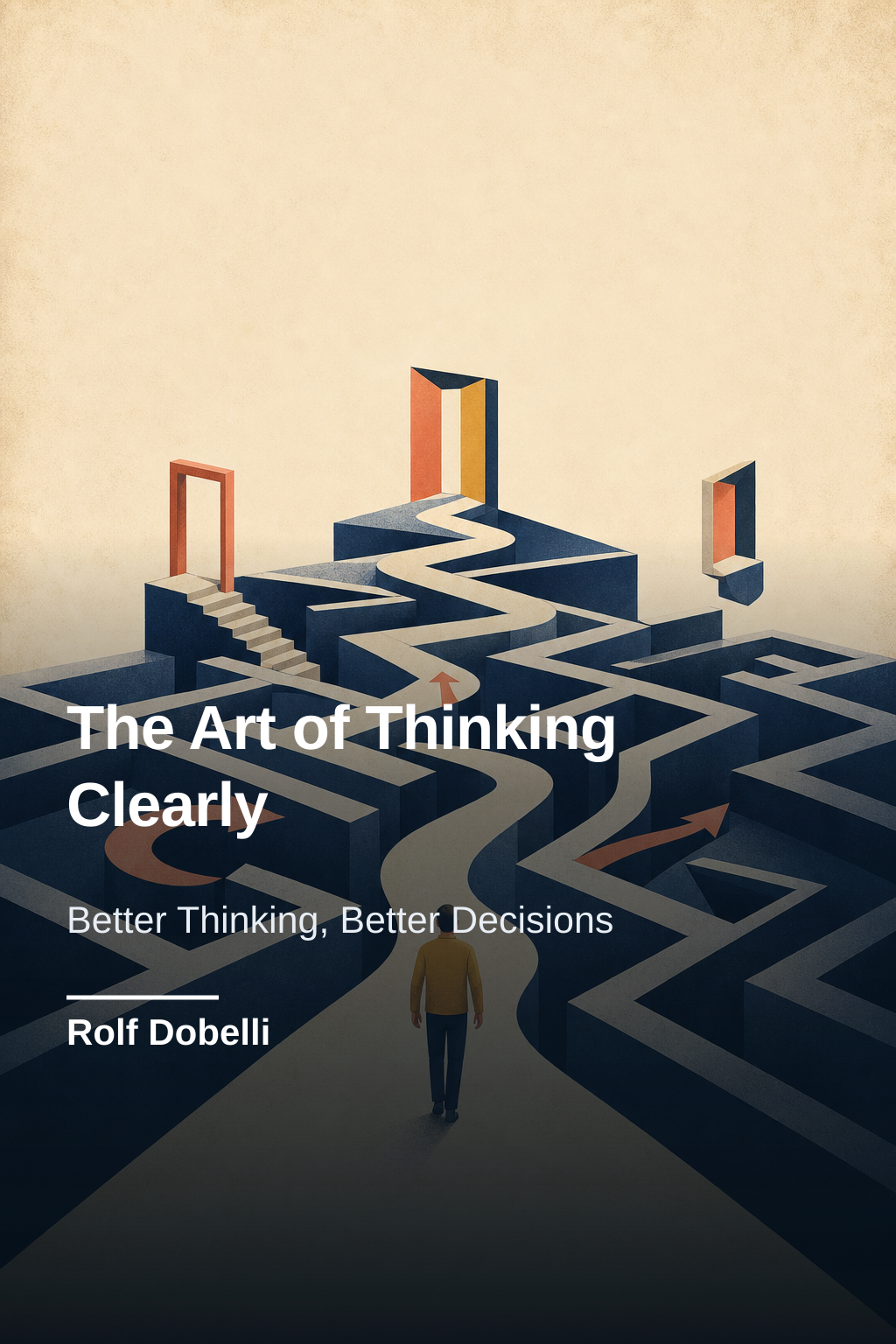
Thinking clearly is not the art of never being wrong. It is the practice of becoming less predictably wrong, more honest about uncertainty, and more capable of learning before the same invisible bends in the maze lead you back to the same familiar dead end.