

Free text
Summary and key ideas
Book summary prepared by ReWio. Original book author: David Brooks.
Introduction
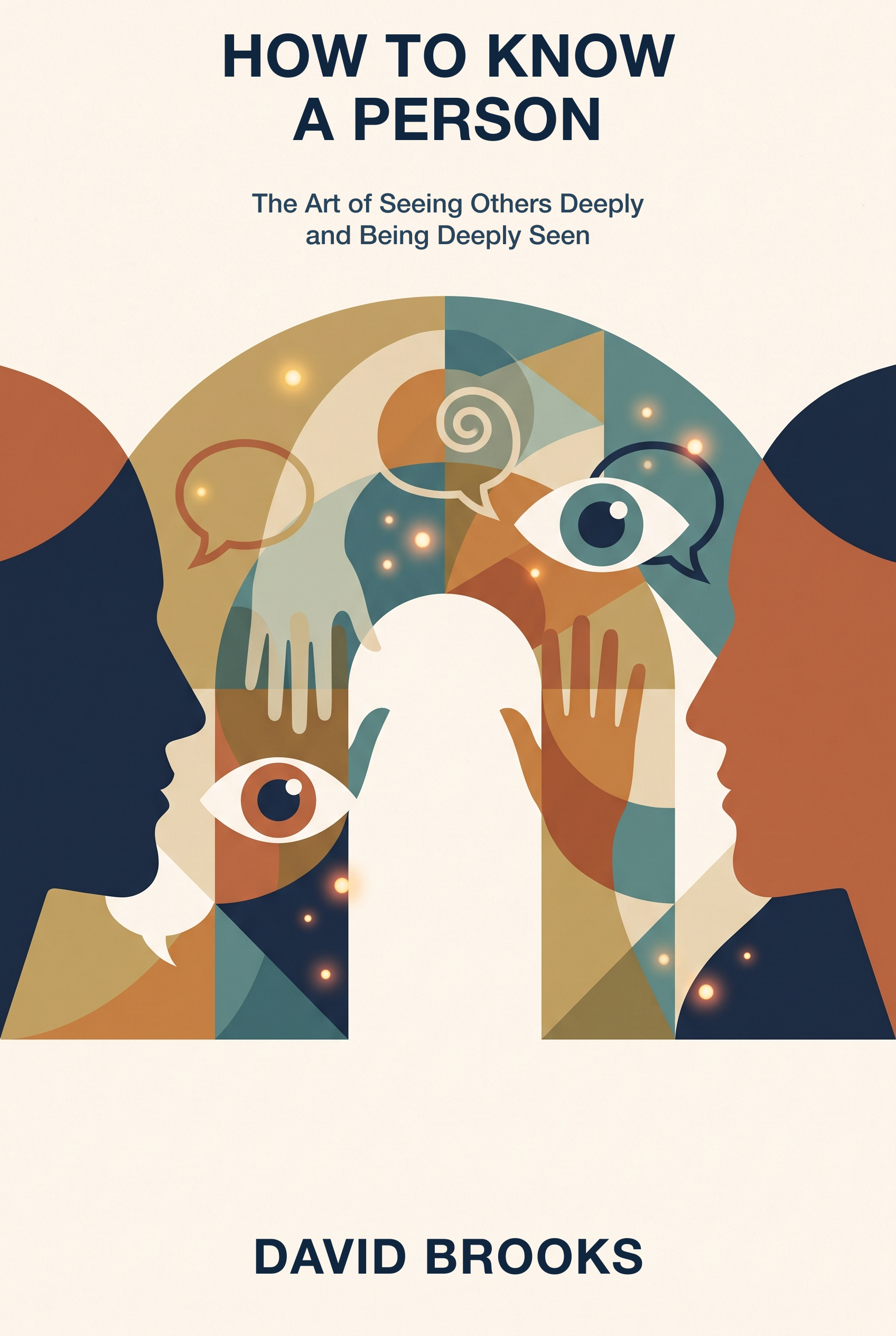
How do you know whether somebody feels genuinely seen by you? Not whether they were entertained, advised, impressed, or politely acknowledged, but whether they left the interaction feeling more real to themselves. That is the question at the center of David Brooks’s How to Know a Person.
Brooks’s core claim is ethical as much as social: the ability to perceive another person with accuracy, curiosity, and respect is a foundational human skill. It matters in friendship and marriage, at work and in classrooms, in neighborhoods, and across political divides. The official reader’s guide highlights the book’s recurring concerns with deep listening, curiosity, dignity, humility, insecurity, and the contrast between people who enlarge others and people who make them feel smaller.
This is not a book claiming that there is a foolproof technique for decoding people. In fact, one of its most helpful messages is that people exceed our first impressions and our categories. Brooks mixes anecdotes, moral reflection, and ideas from psychology, neuroscience, education, philosophy, and theater. His stories and broad cultural diagnoses are his interpretations, not settled scientific findings. Where research is relevant, the safer conclusion is modest: attentive listening, responsive conversation, social support, and feeling understood are generally associated with healthier relationships and well-being. They do not give us perfect access to another mind.
The book asks for a change of posture. Instead of approaching people as puzzles to solve, audiences to win, threats to manage, or resources to use, approach them as inwardly complex lives. The practical question becomes: what would I do differently today if I believed that every person I met had a story I could not see yet?
Choose to Illuminate
Brooks organizes much of the book around two social types: illuminators and diminishers. An illuminator brings out a person’s presence. They convey, through facial expression, questions, timing, and tone, that the other person is worth noticing. A diminisher does the opposite. They redirect attention to themselves, treat people as stereotypes, rush toward judgment, compete for status, or subtly communicate that the other person is boring, inadequate, or beneath consideration.
These are not permanent personality categories. The point is not to diagnose villains and heroes. Most of us illuminate in some moments and diminish in others, especially when distracted, anxious, hurried, defensive, or eager to appear smart. Brooks’s useful provocation is that conversation has consequences beyond information exchange. A small interaction can either strengthen someone’s sense that they belong in the world or confirm their fear that they do not.
His language here is normative. He is asking what kind of person we ought to become. Psychological research can support a narrower related idea: people are sensitive to signals of acceptance, rejection, responsiveness, and status, and perceived partner responsiveness is important in close relationships. But the book’s larger claim—that illumination is a central civic virtue—is Brooks’s moral synthesis.
To practice illumination, begin before the first question. Put away the device. Orient your body toward the person. Let your face show that you are receiving rather than evaluating. Notice when you are rehearsing your reply. Then make a specific, non-flattering observation: ‘You seemed energized when you mentioned that project,’ or ‘That sounds like it took more courage than you are giving yourself credit for.’ The aim is not praise for its own sake. It is accurate recognition.
Illumination also means resisting the temptation to freeze someone at their least impressive moment. People can be awkward, guarded, angry, or self-protective and still contain capacities not visible to us yet. Seeing those capacities does not require naïveté or endless tolerance. It requires refusing to make a thin snapshot stand in for a whole person.
Attention Is a Moral Act
Brooks treats attention as a moral quality. We often describe attention as a neutral mental resource: you either focus or you do not. But in a relationship, how we attend reveals what we assume about another person. Do we scan for status markers? Do we listen only for something that confirms our theory? Do we wait for an opening to display our own experience? Or do we make room for surprise?
The book’s argument is that good attention is active, generous, and disciplined. It asks us to notice the individual in front of us rather than the role they occupy: not simply the difficult coworker, the successful sibling, the teenager, the stranger with the wrong politics, or the person who has disappointed us. Roles matter, but they never exhaust a life.
Brooks also emphasizes humility. You do not know someone merely because you share a demographic group, a profession, a diagnosis, a religion, or a political label. Those contexts may shape experience, but they do not settle the meaning of that experience. The humble listener holds an initial hypothesis lightly and lets the person revise it.
There is established support for part of this picture. Attention is limited, and distraction impairs comprehension and memory. Interpersonal research also suggests that people tend to value partners who seem responsive—who appear to understand, validate, and care for them. Still, we should not turn this into a performance trick. Someone can deploy eye contact and affirming phrases while remaining manipulative or incurious. The moral substance lies in whether your attention actually changes what you are willing to notice and how you act.
A daily exercise is to choose one encounter in which you will not optimize for speed, influence, or self-presentation. Optimize for presence. Ask yourself afterward: What did I learn that I would have missed if I had relied on my first impression? That question turns attention from a vague virtue into a repeatable practice.
Questions That Reveal a Life
Small talk is not the enemy in Brooks’s account. It can be a gentle bridge into contact. The problem comes when conversation never leaves the surface, or when questions are used like an intake form: efficient, extractive, and forgettable. To know a person, Brooks encourages questions that invite narrative, meaning, and self-interpretation.
A life-story question is not necessarily dramatic. Rather than asking only what someone does, ask how they came to care about it. Instead of ‘Where are you from?’ try ‘What was that place like for you growing up?’ Instead of ‘How was your weekend?’ ask ‘What was the best part of it?’ You might ask about a turning point, a mentor, an object they keep, a decision they reconsidered, a period that formed them, or a hope they are carrying now.
The difference is important. Facts organize a résumé; stories reveal a person’s felt world. They show what someone notices, whom they credit, what they regret, what they protect, and the language through which they make sense of their own life. Even then, remember that stories are not transparent windows. People may be private, uncertain, strategic, or still discovering what an event meant. Good questions create an invitation, not an obligation to disclose.
Brooks’s approach also requires pacing. A highly personal question can feel caring in a close friendship and intrusive in a new workplace relationship. Match the depth of your question to the trust that exists, and offer some appropriate vulnerability yourself. Reciprocity reduces the sense that one person is being examined.
A practical sequence is: ask an open question; listen for a phrase with emotional energy; follow that phrase rather than jumping to the next topic; and finally check your understanding. ‘It sounds as if that move was exciting, but it also cost you a community. Is that close?’ This is more valuable than an impressive question list. The person, not the technique, should determine where the conversation goes.
Listen for Meaning, Not Just Content
Deep listening is perhaps the book’s central skill. Brooks distinguishes it from simply staying quiet while another person speaks. Listening deeply means trying to understand not only the literal content of someone’s words, but also their emotions, assumptions, longings, conflicts, and unanswered questions.
That sounds intuitive, but it is difficult because the mind races ahead. We compare their story with ours, formulate advice, decide whether they are right, or prepare our own anecdote. Brooks asks listeners to postpone those reflexes. The first task is not to fix, rank, or rebut. It is to help the speaker feel that their experience has landed somewhere.
Reflective responses help. You can summarize the emotional shape of what you heard: ‘You are proud of what you did, but also exhausted by being the reliable one.’ You can name ambiguity: ‘Part of you wants the opportunity, and part of you fears what you would lose.’ Or you can ask a simple clarifying question: ‘What did that moment mean to you?’ These responses are valuable when they are tentative. Say ‘It sounds like’ rather than announcing that you know exactly what another person feels.
Brooks’s concern about projection is crucial. Empathy is not pretending that their experience is your experience. When somebody describes grief, illness, racism, betrayal, financial fear, or a family conflict, your similar story may help later. But rushing to it can replace their reality with yours. A better stance is compassionate curiosity: I may not know this from the inside, but I want to understand how it has been for you.
Research on active or responsive listening supports the broad practical direction: people generally feel more understood when listeners attend, ask relevant follow-ups, and respond in ways that show comprehension. Yet no method guarantees accuracy. We sometimes misread signals. The repair is simple and powerful: invite correction. ‘Did I get that wrong?’ That sentence makes listening a collaborative process rather than a claim of mind-reading.
See Personality in Context
Brooks warns against two opposite errors. One is flattening people into types: the introvert, the narcissist, the conservative, the anxious employee, the difficult parent. The other is acting as if personality does not exist at all. His middle path is to notice enduring tendencies while remembering that behavior changes with context, history, culture, power, stress, and safety.
People differ in temperament, social energy, emotional reactivity, communication style, and need for structure. Personality psychology does find relatively stable patterns of traits across time, though traits are descriptive tendencies, not destiny. At the same time, the same person can appear reserved in a competitive meeting, funny with siblings, careful with strangers, and generous in a crisis. Context does not make the person fake. It reveals different parts of their repertoire.
Brooks’s practical advice is to become a better observer of the environments that shape behavior. Ask what pressures the person may be under. What social rules are operating here? Who has more power? What has this person learned is safe to reveal? What cultural assumptions might be shaping the interaction? Such questions reduce the common mistake of turning a situational reaction into a character verdict.
This is especially important in conflict. If a colleague seems dismissive, the explanation might be arrogance. It might also be time pressure, fear, an unfamiliar communication norm, or a history you do not know. Contextual curiosity does not excuse harmful conduct. It simply improves diagnosis before response.
A useful practice is to replace the sentence ‘They are the kind of person who…’ with ‘In this setting, they seem to be responding as if…’ The second sentence is less final. It leaves room for new evidence, for accountability, and for the possibility that your first reading was incomplete. In Brooks’s terms, it is another way of respecting the mystery and particularity of a person.
Accompany Suffering Without Taking It Over
One of the hardest forms of seeing is to remain present when someone is in pain. Brooks argues that suffering cannot always be solved, explained, or converted into a lesson. In moments of grief, illness, loss, depression, humiliation, or trauma, a person may need companionship more than instruction.
This is where well-meant empathy often goes wrong. We minimize: ‘Everything happens for a reason.’ We rush toward silver linings. We compare: ‘I know exactly how you feel.’ We problem-solve before permission has been given. Or we withdraw because another person’s suffering makes us helpless and uncomfortable. Brooks calls for a more patient response: acknowledge what is real, stay nearby, and let the sufferer retain authority over their own story.
The distinction between empathy and projection matters. Empathy says, ‘I am trying to be with you in this.’ Projection says, ‘Your pain is now a stage for my feelings, memories, advice, or need to be useful.’ The first makes room; the second crowds the person out.
The book’s guidance is humane rather than clinical. Severe depression, trauma, suicidality, abuse, addiction, and acute mental-health crises may require trained professional or emergency support, not just a caring friend. But companionship still matters. Small concrete offers are often better than vague declarations: bring dinner on Tuesday, drive them to an appointment, sit quietly, send the message you promised to send, or remember an anniversary that will be difficult.
Psychological evidence broadly supports the importance of social connection and support for coping and well-being, though support must fit the recipient’s needs to be helpful. Brooks’s deeper claim is moral: do not demand that pain become convenient, inspiring, or quickly resolved. To accompany someone is to communicate, through reliable presence, ‘You do not have to perform being okay for me.’
Disagree Without Stripping Dignity
Brooks sees social fragmentation as partly a failure of perception. In hard conversations, we often become prosecutors. We collect evidence, assign motives, and prepare a devastating counterargument. The other person becomes a representative of a tribe rather than a particular human being with fears, loyalties, experiences, and reasons.
His alternative is not agreement, passivity, or false balance. Some beliefs and actions do real harm and should be challenged. The skill is to challenge without contempt—to oppose a claim without treating the claimant as irredeemably stupid or evil. That begins by making sure you can state the other person’s view in a way they would recognize. It includes distinguishing their position from the worst version of it. And it requires asking which experiences or values make that position feel compelling to them.
This approach is not a shortcut to consensus. Sometimes the more clearly you understand another person, the more plainly you will disagree. But understanding changes the quality of disagreement. It makes you less likely to invent motives, less likely to humiliate, and more able to identify whether the dispute is about facts, values, identity, status, or fear.
Brooks also emphasizes dignity: every person should be treated as possessing worth that does not depend on achievement, charm, usefulness, or ideological alignment. Dignity is not endorsement. It is a limit on how we conduct opposition.
Try a three-part structure in a difficult exchange. First, name the shared concern, if one exists: ‘We both want people to be safe.’ Second, state your understanding of their reasoning: ‘You seem worried that this policy creates a different kind of harm.’ Third, explain your disagreement in concrete terms, using evidence where possible. Then ask a real question, not a trap. This will not always soften the conversation, but it protects against the corrosive habit of treating victory as more important than the humanity of the person across from you.
Final Summary
How to Know a Person is a case for relational craftsmanship. David Brooks argues that the quality of a life and a society depends heavily on whether people learn to see one another with curiosity, humility, and dignity. His most memorable contrast is between the illuminator, who helps another person feel more visible and substantial, and the diminisher, who leaves them reduced.
The book’s practical program is not mysterious, though it is demanding. Give full attention. Replace snap judgments with provisional hypotheses. Ask questions that invite stories rather than merely collecting facts. Listen for emotional meaning as well as literal content. Reflect back what you think you heard, while welcoming correction. Notice how personality and behavior are shaped by setting, culture, power, and history. In suffering, offer presence before explanation. In disagreement, pursue clarity without contempt. And treat dignity as something you owe people, not something they must earn.
Brooks presents these ideas through moral reflection and anecdote, sometimes supported by research from psychology and neuroscience. The strongest evidence-based takeaway is appropriately modest: attentive, responsive, supportive interaction is generally good for relationship quality and can help people feel understood. The larger vision—that better seeing might repair loneliness, mistrust, and civic division—is an aspiration, not a result that any one technique can guarantee.
Still, the aspiration changes ordinary moments. Before your next conversation, set one intention: leave the other person with more room to be a person. You do that not through dazzling insight, but through concrete acts—looking up, slowing down, asking the second question, resisting the urge to make it about you, naming a strength accurately, and staying present when there is nothing easy to say. Being deeply seen is rare. Brooks’s invitation is to make it less rare for the people around you.