

Free text
Summary and key ideas
Book summary prepared by ReWio. Original book author: Jonathan Haidt.
Introduction
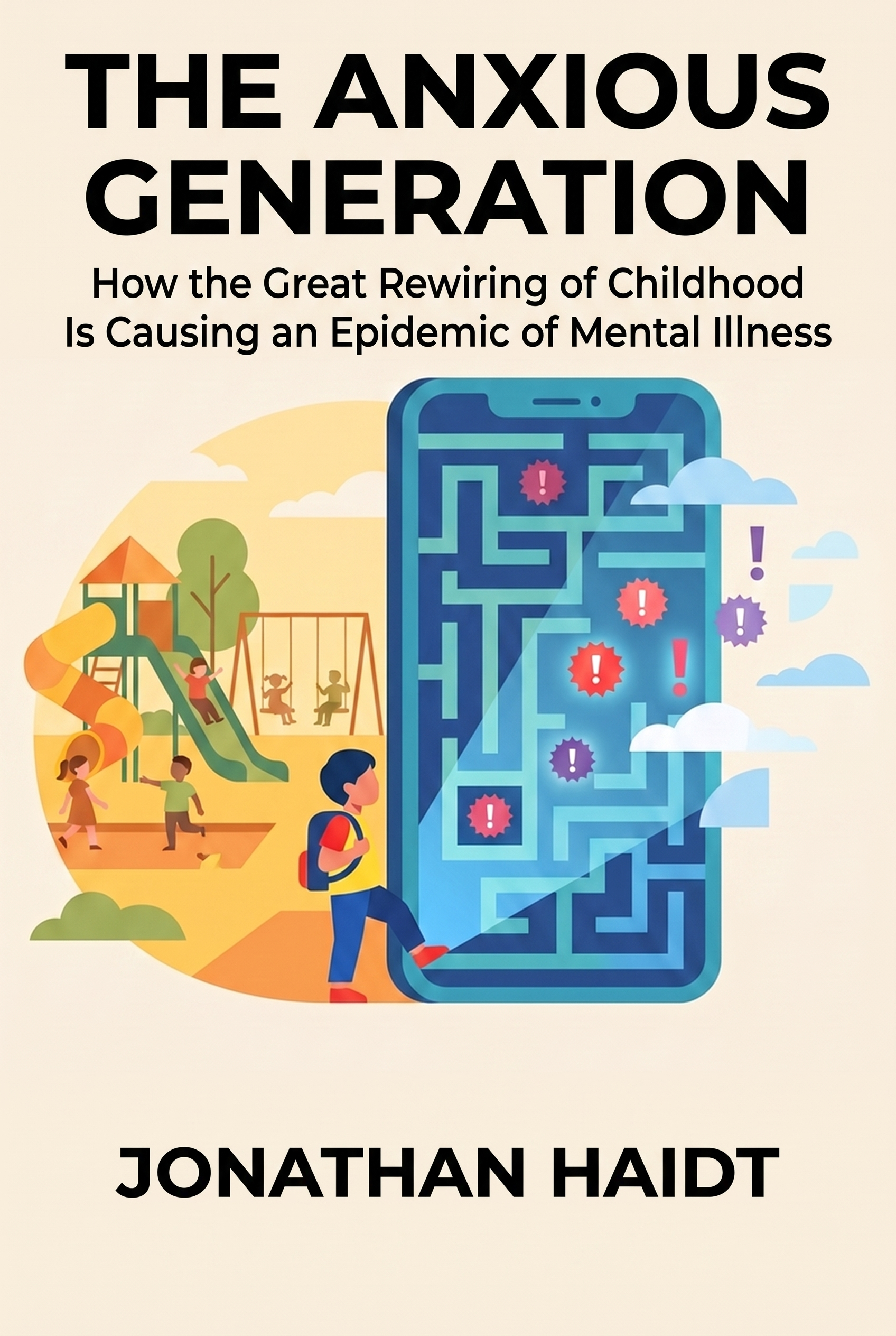
The Anxious Generation is Jonathan Haidt’s argument that a major change in childhood occurred in the early 2010s: young people gained constant access to smartphones and social media just as they lost opportunities for unsupervised play, face-to-face friendship, and everyday independence. Published in 2024, the book is deliberately alarmed in tone. Haidt believes this combination helped produce a broad rise in adolescent anxiety, depression, self-harm, loneliness, and other forms of distress, especially among girls.
His central image is a move from a play-based childhood to a phone-based childhood. The first lets children test limits, negotiate with peers, recover from small failures, and gradually become competent. The second, he says, gives children less freedom in the physical world while exposing them to a socially intense, commercially engineered digital world.
The book’s strength is that it turns a vague parental unease into a concrete social problem. Its weakness, or at least the place to read it carefully, is causal certainty. Mental-health trends are real and deeply concerning, but the research does not allow every increase in distress to be assigned to phones alone. Social media is not one uniform treatment. Effects vary by person, platform, content, timing, sleep, family context, and pre-existing vulnerability. A useful reading of Haidt is therefore neither “phones explain everything” nor “there is nothing to worry about.” It is: childhood environments changed quickly; some features of those changes plausibly create harm; and families and communities can improve the environment while research continues to refine the picture.
The Great Rewiring
Haidt’s explanatory story begins with timing. In several affluent countries, he identifies a marked deterioration in many indicators of adolescent mental health around the early 2010s. At roughly the same time, smartphones, front-facing cameras, high-speed mobile internet, and image-heavy social platforms became ordinary parts of teen life. For Haidt, that convergence is not merely coincidence. It is the first clue in a causal case.
His claim is stronger than the simple observation that troubled teens use more social media. He argues that a generation was collectively moved into a new developmental setting: an always-on social arena, portable into bedrooms, classrooms, and private moments. A child no longer has to be at a party, in a hallway, or on a playground to be excluded, judged, teased, compared, or distracted. The audience can feel endless, and the pressure can outlast the school day.
The supporting research matters, but so do its limits. Population trends can show that two developments moved together; they cannot, by themselves, prove one caused the other. Rising distress may also reflect economic strain, academic pressure, reduced sleep, family stress, social polarization, changing diagnosis and reporting, the COVID-19 pandemic, or greater willingness to name emotional pain. These explanations can overlap rather than compete.
Haidt’s most persuasive point is not that every minute of screen use produces the same damage. It is that a rapid environmental shift deserves precaution when it reaches millions of developing people before long-term evidence is complete. The more careful conclusion is that broad trends justify concern and action, especially where risks are low-cost to reduce, but they do not justify treating every young person’s phone as the single cause of their mental health.
Why Play Builds Capacity
The book’s deepest idea may be less about technology than about development. Haidt argues that children are anti-fragile: within ordinary, age-appropriate limits, they grow through manageable challenges. They need chances to make decisions, cope with boredom, settle disputes, assess risks, get lost briefly, fall down, apologize, and try again. Free play supplies repeated practice in these skills without an adult directing every move.
This is a reasonable developmental principle. Competence often grows through experience, and overprotection can accidentally communicate that the world is too dangerous to navigate. Haidt argues that adults became increasingly restrictive in the real world while becoming too permissive online. The result, in his view, is a damaging mismatch: fewer real experiences that build confidence and more digital experiences that intensify insecurity.
Still, freedom should not be romanticized. Neighborhood safety, disability, transport, racism, poverty, local amenities, and parents’ work schedules shape what independence is realistically available. A call for more free play cannot mean asking families to ignore genuine hazards or blaming parents who lack safe public spaces. The practical target is not nostalgic neglect. It is graduated autonomy: responsibilities and freedom that expand with a young person’s skills and setting.
Parents can start small: let a child order food, walk a short familiar route with a friend, manage a minor disagreement before adults intervene, help with a meaningful household task, or organize an afternoon activity. Schools and communities can help more powerfully by creating places where children can safely gather without needing a purchase, a parent chauffeur, or a device. The important shift is from asking only, “How do we keep kids safe?” to asking, “What experiences help them become capable?”.
The Digital Pressure System
Haidt proposes several pathways through which phone-based childhood could harm well-being. First is sleep: late-night notifications, endless content, and the habit of keeping a phone nearby can delay bedtime and interrupt rest. Second is attention: feeds, alerts, and rapidly changing media compete with sustained work, quiet thought, and in-person conversation. Third is social comparison, particularly where appearance, popularity, achievement, and relationships are displayed as polished public scoreboards.
He also emphasizes social exclusion and contagion. Digital conflict can spread faster and reach a larger audience than an argument in a schoolyard. Vulnerable young people may encounter harmful content, harassment, sexual exploitation, extreme communities, or repeated messages that reinforce hopelessness. None of these mechanisms is implausible. Research reviews identify developmentally relevant routes such as social feedback, exclusion, risky content, self-presentation, and comparison.
But mechanism is not proof of a uniform outcome. Research on overall time spent online has often found small, mixed, or inconsistent average associations with well-being. That does not mean the risks are imaginary. An average can conceal a minority experiencing serious harm, while another group gains connection, identity exploration, creative expression, peer support, or access to help. It also matters whether a person is actively talking with friends, passively scrolling, being targeted, losing sleep, or using technology to cope with distress already present.
So replace the blunt question, “How many hours?” with better ones: What happens on the phone? At what time? What is displaced—sleep, homework, sport, family conversation, real friendship? Does the young person feel more connected or more trapped afterward? The goal is not moral panic about screens. It is attention to patterns that either support or undermine a particular child’s life.
Girls, Boys, and Different Risks
Haidt argues that the great rewiring harmed girls and boys in somewhat different ways. He suggests that image-centered and relationship-centered platforms may be especially hard on girls because adolescence already heightens sensitivity to evaluation, belonging, appearance, and social rank. He links this to perfectionism, body-image pressure, relational aggression, and self-harm. For boys, he emphasizes withdrawal into gaming, pornography, online entertainment, and a reduced engagement with school, work, community, and in-person relationships.
There is meaningful evidence for taking gendered patterns seriously. Adolescent girls have reported high levels of emotional distress in many data sets, and research has explored how appearance-focused comparison and social feedback can compound vulnerability. Boys can also face distinct online pressures, including isolation, risky content, and compulsive patterns of use. But these are group-level tendencies, not destinies. Girls game; boys use image-based social platforms; many young people do neither heavily. Gender, sexuality, disability, race, family circumstances, and mental-health history can all alter both exposure and impact.
A balanced response avoids using the book to stereotype. Instead, ask what developmental task is being made harder for this person. Is it body confidence? Finding trustworthy friends? Building offline confidence? Handling sexual content? Managing anger? Sleeping? Seeking support without turning every feeling into a public performance?
Young people deserve a voice in these conversations. Adults should not simply confiscate a device and declare victory. They should explain the concern, invite honest reports about online life, and make room for the genuine benefits a teen may experience there. Firm boundaries work better when paired with respect, alternatives, and a credible promise: we are not punishing you for living in the world adults built; we are helping make that world more livable.
A Collective Action Problem
One of Haidt’s most practical insights is that many families feel trapped by a collective action problem. A parent may want to delay a smartphone or social media account, but fears their child will be excluded if everyone else has one. A school may want phones away during the day, but worries about enforcement or parent resistance. A teenager may dislike the pressure of constant connection yet feel unable to step back alone.
That means private willpower is an inadequate solution. The question is not whether one unusually strict family can opt out. It is whether a peer group, school, town, or platform can change the default together. Shared norms lower the social cost of healthier choices.
Haidt’s four headline proposals are clear: no smartphones before high school; no social media before age sixteen; phone-free schools; and far more unsupervised play, free play, and childhood independence. These are policy-like guardrails, intended to reset expectations rather than force parents into isolated battles.
The proposals are worth treating as experiments and community commitments, not magic thresholds. Age sixteen is a bright line, while maturity and circumstances differ. Age verification raises privacy, feasibility, and equity questions. A phone ban without secure ways to contact caregivers, accessible accommodations, or fair enforcement can create other problems. And delaying access does not teach a young person how to navigate digital life when access eventually arrives.
Even so, collective boundaries can be useful. A school-wide phone-free day reduces the burden on any one child to resist. A parent network that agrees to delay smartphones makes friendship easier, not harder. The standard of success should be observable: more conversation at lunch, better sleep, fewer conflicts, richer activities, and children who feel trusted enough to grow.
Repairing the Childhood Environment
The book closes as a call to action, and its recommendations are strongest when they expand life rather than merely restrict devices. For parents, create clear household rhythms: phones charge outside bedrooms; nighttime is protected; meals and important conversations are device-light; and social media access comes with ongoing discussion, not a one-time permission slip. Model the rule yourself. A child will notice when adults demand focus while continually checking their own alerts.
For schools, phone-free instructional time can protect attention and reduce the constant social theater of the group chat. But enforcement should be calm, consistent, and coupled with better recess, clubs, arts, sports, lunch spaces, counseling, and routes to belonging. Removing a phone from a lonely student without improving the social environment is not enough.
For communities, make independence practical. Invest in sidewalks, parks, libraries, youth centers, safe transit, and low-cost activities. Normalize children walking, biking, playing outdoors, and contributing to local life. Parents can coordinate so that freedom is shared rather than seen as one family taking an unusual risk.
For young people, the invitation is not to become technology purists. It is to become active designers of attention. Turn off nonessential notifications. Protect sleep. Curate feeds ruthlessly. Notice which accounts create envy, fear, humiliation, or compulsive checking. Keep some friendships in places where eye contact, awkwardness, repair, and laughter can happen without an audience. Ask for help early if online experiences become frightening, coercive, or overwhelming.
Most importantly, distress deserves care whether or not a phone contributed to it. Persistent sadness, anxiety, self-harm, eating concerns, trauma, bullying, or suicidal thoughts call for trusted adults and qualified professional support. Better technology rules are preventive supports, not replacements for mental-health care, social justice, family stability, or compassionate listening.
Putting the Ideas Into Practice
The Anxious Generation is a forceful diagnosis of a cultural mistake: adults may have reduced children’s freedom in the physical world while allowing powerful digital systems to occupy too much of their social and emotional world. Haidt argues that this reversal helped create a generation marked by anxiety and disconnection. His remedy is a return to more play, independence, sleep, embodied friendship, and collective limits on phones and social media.
The evidence-aware takeaway should be both more modest and more actionable than the book’s boldest formulation. We can say with confidence that adolescence is a sensitive period, sleep and in-person connection matter, online environments can expose young people to genuine harms, and some digital design features are built to capture attention rather than support flourishing. We can also say that research has not settled a single, large, universal causal effect of social media on all adolescents. Average effects may be small while risks for particular people and contexts are substantial.
That uncertainty is not a reason for passivity. It is a reason for proportionate action and better listening. Do not diagnose every teenager as damaged by a screen. Do not dismiss their distress because technology also offers benefits. Build environments in which the healthy choice is easier: friends can meet without phones, schools protect learning, families protect sleep, communities permit independence, and platforms face pressure to reduce predictable harms.
Haidt’s enduring challenge is ultimately civic. Childhood is not shaped only by individual parenting decisions. It is shaped by the norms, streets, schools, business models, and public spaces a society creates. A better childhood is not a trip back to the past. It is a deliberate redesign of the present so that young people can practice being free, capable, connected human beings.
Final Summary
Begin with one shared, realistic change this week. Move charging out of bedrooms, establish a phone-free meal, organize an outdoor meet-up, or speak with other parents about common expectations. Then ask young people what would make offline life more inviting. The best answer to a phone-based childhood is not simply less phone. It is more of what children and adolescents need enough to choose: trust, autonomy, rest, play, purpose, and people who are fully present.