

Free text
Summary and key ideas
Book summary prepared by ReWio. Original book author: Leil Lowndes.
Introduction
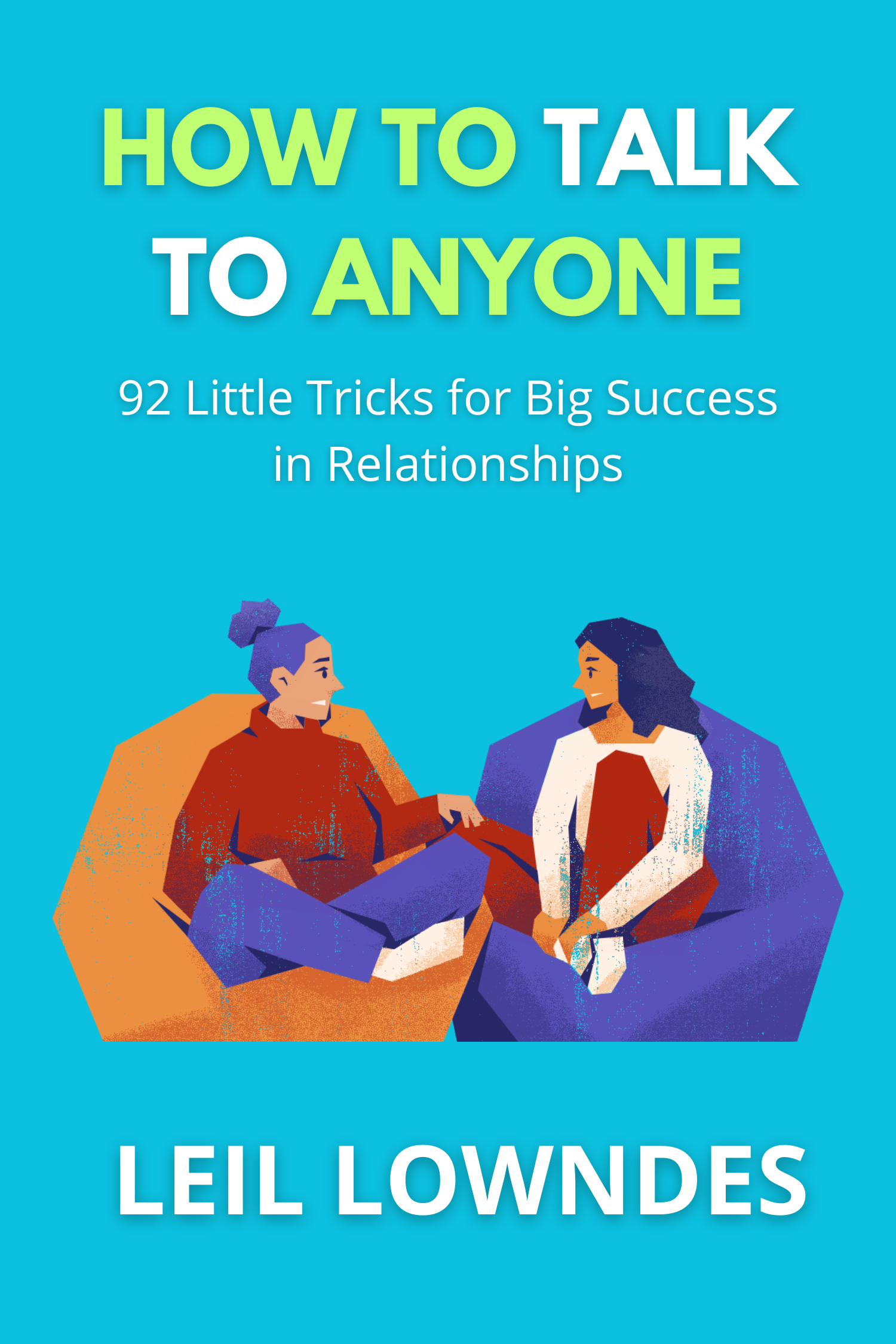
The book "How to Talk to Anyone" by Leil Lowndes is a practical guide for anyone who wants to become a skilled communicator. It contains 92 specific tips and tricks for improving interpersonal relationships, from small talk to deep discussions. The author draws on her own experience, having overcome great shyness herself to become an expert communicator. The book covers various aspects of communication, including how to appear confident, how to listen effectively, how to recognize nonverbal cues, and how to handle social situations.
Master "small talk" and its transformation into meaningful communication
All of us have at some time or another found ourselves in a situation where we felt that small talk was just irrelevant silence-filling. But the truth is that this "small talk" can be a key tool for establishing deeper and more meaningful relationships.
Imagine you're at a social event and you don't know anyone. The first step is to master the art of introducing yourself. A mutual acquaintance or host can be a great bridge to new people. Just ask a few questions about the person you want to meet and you have a topic for conversation. If you don't have that option, try hanging around an interesting stranger and listening to their conversation for an opportunity to engage.
One proven technique is to have an "icebreaker" ready. It can be something that immediately catches the eye, like a vintage pocket watch or a unique handbag. This will open the door to questions like "Where did you get that?" and the conversation can flow naturally.
Once the conversation has started, it's important to focus on what the other person is saying. Maintain eye contact and match your responses to their mood. If they are energetic and use animated gestures, do the same. If the mood is quieter and calmer, adapt as well. This way, you'll create an atmosphere in which the other person feels comfortable and open.
Small talk is also an excellent opportunity to show that you are a good listener. People love to talk about themselves, so if you give them space and show sincere interest, they will consider you a great conversation partner. An easy way to keep the conversation going is to repeat the last thing the person said, thus giving them
the imaginary ball back. You can use this trick to keep your conversation partner active and engaged.
If you're worried that you have nothing interesting to say, prepare a few interesting facts or anecdotes about yourself. For example, if someone asks you where you're from, instead of a one-word answer, you can expand on the topic and mention some fascinating aspect of your hometown. This way, you'll not only intrigue, but also open the door to other topics.
Last but not least, be authentic. People are quick to recognize insincerity and fakery. Let your smile grow slowly and naturally, maintain steady eye contact, and try to be yourself. Authenticity creates trust and is the foundation for building strong and lasting relationships.
The art of small talk is about more than just the words you say. It's about making connections that can lead to deeper and more meaningful conversations and relationships. With these techniques, you can turn any superficial conversation into an opportunity to create a valuable connection.
Always look confident, trustworthy and charismatic
In the social and professional world, first impressions are invaluable. How others perceive us can fundamentally affect our relationships and career progression. That's why it's important to always come across as confident, credible and charismatic.
One of the most important aspects that contribute to this impression is our body language. When you walk into a room, imagine you are a pop star on stage. Stop at the door, take a deep breath, look around, and then proceed with a smile. This dramatic entrance is guaranteed to attract attention and signal your confidence.
Another key element is your smile. It's important to keep it natural and slow to develop because people will quickly recognize a fake. Studies have shown that a slow-developing smile is perceived as more sincere and personal, which is especially important for women in corporate environments where credibility is essential.
Eye contact is another powerful tool for creating trust and affection. Maintaining steady eye contact, even when you're not talking, helps build a stronger
relationship and shows that you're fully engaged in the conversation. This small gesture can greatly increase your charisma and authority.
Your body language should also convey confidence. Turn your whole body towards the person you are speaking to show that you are giving them your full attention. Avoid gestures that may make you feel nervous or unsure, such as touching your face. Keep your hands relaxed and away from your face to appear calm and confident.
When talking to others, it is important to match your behaviour to their mood and tone of voice. If someone is animated and energetic, mirror their enthusiasm. If the atmosphere is calmer, adapt to it. That way, the other person will feel comfortable and appreciate your ability to tune into her wave.
Confidence and trustworthiness also radiate from the way you speak. Clear, firm and positive speech without unnecessary "um's" and "ahem's" is key. Maintaining a positive attitude and avoiding complaining or negative remarks helps to create a favorable impression. Remember that your confidence is reflected in how you present yourself and a positive attitude is often more important than the words themselves.
Mastering these techniques will help you to always appear confident, trustworthy and charismatic, earning you respect and admiration in all social and professional situations. In this way, you can easily establish and maintain meaningful relationships that will propel you forward in both your personal and professional life.
Talk so people listen and listen so people talk
The key to successful communication is not only how you speak, but also how you listen. If you want to engage your listeners and encourage them to actively participate in the conversation, you need to master the art of both speaking and listening.
When you speak, focus on clarity and intelligibility. Use simple, direct sentences and avoid overly complicated words or phrases. Clarity of speech promotes confidence and makes it easier for your listeners to understand your message. A great example is to use specific stories or anecdotes that illustrate your point and keep your listeners' attention. Stories are a powerful tool because they can bring
abstract ideas to life and make them tangible and interesting.
It is important to maintain eye contact when speaking. This not only shows your self-confidence, but also signals that you care about your listener understanding what you are saying. Eye contact strengthens the feeling of connection and improves mutual trust. Research shows that people who maintain eye contact are perceived as more trustworthy and competent.
Listening is just as important as speaking. Active listening means paying full attention to the person who is speaking and responding to their words with empathy and understanding. This may include nodding, smiling or verbal expressions such as "I understand" or "that's interesting". These small gestures encourage the other person to continue the conversation and show that their opinion is important to you.
Listening also means knowing how to ask the right questions. Questions that are open-ended and focused on what the person is saying show that you are genuinely interested in their opinion. For example, if someone is talking about their project, you might ask: "What do you enjoy most about this project?" or "What challenges have you had to overcome?" Such questions help develop the conversation and show your genuine interest.
How you react to information is also important in interviews. If someone shares something personal or significant, make sure your response is appropriate and honest. Praise or acknowledgement can strengthen the relationship and encourage the other person to share more.
Communication is a two-way process where everyone plays a role. When you learn to speak clearly and engagingly while listening actively and empathetically, you will be able to create meaningful and productive conversations that are rewarding for all parties involved. In this way, you can become not only a better communicator, but also a better partner in any dialogue.
Gain an advantage by answering the question "What do you do?"
When someone asks you what you do, you have a unique opportunity to leave a strong impression. By using a well-phrased answer, you can not only pique interest, but also open the door to other conversations and opportunities.
Imagine meeting someone new at a party or business meeting. A common response to the question "What do you do?" could be simple and uninteresting, such as "I'm an accountant." But if you prepare this answer strategically, you can instantly impress. Instead of a one-word answer, try adding a piece of information that shows your job in a different light: "I help companies organize their finances and find new ways to save money." This answer not only explains what you do, but also suggests the value you bring.
An interesting and well-crafted response should include a few key elements. First, include something that piques curiosity. An example might be mentioning an unusual or fascinating part of your work. If you work in marketing, you might say: "I help companies tell their stories in ways that engage their customers and increase sales." This not only explains your work, but also highlights your creative approach.
Second, avoid vapid and generic answers. Make your answer personal and specific. For example, if you work in technology, instead of "I'm an engineer," you might say: "I develop technologies that improve people's daily lives by enabling them to solve their problems faster and more efficiently." This way, you're not only describing what you do, but also why your work is important.
Another effective approach is to start your answer with a short story or anecdote that illustrates your work. Stories are a powerful tool for grabbing attention and leaving a lasting impression. For example, if you work in healthcare, you might start with the sentence, "I recently helped a patient through a difficult treatment and now he is completely healthy." This story not only illuminates your work, but also creates an emotional connection with the listener.
In addition to the content, the way you deliver your answer is also important. Speak with enthusiasm and conviction. Your energy and enthusiasm for the work will be contagious and listeners will be more likely to engage in the conversation. Maintain eye contact and use open body language to reinforce a positive impression.
Finally, be prepared for follow-up questions. Your answer should open the door to further conversation, so have some additional information or stories ready to share. If someone expresses interest, take the opportunity to expand on the topic and make a deeper connection.
Using these techniques, you can turn a simple question into "What do you do?" into a powerful tool for building relationships and creating new opportunities. Every conversation can become an opportunity to leave a lasting impression and open new doors in your professional and personal life.
Find out when someone is lying to you
Detecting a lie can sometimes be challenging, but there are a few signals that can help you recognize when someone isn't telling you the truth. Scientists and communication experts have identified a number of indicators that show up in a person's body language, voice, and behavior.
One of the clearest signals that someone is lying is a mismatch between words and body language. If someone says something positive but their body shows signs of restlessness or nervousness, it may be a sign that they are lying. For example, if someone claims to be happy with a situation, but at the same time keeps looking around or scratching their nose, they may not be sincere.
Another indicator may be avoiding eye contact. Although some people do not naturally maintain eye contact, this is often more pronounced when lying. Liars may often avert their gaze or look at the ground to avoid direct contact that could betray them.
Nervousness and restlessness may also show in small body movements. Liars often touch their face, neck or hair, which is due to a subconscious effort to self- soothe. These gestures are often automatic and may include scratching the nose, stroking the chin or touching the mouth.
Micro-expressions are another key element in lie detection. These are short, quick facial expressions that reveal real emotions, even when someone is trying to hide them. A micro-expression of sadness or anger can reveal that a person is not being sincere, even if they are trying to appear content and happy.
Changes in voice are also a common indicator of lying. Liars may speak faster or slower than usual, their voice may be higher or lower, and there may be longer pauses between words. These changes are often caused by increased stress and a struggle to control their words.
Inaccuracies and changes in the story are another signal that someone may not be
being honest. Liars may often change their statements, adding or taking away details when confronted with questions. These inaccuracies can reveal their insecurities and efforts to hide the truth.
Monitoring nonverbal cues and reactions can be a powerful tool to detect lying. It is important to observe not only the individual signals, but also the overall context and interplay of the various expressions. Each person is unique and some signals may have different meanings depending on the situation and the person. Therefore, it is essential to see the communication as a whole and be receptive to subtle cues that may reveal the truth.
Reveal whether you are attracted to someone
Attracting someone can be a subtle affair full of unspoken signals and subtexts. Detecting whether you are attracted to someone often requires sensitive perception and observation of body language, facial expressions, and other nonverbal cues, just like detecting a lie.
The first indicator of attraction is eye contact. If someone frequently seeks your gaze, watches you for an extended period of time, or smiles when looking at you, this is a good sign. Eye contact is a strong sign of interest and can signal that the person perceives you as attractive and interesting.
Smiling is another important indicator. A sincere smile that reaches as far as the eyes can indicate that someone finds you attractive. A smile creates a positive atmosphere and signals openness and approachability. Studies show that people who smile often are perceived as more attractive and pleasant.
The body posture is also very welcoming. If someone leans toward you, has an open body posture, and mirrors your movements, it's a strong signal of attraction. Open body language, such as uncrossed arms and legs, indicates that the person is approachable and interested in you. Mirroring is a subconscious expression that indicates sympathy and an effort to make a connection.
Touching can be a very telling signal of attraction. If someone touches you gently on the arm, shoulder or back, it is a clear sign of interest. These touches can be very subtle, but if they are repeated, they indicate that the person feels attraction to you. It is important to see these gestures in the context of the overall behavior and situation.
Another indicator may be an increased concern for appearance. If a person frequently fixes their hair, checks their appearance, or tries to look their best when they are around you, this is a signal that they want to make a good impression on you.
Micro-expressions are brief, quick changes in facial expressions that can reveal true emotions. A brief smile, dilated pupils, or a twinkle of joy in the eyes are all signs that can indicate attraction. These subtle signals are often unconscious and can be an important indicator of true feelings.
Tone of voice and manner of communication also play a role. If someone uses a softer, more pleasant tone of voice, often laughs at your jokes, and tries to keep the conversation going, this is a good sign. Intonation and voice modulation can reveal a lot about how a person feels in another's presence.
Noticing these subtle signals and interpreting them in the context of your overall behavior will help you discover if you're attracted to someone. These nonverbal expressions can be the key to understanding the true feelings and interests of others, allowing you to better navigate your social and romantic relationships.
Handle social situations like a pro
Being successful in social situations requires skills that allow you to interact comfortably and effectively with a variety of people, regardless of context. Handling these situations like a professional means knowing how to present yourself, how to carry on a conversation, and how to behave to leave a positive impression.
The first step is preparation. Before entering any social situation, think in advance about how you will present yourself and what topics you might bring up. Think of a few questions that you can use as icebreakers. For example, if you're going to a business meeting, you might ask about current industry trends or the recent successes of the company you're meeting with.
When you enter the room, make a strong first impression. Stop at the door, take a deep breath and look around. This brief moment will help you gain confidence and prepare for the interaction. Smile and maintain eye contact when you meet someone new. Smiling and eye contact are key elements that signal openness and
trust.
Pay attention to body language during conversation. An open and relaxed body position indicates that you are approachable and willing to listen. Mirroring the other person's movements can also help create a sense of sympathy and understanding. For example, if your conversation partner tilts their head to the side, you can gently mimic this gesture to show that you are on the same wavelength.
Active listening is another essential element. Let your partner talk and give them your full attention. Nods, smiles, and brief verbal acknowledgements such as "I understand" or "that's interesting" show that you are engaged and interested in what he or she is saying. The questions you ask should be open-ended and aimed at developing the conversation, not closing it down.
One of the keys to success in social situations is the ability to adapt quickly to different personality types. Some people are more introverted and need more time to warm up, while others are extroverted and jump right into the conversation. Try to adapt your communication style to the person you are talking to. If someone is quieter, give them space and don't try to talk over them. Conversely, if someone is very energetic, try to keep up with their pace and enthusiasm.
When you're at a business meeting or conference, it's important to know how to move around the room. Don't be afraid to approach groups of people and engage in their conversation. You can introduce yourself and ask a question that ties in with the topic they are discussing. If you want to leave a good impression, don't forget details like a firm handshake and a clear introduction.
Last but not least, always maintain a professional attitude and make sure you are considerate and respectful. Remember that every social interaction is an opportunity to build relationships that can be valuable in the future. In this way, you can successfully control social situations and achieve your goals.
Master communication with different personality types
Communicating with different personality types requires flexibility and the ability to adapt to different styles and preferences. Different people react differently to the same stimuli, so it is important to recognize these differences and adapt your
communication to achieve the best possible outcome.
Introverts and extroverts are basic personality types that require different approaches. Introverts prefer quiet environments and deep conversations, often needing more time to think through responses. When communicating with introverts, it's a good idea to give them space to express themselves and not overload them with questions. For example, you can start the conversation slowly and let them talk about topics that interest them, creating a comfortable atmosphere.
In contrast, extroverts are often energetic and sociable. They like to engage in dynamic and lively conversations. When communicating with extroverts, it is advisable to be active, use gestures, and maintain a high level of energy. Extroverts appreciate it when you allow them to express themselves and be the center of attention.
Another important aspect is communicating with people who have different emotional and social preferences. Some people are more fact and data oriented, while others prefer an emotional connection. When communicating with analytical types, it's important to be specific and precise. Use facts, figures, and evidence to back up your arguments. On the other hand, people with high emotional intelligence appreciate it when you show empathy and focus on building relationships.
In a work environment, it is also important to be able to communicate with different professional types. For example, when communicating with managers, it is effective to be concise and specific, focusing on key points and outcomes. Conversely, creative workers appreciate open discussions and brainstorming sessions where they can express their creativity.
Communicating with people who have different cultural backgrounds also requires consideration of their cultural norms and values. It is important to be aware of differences in communication, such as the use of gestures, personal space and eye contact, which may have different meanings in different cultures. For example, while in some cultures eye contact is seen as a sign of respect and concern, in others it may be perceived as rudeness or aggression.
Another important aspect is communicating with people who have different communication styles. Some people prefer direct and open conversations, while
others may be more reserved and indirect. It is important to adapt your communication style to these preferences in order to achieve the best possible understanding and cooperation.
There are also different techniques and strategies associated with successfully communicating with different personality types that can help overcome barriers and improve interactions. These techniques include active listening, asking open- ended questions, mirroring body language, and empathy. These techniques will enable you to better understand the needs and expectations of others and adapt your communication to be effective and productive.
Mastering communication with different personality types is a key skill that will enable you to better navigate social and work situations, build strong relationships, and achieve your goals. By being flexible and adaptable, you can improve your communication skills and become an effective and successful communicator.
Final summary
The book "How to Talk to Anyone" by Leil Lowndes offers practical advice and techniques to help improve interpersonal communication in a variety of situations. The author stresses the importance of first impressions, proper use of body language, active listening, and the ability to adapt to different personality types. These skills not only allow one to better establish and maintain relationships, but also to communicate more effectively in a professional setting. Lowndes provides concrete examples and science-based tips that are easily applied to everyday life, helping readers become more confident and successful communicators.