

Free text
Summary and key ideas
Book summary prepared by ReWio. Original book author: Bruce Feiler.
Introduction
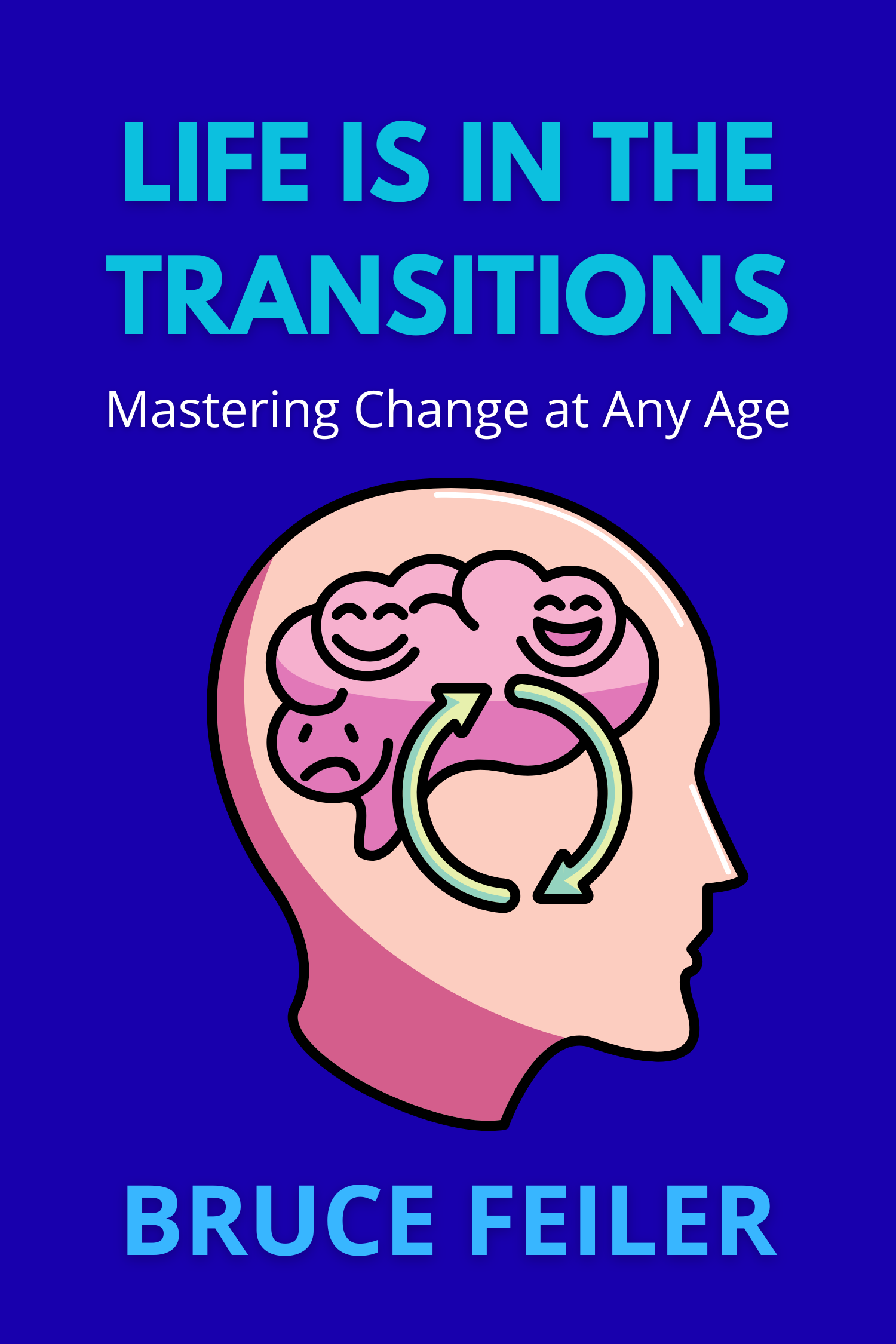
Bruce Feiler's book "Life is in the Transitions" is an inspirational guide to coping with life's inevitable changes. Feiler emphasizes that changes are not just isolated or exceptional, but form the essence of our lives. He shares his own experiences of challenging times such as health problems, financial difficulties, and family challenges, while also drawing on conversations with people who have gone through similar transitions.
The author offers practical tools for coping with the fear and uncertainty that change brings, and encourages readers to see changes as opportunities for personal growth and discovering new meaning in life. The book draws on psychological research and concrete experience, making it a valuable resource for anyone seeking to cope with inevitable change and create new beginnings from it.
Preparing for life changes
Change is an inevitable and natural part of life, and we should be prepared for its arrival. The COVID-19 pandemic serves as one of the most striking examples where global change has affected all areas of life and forced people to adapt to new conditions. Feiler shows that change can take different intensities and forms - from small adjustments such as working from home to serious crises such as health problems or the loss of loved ones.
The important message is that every change, whether personal or professional, brings with it opportunities for growth and reassessment of priorities. Feiler emphasizes that change gives us a chance to redefine what is truly important in our lives. To manage these challenges, she offers practical tools and techniques to help face fear and uncertainty. Preparing for change, he argues, involves not only practical steps but also mental preparedness and the ability to adapt to new situations.
Feiler's own experience with serious illness and financial crisis has taught him that flexibility and openness to change are the keys to survival. He stresses that coping with change is not only about personal approach, but also about community support. The experiences of the people Feiler interviewed show that sharing and
support within the community can greatly facilitate the process of adapting and adjusting to new circumstances.
According to Feiler, preparedness for life changes is a continuous learning process that requires constant adaptation to new challenges and situations. His book provides guidance on how to face change with courage and how to find new opportunities for growth and fulfillment in change.
Embracing fear and uncertainty
Feiler emphasizes in his book that accepting fear and uncertainty as a natural part of life is key to coping with change and personal growth. Fear and uncertainty are normal reactions to life transitions and challenges, but instead of resisting or succumbing to them, we should learn to work with them and use them as opportunities for growth.
Feiler presents several techniques for coping with fear, including meditation, mindfulness, and various forms of therapy. Meditation helps us quiet the mind, which reduces the stress and feelings of overwhelm that often accompany change. Practicing mindfulness teaches us to focus on the present moment and accept reality without trying to change it or escape it, leading to greater emotional stability and better coping with uncertainty.
Feiler shows in her personal experiences, as well as in other people's stories, how important it is to face fear directly. When he was diagnosed with a terminal illness, he began using mindfulness techniques and therapeutic conversations to find inner peace and equanimity. This approach helped him not only to manage his fear of the future, but also to understand that fear can be an impetus for deeper personal development.
Another essential element of coping with fear is support from others. Feiler stresses the importance of family, friends and community who can provide emotional support and practical advice during difficult times. Having a supportive environment around us helps us face fear with greater confidence.
Accepting fear also involves being open to new perspectives and possibilities. Feiler argues that fear of the unknown can be a signal that we are facing something new and potentially positive. If we learn to see fear as an opportunity for growth and discovery of new paths, we can use it as a driving force for positive change.
Embracing fear and uncertainty is a long-term process that requires patience and practice. Although it can be challenging, with the right tools and support, we can turn fear into a strength that prepares us for future challenges and personal growth.
Myths about linear living
Feiler highlights the widespread myth that life is a linear story that unfolds in a predictable sequence from education to career and family life to retirement. This traditional view of life, however, fails to take into account the reality in which we live. Instead, life is full of unpredictable changes that force us to reassess our goals, values and ideas about the future.
Over the centuries, historical perceptions of life have changed. Ancient civilizations, such as Babylon and Egypt, viewed life cyclically, where changes and transitions were seen as a natural part of life, similar to the changing of the seasons. With the advent of Christianity, a linear view of life began to take shape, based on a clear trajectory with prescribed stages, which was further consolidated during the Middle Ages and the Industrial Revolution. In modern times, with the increasing precision of timekeeping and technological advances, this linear view has become the norm.
According to Feiler, this rigid linear model does not account for unexpected events such as health problems, career crises, personal losses, or relationship changes that can fundamentally affect the course of our lives. These events often distort our ideas of how our lives should be and can lead to frustration if we hold too tightly to fixed expectations.
The author therefore invites us to adopt a more flexible view of life, seeing it as a
series of transitions and transformations that can occur at any time. This approach will help us better cope with unpredictable events and use them for personal growth. By letting go of the notion of a linear life, we become more adaptable and resilient to change, which can lead to a more meaningful and fulfilled life.
Feiler's book is an invitation to move away from rigid planning and begin to see life as a dynamic and changing process that can lead us to new and enriching experiences.
The importance of stories in crisis
Stories play an important role in crisis situations and can help us find meaning and direction when we find ourselves in difficult times. The stories we tell ourselves about our lives can serve as an emotional lifeline to help us cope with major life transitions and crises.
Feiler, who faced serious personal crises, realized the power of stories in his own life. When he was diagnosed with a fatal form of bone cancer and faced financial hardship, in addition to coping with his father's struggle with Parkinson's disease and his repeated suicide attempts. These situations forced him to reevaluate his life and realize that he had lost control of his story.
At this stage, Feiler began to search for meaning through conversations with his father, asking him about his childhood, life choices and regrets. This process helped not only his father, but also himself to find new meaning and direction. As a result, Feiler's father wrote an autobiography, which brought him a new zest for life and emotional relief.
This experience inspired Feiler's Life Story Project, in which he conducted 225 interviews with people of different ages and backgrounds who were struggling to cope with unexpected life changes. Through these interviews, he found that people who were able to incorporate change into their life stories were much more successful in overcoming crises. The stories helped them understand their experiences and transformed their outlook on life.
Telling and rewriting their stories has both a therapeutic and transformative effect. This process allows us to process emotional pain, embrace change and find new meaning in life. Storytelling is a tool that can help people cope with a variety of life transitions, whether it be health issues, job loss, or personal crises.
Feiler's book challenges us to learn to work with our stories and see them as a way to better manage crises and find opportunities for personal growth and meaning in them. Stories become a bridge between our past, present, and future that helps us overcome even the most difficult challenges.
Life changes
Feiler explores the concept of fundamental changes that disrupt the stability of our lives and force us to adapt to new circumstances. During his research, Feiler identified 52 types of life changes, which he divided into five main categories: body, love, work, identity, and beliefs. Each of these areas can be affected by changes that force us to reevaluate our life goals and focuses.
1. Physical Changes - Health issues such as sudden illness, chronic disease, or serious injury are among the most common changes. An example is the story of a woman Feiler interviewed who experienced liver failure during college, which profoundly affected her life plans. According to statistics, six out of ten Americans suffer from chronic illnesses, showing how widespread these bodily changes are.
2. Changes in Love - Feiler points out that family and partner relationships are increasingly changing today, whether it is the birth of a child, divorce, caring for aging parents, or the creation of a new family unit. The traditional image of the stable family is being overcome. In the 21st century, for example, the number of marriages has fallen, signalling that families and relationships today are undergoing different forms.
3. Career changes - Career changes are an integral part of modern life. Feiler presents stories of people who have left their traditional occupations and established themselves in new, nontraditional fields. Career changes are common, and statistics show that people change an average of 12 jobs in their lifetime.
4. Changes in beliefs - These changes affect our worldview, religious beliefs or identity. Changes in beliefs can be due to education, moving to a new environment, or internal changes. Some people re-evaluate their gender or religious beliefs as a result of personal experiences or new experiences.
5. Identity Changes - Changes related to self-knowledge and personal identity may involve reevaluating one's gender, religious beliefs, or relationship to self. These changes often come after significant life events that force us to seek new meaning and identity.
Feiler's research has shown that the average person will experience approximately 36 major life changes in a lifetime. These changes may be manageable for some, but some can fundamentally disrupt our perception of ourselves and our life paths. What matters is how we deal with these changes and how we can incorporate them into our stories. In her book, Feiler provides practical tools and techniques to help manage these transitions and use them for personal growth and building a meaningful life.
Life's upheavals
In his book, Bruce Feiler analyzes the concept of life upheavals, major life-changing events that can be both voluntary and involuntary. These events, whether negative or positive, disrupt our existence, cause disorientation, and often induce fear. Such events may include natural disasters, loss of a job, leaving school or buying a new house.
Feiler relates the story of Lisa, a marketing manager who experienced a life shattering experience when she accidentally overheard colleagues gossiping about her ambitions and personality during a work call. The experience was the impetus for her to quit her unfulfilling career and embark on a journey as a life coach and hypnotherapist, which allowed her to find new meaning and help other people cope with trauma.
The average person will experience three to five life upheavals in their lifetime. Their intensity and nature can vary - some changes are processed more quickly, others leave a deep and long-lasting impact. But Feiler stresses that the way we
perceive these events and the meaning we attach to them is crucial. What may seem like a huge life change for one person may not be such a significant experience for another.
Another important aspect is the accumulation of disturbing factors. Shocks often come at moments when we are already vulnerable, and sometimes several crises can occur at once. Feiler gives the example of a man who lost his job and at the same time discovered that his wife was having an affair. Such a double whammy can cause a life "earthquake" that fundamentally changes his entire life story.
Life upheavals are challenging, but they also present opportunity. Feiler discusses how these crises allow one to reassess life's priorities, values, and goals. His book provides practical tools for coping with such upheavals and helps people find meaning and direction even in the midst of chaos, fostering personal growth and the creation of a new life story.
Questions of identity and goals
Turmoil can often lead to a fundamental reassessment of what makes our lives meaningful. These events disrupt the stories we tell ourselves about our lives and bring with them confusion and questions about our identity and goals. When faced with life's upheavals, we need to reflect on what drives us in life and what gives us a sense of fulfillment.
Feiler describes this process as an "alphabet of meaning," which consists of three key elements: autonomy, belonging, and cause. Autonomy represents a sense of independence and control over one's life. Belonging refers to belonging to a community or group, which gives us a sense of connection with others. Cause means that our life and actions contribute to a larger goal or mission, giving them deeper meaning.
Feiler brings stories of people who have undergone major life changes and found new meaning in life through these three elements. For example, a former ballerina who was unable to continue her career after a serious injury found a new meaningful role as a life coach where she helps other people. Another example is
that of a mother who, after years devoted to caring for her family, rediscovered her autonomy and started a new career.
Life's upheavals often force us to shed old beliefs and identities that no longer reflect our current values and goals. This process can be difficult, but it is essential for personal growth. Life's upheavals also offer us the opportunity to be open to new opportunities and explore new paths that can bring us meaning and fulfillment.
The book emphasizes that although life's upheavals are often challenging and frightening, they bring with them the opportunity to reevaluate our lives, values, and direction. This process allows us to create a new, meaningful life story that aligns with what truly fulfills us at any given moment in our lives.
Checking reactions to disturbing events
Although we cannot control the disturbing events that befall us in life, we do have the power to control how we respond to them. These unexpected events, such as a serious car accident or job loss, may be beyond our control, but what meaning we assign to them and what actions we take as a result is in our hands.
Feiler provides examples of people who have been able to turn destructive experiences into meaningful transformations. For example, a survivor of a car accident may decide to start a career in road safety, giving new meaning to his or her ordeal. This approach is built on the idea that even if we cannot control the event itself, we can choose how we respond to it and what we make of it.
One of the key tools Feiler recommends in coping with life's upheavals is acceptance. Many people initially react to change with denial or resistance as they try to hold on to the world they know. Feiler argues, however, that accepting reality as it is opens up new avenues and allows us to detach from the question "Why did this happen?" to the question "Where can I go from here?"
For example, a woman who suffered from chronic migraines only realised that her pain eased when she left her stressful job and accepted the reality of her situation.
Another example is a man who found his inner peace by accepting his transgender identity, thereby freeing himself from the mismatch between body and mind.
Acceptance does not mean suppressing negative emotions. Feiler emphasizes that acceptance involves opening up to feelings of fear, sadness, and shame, which are a natural part of the process of coping with loss or change. This process, which Feiler calls the "long goodbye," allows us to move from the past to a new future.
Although life's upheavals can be unpredictable and challenging, our ability to embrace them and respond to them with openness gives us the power to turn crises into opportunities for growth. With this approach, we can prepare ourselves to meet future challenges and find new meaningful paths in our lives.
The importance of rituals
Rituals play a key role in coping with major life transitions. These rituals help us to symbolically close one stage and prepare for the next, providing us with the emotional and psychological structure to cope with change. Rituals make sense of transitions, whether they are happy events or losses, and allow us to incorporate the past into a new life stage.
Feiler describes examples of people who have created their own rituals to mark significant changes. For example, a former Nazi chose to cover his old tattoos with religious symbols as a sign of his new beliefs, creating a personal ritual to express his transformation. Other people, after divorce, made the decision to get a new haircut or piercing, symbolically closing an old chapter of life and opening up to a new one.
Rituals also have great significance in the context of celebrations and ceremonies. Feiler points out that these social events allow us not only to celebrate important life moments, such as graduation or the beginning of a new career, but also to work through grief and loss. For example, celebrating after cancer treatment can be a powerful ritual to acknowledge the challenge overcome and open ourselves to a new future.
Objects also play an important role in rituals. They can symbolize a connection to the past while also commemorating the transition to a new phase of life. Feiler describes a veteran and a former prisoner who kept their dirty shoes as a symbol of their past, honoring the lived experience and closing old chapters.
In the context of grief and loss, rituals are essential. Feiler cites the example of Rabbi Larry, who created his own rituals to cope with the loss of his first child, as there were no established rituals within his community for mourning aborted and stillborn babies. This process helped him not only to express his grief, but also to provide support to others who were experiencing similar pain.
Rituals have the power to heal and help us move from one stage of life to another. No matter how difficult these transitions are, rituals allow us to process our emotions and prepare for the new challenges and opportunities that life brings.
An essential part of the transformation process
Every major life transition is accompanied by a period of chaos and disorientation, which we refer to as the "chaotic middle." This period is an inevitable part of the transition process when we feel lost and confused because old patterns and identities no longer work, but new ones are not yet fully understood.
Feiler likens this process to a snake shedding its old skin in order to grow. Similarly, we must let go of old beliefs, habits, and identities that no longer suit us in order to make room for something new. This process can be painful because it forces us to face the unknown and uncertainty, but it is also the key to personal growth.
Historical narratives, religious texts, and fairy tales often acknowledge the value of chaos and loss of orientation as harbingers of significant transformation. For example, Jesus endured a period in the desert before attaining enlightenment, or Muhammad gained his wisdom during his isolation on a mountain. These stories emphasize that being lost and facing chaos can be a necessary step toward personal transformation.
To achieve true transformation, we must embrace this chaotic middle. Although this stage can feel vulnerable and uncertain, it is an opportunity to reevaluate old identities and beliefs that no longer serve us and to create something new. In this phase of transition, opportunities open up to discover new strengths and resources that can be the foundation for the next chapter of our lives.
To survive the chaotic middle, Feiler recommends creating structure through daily rituals such as journaling or nature walks. These regular activities can help us maintain stability even as the rest of our lives change. For those who crave more freedom, it can be helpful to use this period to explore new experiences or seek new challenges, such as traveling or experimenting with new life directions.
Feiler points out that although we may feel without a fixed point during the chaotic middle, it is a period that precedes a new beginning. Embracing this chaos and understanding that it is an inevitable part of the transformation process will allow us to move through this period with greater confidence and readiness for future challenges.
Chaos and disorientation are natural parts of major transitions. Although it is a challenging time, it provides us with an opportunity to reassess our lives, to grow and to prepare for the new opportunities and challenges that lie ahead.
Final Summary
"Life is in the Transitions" by Bruce Feiler provides valuable insight on how to cope with life's inevitable changes and crises. Feiler points out that life is not a linear story with clear phases, but rather a series of unpredictable transitions and upheavals that force us to reevaluate our values and goals. The book draws on the stories of people who have gone through significant changes and on Feiler's personal life to show how we can turn these challenges into opportunities for growth.
One of the book's key messages is the importance of telling and rewriting our life stories. When we face crises, Feiler suggests that we have the opportunity to create new stories that reflect who we have become and what we need in a given
situation. This process goes through what is called the "chaotic middle" - a period of uncertainty and disorientation that is necessary for true personal transformation.
Feiler also stresses the importance of rituals to help us acknowledge and accept the endings and beginnings of new stages in our lives. Rituals provide structure and meaning during times of change and thus help us find the strength to navigate through these transitions. Accepting reality and our emotions is key, according to Feiler - instead of resisting change, we should embrace it and use it as an opportunity for growth.
"Life is in the Transitions" is full of practical advice and inspiring stories that show how even the most difficult changes in life can bring new meaning and direction. Feiler's book is a guide for anyone going through a challenging time, and teaches us that with courage and openness we can navigate life's upheavals and create a new life of meaning.